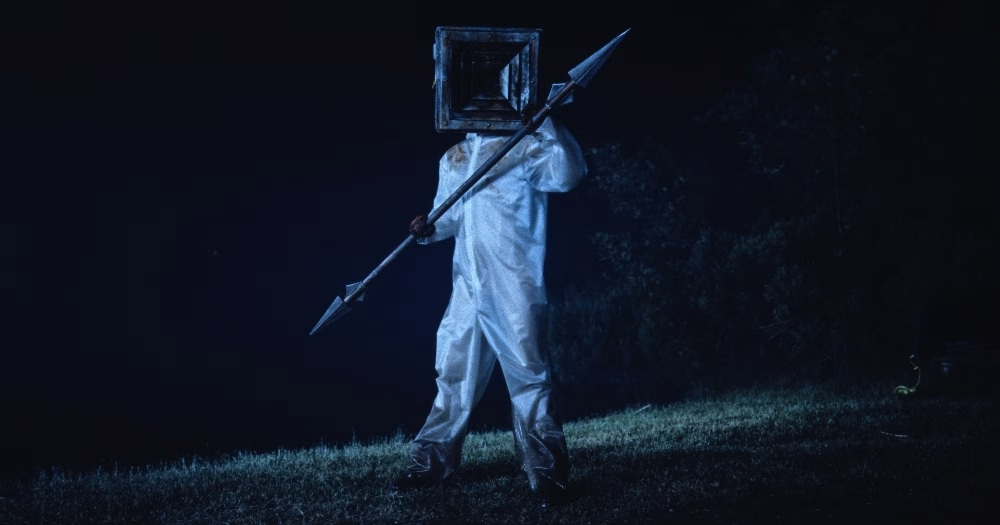
Teenage Sex and Death at Camp Miasma is a taboo-breaking melting pot of slasher staples and queer horror. Unapologetic, hauntingly poetic, horny, bloody and avant-garde. And we’ve all fallen hard for it.
In one scene, glamour-cat Billie Presley (Gillian Anderson) tells filmmaker Kris (Hannah Einbinder) why she chose to live on the shooting location of slasher opus Camp Miasma: to be part of its ongoing mythology, to retreat into her own private alternate reality.
It speaks to why so many of us found safety and catharsis in the genre. Worlds to occupy briefly. Final girls to engage with. Masked killers to vanquish.
Jane Schoenbrun’s third feature gives the slasher – once the most ubiquitous, most rigid staple of horror – a deeply personal and subversively delicious tweak. They’ve reimagined it as a landscape with space for queer and trans identity, without relegating us to a problematic trope (Sleepaway Camp, Dressed to Kill).
This is queer reclamation. A nostalgia-fuelled, joyful love letter to the movies we embraced as teens, and a reinterpretation of a subgenre that rarely stepped beyond its own moral framework. If only I’d seen a film like this in the ’90s.
I was raised on horror. Older brothers are evil. I had quite the collection: Slugs, Dolls, Friday the 13th 1-8, Carrie, From Beyond, Hellraiser, and Elvira: Mistress of the Dark was my Jesus.
Scream hit Irish video stores in 1996. I was 14. Kevin Williamson was a queer kid in Carolina putting down the bones of what would become an enduring franchise. Back then, queer identity and horror existed in opposition. To be clear: we were defined by our complete and utter absence across the bloody spectrum.
I missed Scream at the cinema. I rented it from the mobile video man with my friend Kenneth. We planned to watch it in the box room upstairs with my cat Molly. Mammy hollered from the kitchen. She was cooking lasagne, pronouncing it “lazane”, immune to our Nosferatu-like tiptoeing upstairs. I’d told her three weeks earlier I’d liked it, and she’d cooked it every day since. Some things are far more terrifying than a masked maniac.
From that legitimately terrifying opening with Drew Barrymore, I was hooked. Williamson’s script had smooth, satirical storytelling, characters you invested in immediately, an absorbing small-town mystery, and Wes Craven’s Juggernaut pacing. By embracing every cliché of the genre, they upended them effortlessly. Psycho, Halloween, The Town That Dreaded Sundown, Prom Night – the references were all in there, plus Skeet Ulrich, Rose McGowan, Neve Campbell, and Courteney Cox chewing the scenery as merciless tabloid reporter Gale Weathers.
It was a scream! Sydney’s survival was intended, at least subtextually, as queer-coding on Williamson’s part. A reflection of growing up gay in a small town. And it wasn’t enough.
So it is heartening when queer-focused horror like Teenage Sex and Death at Camp Miasma and Leviticus break into the mainstream. The work merits it. These films are confrontational and deconstructive and yet, fun. Schoenbrun has exploited familiar horror trappings and deployed them in fresh, transgressive ways while paying homage to the movies we grew up on and still traumatise us today.
To talk about being queer in a rural area like Wicklow in the ’90s would in all likelihood have been met with hostility, or even outright violence. You’d find yourself marginalised… you could describe it as a little death.
Schoenbrun understands the horror of isolation and the necessity of the connections we make with pop culture. I Saw the TV Glow mirrored my own obsession with Xena: Warrior Princess, and at the time, this was vital, like stepping through a portal into another world. Horror was an armour. Horror movies helped break down barriers with my schoolmates. I’d invite people over to watch The Blair Witch Project and convince these boys it was all true – they fell for it every time and a few left misty-eyed.
Following the success of Scream, the subgenre would define horror, triggering a wave of self-aware entries that dominated the genre well into the noughties. Teens were stalked and murdered following a transgression in I Know What You Did Last Summer, Jamie Lee Curtis reprised the role of Laurie Strode in Halloween H20, and we met Chucky’s equally unhinged wife Tiffany (Jennifer Tilly) in Don Mancini’s The Bride of Chucky.
Scream 2 arrived in 1998 and screened at the Abbey Cinema in Wicklow town. A few of us had drunk cider on the pier before the movie and worried if we’d be asked for ID. We weren’t.
Kenneth looked like a young Lionel Blair, strutting in teeth first, spray-tanned, talking hands, and in hindsight, I could have doubled as Lindsey England, the awkward queer kid lurking by the popcorn dispenser. Kenneth hated the sequel; I thought it was superior in every way.
30 years apart, what Scream and Teenage Sex and Death at Camp Miasma have in common is that they both revived a corpse. Then there is the other revival: the Terrifier series was a return to low-budget, ultra-violent brutality featuring iconic boogeyman Art the Clown. It captured the visceral mean-spiritness of an exploitation/grindhouse joint.
Teenage Sex and Death at Camp Miasma brings something bolder to the table: heart, and it never needs to resort to carnage or shock-horror. Well, maybe a little blood and one or two decapitations.
Jane Schoenbrun has brought the slasher back and made it brilliant – hornier, bloodier, queerer, and finally mine, mine, mine. Oh, er, I mean ours.
© 2026 GCN (Gay Community News). All rights reserved.
Support GCN
GCN is a free, vital resource for Ireland’s LGBTQ+ community since 1988.
GCN is a trading name of National LGBT Federation CLG, a registered charity - Charity Number: 20034580.
GCN relies on the generous support of the community and allies to sustain the crucial work that we do. Producing GCN is costly, and, in an industry which has been hugely impacted by rising costs, we need your support to help sustain and grow this vital resource.
Supporting GCN for as little as €1.99 per month will help us continue our work as Ireland’s free, independent LGBTQ+ media.