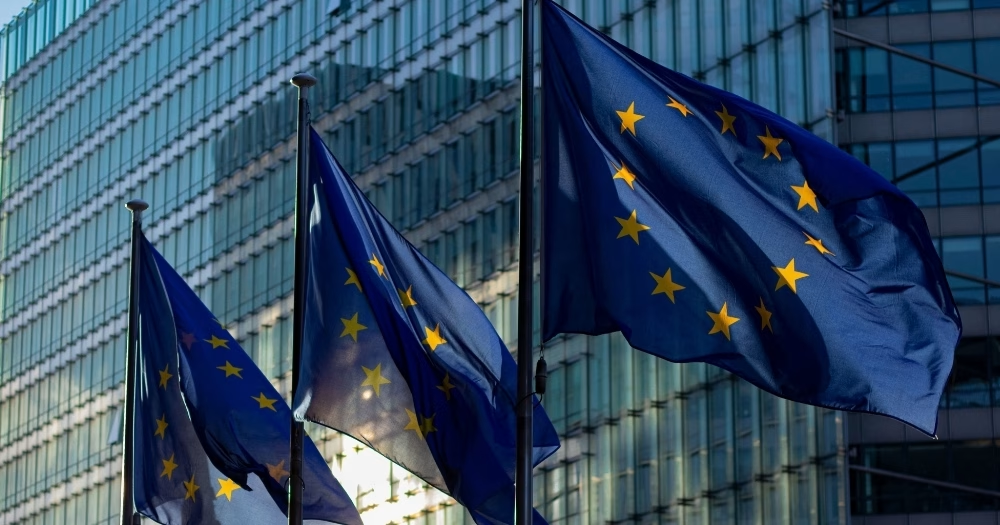
The first-ever Council of Europe Strategy on equal rights for LGBTQ+ individuals has been adopted as of September 24, 2026. The five-year plan, running from 2027 to 2032, comes 45 years after the European Court of Human Rights (ECHR)’s first ruling concerning LGBTQ+ rights in 1981.
Contained within the plan are societal and legal frameworks for a more inclusive Europe. There are four main priorities for action, including “the recognition of the equal rights and dignity of LGBTI people and promotion of a culture of respect and inclusion to counter stigmatisation; countering disinformation and manipulation of information concerning LGBTI people in order to uphold democracy, human rights and the rule of law; preventing and combating violence and hatred against LGBTI people; establishing, safeguarding and strengthening protection through effective legal, institutional and regulatory frameworks.”
The organisation mentions that anti-LGBTQ+ hate speech is a current stress point, with legal protections remaining uneven. 35 of the 46 member states that make up the Council of Europe have explicit legal protections for sexual orientation-related hate speech in criminal cases, compared to 18 that cover gender identity, six that cover gender expression and six that cover sex characteristics. Only three (Belgium, Denmark and Malta) have laws that cover all.
Harmful usage of AI is also highlighted as an area for concern: “Increasing hostility and organised opposition to LGBTI equality are exacerbated by disinformation and AI tools which can increase the reach of hate speech,” the organisation says. “This results in fear, anxiety, depression and avoidance of public life among LGBTI people.”
The council also shared recommendations for member states to close persistent gaps between legal provisions and effective protection.
The LGBTQ+ equality strategy is planned to be officially launched on January 26, 2027, at an event organised under the Montenegrin Presidency of the Committee of Ministers of the Council of Europe.
Building on the recent success of securing disregard legislation in Ireland for men convicted under historic anti-homosexuality laws, the LGBT Restorative Justice Campaign continues to advocate for similar provisions across Europe. Responding to the new strategy, campaign representative Kieran Rose stated, “We welcome the new Council of Europe strategy which commits to working with States to recognise, pardon and expunge historical convictions for same-sex activity which have since been repealed.”
Rose continued, “The European Court of Human Rights, part of the Council of Europe, was central to the decriminalisation of homosexuality in Ireland through the Norris Case in 1988. It is fitting that, almost 40 years later, the Council of Europe is recognising and seeking to remedy the legacy of historical criminalisation across its 46 member states.”
While strategies like this are not legal obligations for member states, they can be used as points of reference for court proceedings and are also often used to set precedents for lawmaking.
© 2026 GCN (Gay Community News). All rights reserved.
Support GCN
GCN is a free, vital resource for Ireland’s LGBTQ+ community since 1988.
GCN is a trading name of National LGBT Federation CLG, a registered charity - Charity Number: 20034580.
GCN relies on the generous support of the community and allies to sustain the crucial work that we do. Producing GCN is costly, and, in an industry which has been hugely impacted by rising costs, we need your support to help sustain and grow this vital resource.
Supporting GCN for as little as €1.99 per month will help us continue our work as Ireland’s free, independent LGBTQ+ media.