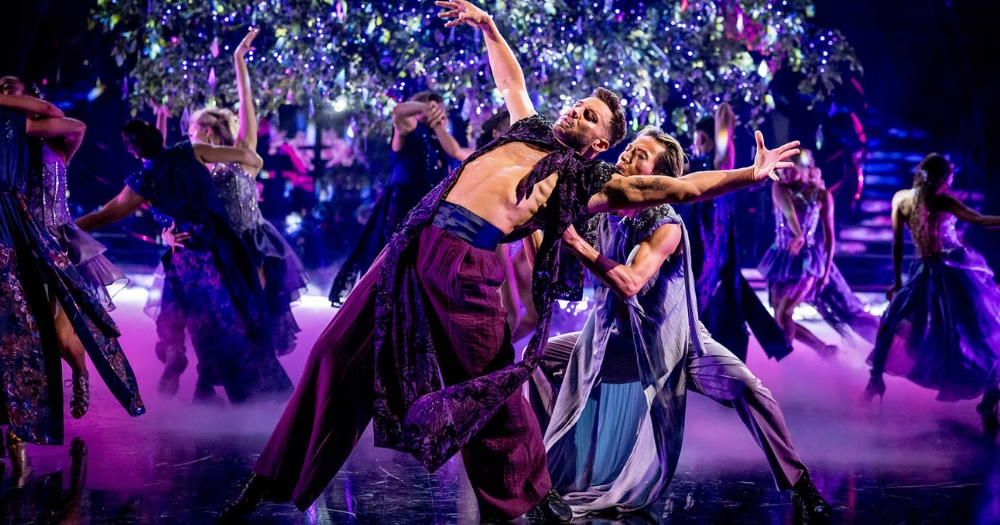
On Sunday, November 15, the weekly Strictly Come Dancing professional performance was a sensual, romantasy-inspired, same-sex dance to Kylie Minogue’s ‘Can’t Get You Out of My Head’. The lead dancers were two male professionals, Vito Coppola and Carlos Gu, and the sultry nature of the routine received some criticism, notably from former Strictly pros.
James Jordan took to X to write “After watching the Strictly results tonight, I couldn’t help thinking the pro performance was less about dance and more about the two men dancing sexually with each other and I’m not sure that’s the brief for a family programme.”
Jordan’s comments sparked backlash and many fans expressed their disappointment that he would be resistant to a sexually-charged dance between two men given that dances between opposite-sex partners historically play into heteronormative gender-roles and sexualise the female dancer.
View this post on Instagram
In defence of Jordan, Brendan Cole, who last appeared on the show in 2018, told The Daily Mail, “If they hadn’t sexualised it, it would have been fine. You’ve got to think it’s a family show and you’ve got children watching it.”
Cole insisted that “The fact it was a same-sex performance is irrelevant.”
The dance began with evocative narration from bisexual actor Alan Cumming, bringing to life the book which we see Coppola reading. Gu then emerges as a character from the book incarnate, and the two begin to tell the story through their bodily movement.
Coppola and Gu took to Instagram to express their appreciation for the choreography and the positive reception to the dance amidst the criticism from the two ex-professionals. Acknowledging the intimacy of the routine, Coppola’s caption noted that “In every hands or look there is a specific meaning and we hope to have represented right for you.”
View this post on Instagram
If two men dancing intimately generated pushback, it is worth looking back at the history of LGBTQ+ representation on Strictly Come Dancing.
Before same-sex pairings were introduced, there had been LGBTQ+ celebrity contestants including Will Young and Susan Calman. But the first same-sex dance was performed in 2019 by male professionals Johannes Radebe and Graziano Di Prima.
Then, in 2020, Olympic champion boxer Nicola Adams was set to be one half of the first same-sex partnership alongside professional Katya Jones. Unfortunately, this pairing never came to fruition due to testing positive for Covid.
Around this time, other international iterations of the show (‘Dancing with the Stars’ in various countries) introduced same-sex dance partnerships.
Eventually, in 2021, Strictly had its first same-sex couple in Johannes Radebe and John Whaite, who made it all the way to the Season 19 finals.
2022 saw two same-sex pairings: Jayde Adams and Karen Hauer and Richie Anderson and Giovanni Pernice. Then, in 2023, there was Layton Williams and Nikita Kuzman, who also came close to the Glitterball.
Since 2023, there was a notable absence of same-sex couples, but 2026 saw a return with the pairing of Bethany Antonia and Nancy Xu. However, this season also saw controversy when the BBC blurred a T-shirt worn by Antonia during a training session. The t-shirt read “Protect the Dolls”, a slogan used to relay support for the rights of transgender women. The televised version was edited to make it appear as though Antonia was wearing a plain white top.
Following the debate surrounding the same-sex professional dance and recent censorship of trans allyship, Strictly Come Dancing’s fractious relationship to LGBTQ+ visibility appears symptomatic of the BBC’s persisting problem with politicising representation.
© 2026 GCN (Gay Community News). All rights reserved.
Support GCN
GCN is a free, vital resource for Ireland’s LGBTQ+ community since 1988.
GCN is a trading name of National LGBT Federation CLG, a registered charity - Charity Number: 20034580.
GCN relies on the generous support of the community and allies to sustain the crucial work that we do. Producing GCN is costly, and, in an industry which has been hugely impacted by rising costs, we need your support to help sustain and grow this vital resource.
Supporting GCN for as little as €1.99 per month will help us continue our work as Ireland’s free, independent LGBTQ+ media.