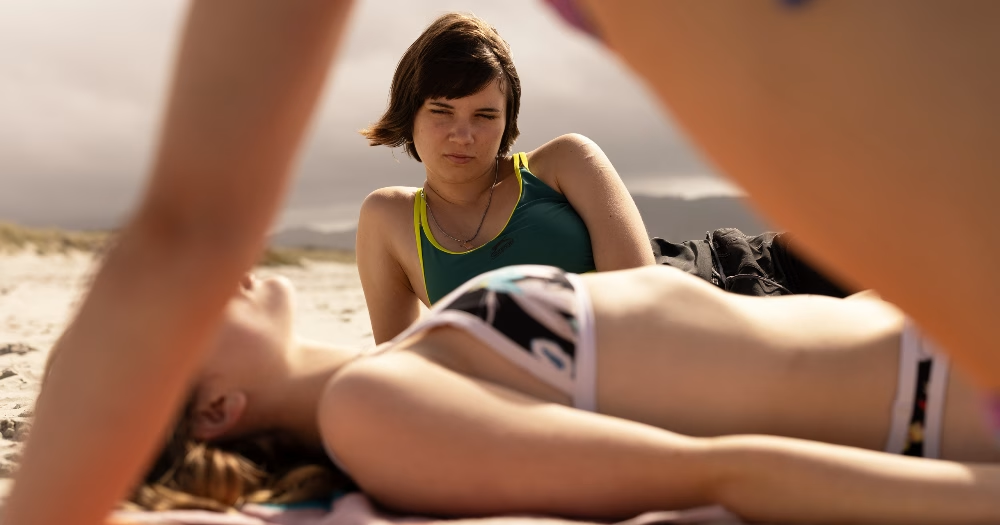
Big Girls Don’t Cry, the new film from writer-director Paloma Schneideman, follows 14-year-old Sid during summer holidays in rural New Zealand. With nothing to do and as family issues loom, she uses MSN as a window into a different life, while navigating desire and friendship.
As other teens appear to move through the world easily, Sid tries on their attitudes like stolen clothes. Feeling part envy, part something she doesn’t yet have the words for, her pursuit of belonging somehow leaves her even more lost.
Rich in period detail, the film will be particularly nostalgic for those who came of age in the early days of social media and ‘wuu2’ texts on blockia phones. While queerness may not be explicitly mentioned, many LGBTQ+ viewers will undoubtedly recognise themselves as Sid begins to explore her sexuality. It appears clear that she is more interested in getting girls’ attention than getting physical with the boys around her.
Overall, it is a tender portrayal of life in liminal spaces: between child and adult, consent and non-consent, being desired and being seen and the cost of not knowing the difference. The most striking moments exist in the smallest details, as the film shines a light on the often overlooked complications of teenage life.
Newcomer Ani Palmer gives a strong performance in the leading role, flanked by Noah Taylor (Peaky Blinders, Almost Famous) and Rain Spencer (Good Girl Jane, The Summer I Turned Pretty), as well as Tara Canton and Breatrix Rain Wolfe. The film was executive produced by Jane Campion, who also acted as a mentor.
Speaking about the role of Sid, Campion said that they needed someone with “an innate charisma, someone you could watch do absolutely nothing and still be fascinating.” About seven seconds into Ani Palmer’s first tape, she said she felt “the stillness, the vulnerability, the unspoken pull.”
Writer-director Schneideman drew on her own experiences of adolescence for the project, saying, “Somewhere, in some patch of bush in some country, there’s a girl doing something she doesn’t want to do, just to be accepted by people she doesn’t even like… The film holds up a mirror to that time, not to moralise, but to acknowledge it: it was messy, confusing, joyful and painful.”
She added, “I made Big Girls Don’t Cry for my 14-year-old self. Not for comfort, but for catharsis. For those who still wear the scars of coming of age, where shame lives, and desire and danger blur.”
Schneideman explained that it’s not the type of film usually made in New Zealand, but “that’s precisely why I had to make it”.
“Our cinematic landscape has long been shaped by rugged masculinity or landscape, stoicism, trauma wrapped in genre, or larrikin humour. But I believe there’s another kind of voice, rooted in emotional risk, interiority, and feminine truth. This is my offering to that space.”
Regarding identity and desire in the film, she explained that Big Girls Don’t Cry “resists resolution”.
“It lives in the ambiguity of queer adolescence, where fantasy precedes language, where silence protects as much as it isolates, and where the longing to be chosen can override the ability to choose. It doesn’t hand out answers. It sits in the murky places and listens.”
Big Girls Don’t Cry premiered at Sundance and later won the Grand Prix at Biarritz’s Nouvelles Vagues festival. Presenting the award, queer icon Kristen Stewart said, “I loved this film with my whole heart.”
Catch Big Girls Don’t Cry in cinemas across Ireland from Friday, November 27.
© 2026 GCN (Gay Community News). All rights reserved.
Support GCN
GCN is a free, vital resource for Ireland’s LGBTQ+ community since 1988.
GCN is a trading name of National LGBT Federation CLG, a registered charity - Charity Number: 20034580.
GCN relies on the generous support of the community and allies to sustain the crucial work that we do. Producing GCN is costly, and, in an industry which has been hugely impacted by rising costs, we need your support to help sustain and grow this vital resource.
Supporting GCN for as little as €1.99 per month will help us continue our work as Ireland’s free, independent LGBTQ+ media.