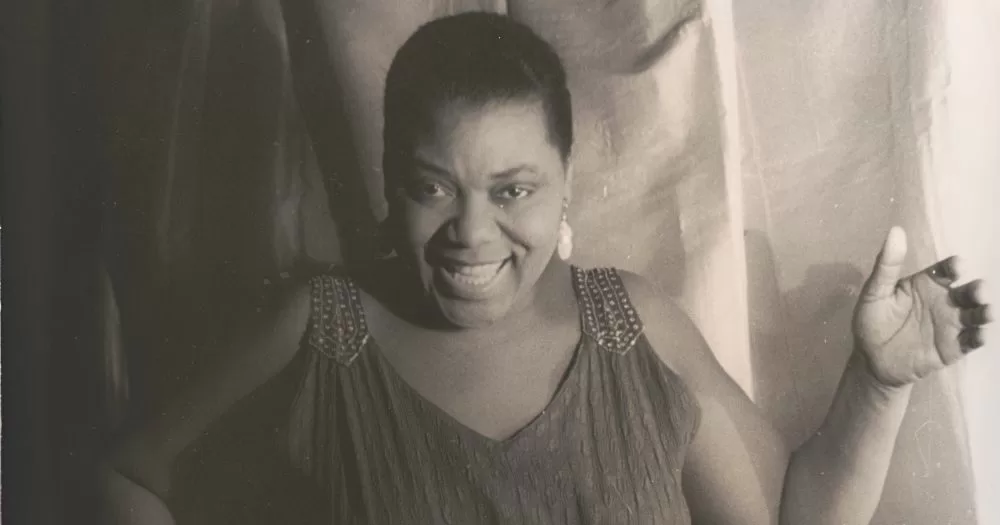

To mark Black History Month, GCN contributor David Ferguson writes about a musical legend and a true bisexual icon: the blues singer Bessie Smith.
Bessie Smith was born in Chattanooga, Tennessee, in 1894. She grew up orphaned and in poverty, with both her parents dying during her childhood. Her voice proved to be her way out.
She started out as a travelling act on the Black vaudeville circuit, joining her brother Claud, who also performed in it. Smith soon connected with Ma Rainey. Known for her powerful vocal abilities, the lesbian singer would go on to be dubbed “Mother of the Blues”, and Smith ended up touring with her. Rainey did not teach her how to sing, but she did teach her about stage presence and provided her with a direct connection to the queer underground jazz scene. The pair enjoyed recounting a legend that Rainey kidnapped Bessie to take her on the road.
Smith began her recording career in 1923, being signed to Columbia Records. The company started a “race records” series with Smith’s song ‘Cemetery Blues’ being the first one. Her recording of the song ‘Down Hearted Blues’ became an enormous success, selling more than two million copies. She made 160 recordings in all. She was accompanied by some of the great jazz musicians of the time, including Fletcher Henderson, Benny Goodman and Louis Armstrong. Her most notable songs included ‘Tain’t Nobody’s Biz-ness If I Do’, ‘Careless Love Blues’, ‘Empty Bed Blues’, and ‘Nobody Knows You When You’re Down and Out’.
Ma Rainey was a lesbian, and her openness about her sexuality may have enabled Smith to feel more comfortable about exploring her own bisexuality. Smith was married multiple times. Firstly, to Earl Love, then Jack Gee, and entered into a common law marriage with Richard Morgan, with whom she remained until her death. However, many of her sexual partners were women. There were rumours about her relationship with Rainey, and it was known that she was involved for some time with chorus dancer Lillian Simpson. In fact, it was being caught with a woman that ended her first marriage, and her bisexuality caused issues in her second.
Becoming the world’s highest-paid Black entertainer, Bessie Smith’s troupe of performers criss-crossed the United States in a custom railroad car. She dazzled audiences at packed engagements and partied after hours at Black-owned speakeasies called “buffet flats.” African-Americans were barred from segregated hotels and these “flats” provided food and lodging for those travelling. They also provided a freewheeling “buffet” of booze, drugs, and sex shows. Buffet flats were also safe havens for the worshipful drag queens tagging Bessie Smith’s tours.
Smith had a long-term companion and confidante, and possibly lover: Ruby Walker. A niece through marriage, Smith took her on the road with her, teaching her moves so that she could be part of the show as an interval performer. One night, Ruby and Bessie were at a buffet flat and Ruby recalled they were with “three girls, myself, and one gay fellow. We all got to drinking and having this ball and all the sudden Bessie said, ‘Oh shit, stop all this motherfucking around and let’s get naked and be ourselves.’ Well, we had one full-size bed and everybody got in that bed. Talk about knowing what to do, there was three girls, and Bessie and I and the landlady — that’s six. Do you know that cat went through the whole crowd? And got up and walked like a man! She said, ‘I’ve had my ball, now I’m gonna call up my husband.'” Smith immortalised the buffet flat she and Ruby partied at in her song ‘Soft Pedal Blues’.
Smith embodied the bawdiness and hedonism of the Jazz Age and bucked respectability politics and gender norms. Smith is known to have exploded at Lillian Simpson, her lover at the time, “I got twelve women on this show, and I can have one every night if I want it.” A heavy drinker and a big eater, Bessie sang about getting rid of “no-good men” and occasionally even about her own queer sexual desires. In the 1920s, blues music was so far under the radar of the American mainstream that singers like Smith could sometimes get away with this. Smith did so in songs like ‘The Boys in the Boat’, ‘Young Woman’s Blues’ and ‘Tain’t Nobody’s Biz-ness If I Do’. In ‘Boys in the Boat’, Smith sang, “When you see two women walking hand in hand, just look ’em over and try to understand: They’ll go to those parties—have the lights down low—only those parties where women can go.”
The hard-partying “Empress of the Blues” died at 43 of injuries suffered in a car accident outside Clarksdale, Mississippi. Her funeral was attended by over 7,000 people, but her grave remained unmarked for years because Jack Gee, her second husband, kept pocketing the money raised for her tombstone. Columbia Records reissued all of Smith’s recordings on five double albums in 1970. This caused a Black Philadelphia housewife to call the Philadelphia Inquirer’s Actionline, asking why Smith’s grave was unmarked. Donations from the likes of singer Janis Joplin and Juanita Green, the daughter of Smith’s cleaner, who grew up to become a prominent civil rights activist, led to her finally getting one. Smith was inducted into both the Blues Hall of Fame (1980), in its inaugural class, and the Rock and Roll Hall of Fame (1989).
If you want to see footage of Bessie Smith, she appeared in the short film St. Louis Blues (1929). It is based on the lyrics of the song of the same name, which Smith sings, and it shows the emotional power of her performance. Her tombstone reads, “The greatest blues singer in the world will never stop singing.”
© 2026 GCN (Gay Community News). All rights reserved.
Support GCN
GCN is a free, vital resource for Ireland’s LGBTQ+ community since 1988.
GCN is a trading name of National LGBT Federation CLG, a registered charity - Charity Number: 20034580.
GCN relies on the generous support of the community and allies to sustain the crucial work that we do. Producing GCN is costly, and, in an industry which has been hugely impacted by rising costs, we need your support to help sustain and grow this vital resource.
Supporting GCN for as little as €1.99 per month will help us continue our work as Ireland’s free, independent LGBTQ+ media.