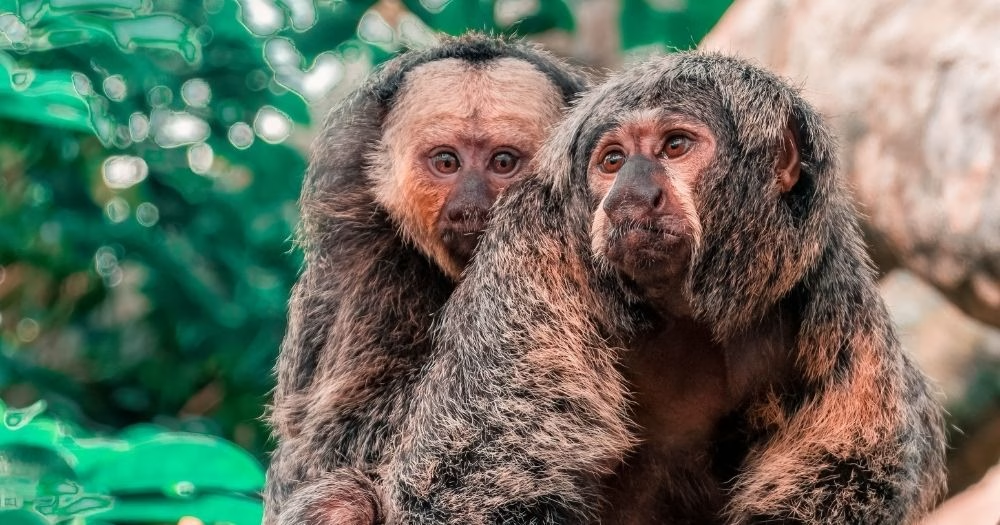
It has long been known that humans aren’t the only creatures to engage in homosexual activities. To date, scientists have documented around 1,500 species, including whales, birds and primates, engaging in same-sex behaviour.
Recent studies have found that homosexual behaviour has been observed in 59 nonhuman primate species. A study published in the journal Nature Ecology & Evolution challenges some common assumptions about the purpose of sex in the animal world. Same-sex relations may occur to reinforce bonds and keep societies together in the face of environmental or social challenges.
An extensive review of hundreds of nonhuman primate species suggests that not only are same-sex relations common, but they are also used to help reinforce social bonds and increase chances of survival. It is also hinted that species that engage in same-sex activities might have an evolutionary advantage to help them face the environmental and social challenges presented to them.
“What we found shows that same-sex [behaviour] is not like something bizarre, aberrant or rare. It’s everywhere, it’s very useful, it’s very important,” says study co-author Vincent Savolainen, Director of the Georgina Mace Centre for the Living Planet at Imperial College London.
In their research, Savolainen and his colleagues looked into 96 published studies that contained observations of same-sex individuals mounting, touching and engaging in other sexual acts. Those studies found that 59 species of the 491 observed were seen engaging in same-sex behaviour.
“People haven’t realised same-sex, as a behaviour, is as important for the functioning of a society as feeding, fighting, making babies, looking after your offspring,” says Savolainen.
The more scientists look into the complexities of same-sex behaviour in the animal kingdom, the more it is shown how important it is. From building a stronger bond amongst the group to settling disputes in a non-violent way, same-sex coupling is a crucial factor for the successful functioning of their societies.
© 2026 GCN (Gay Community News). All rights reserved.
Support GCN
GCN is a free, vital resource for Ireland’s LGBTQ+ community since 1988.
GCN is a trading name of National LGBT Federation CLG, a registered charity - Charity Number: 20034580.
GCN relies on the generous support of the community and allies to sustain the crucial work that we do. Producing GCN is costly, and, in an industry which has been hugely impacted by rising costs, we need your support to help sustain and grow this vital resource.
Supporting GCN for as little as €1.99 per month will help us continue our work as Ireland’s free, independent LGBTQ+ media.