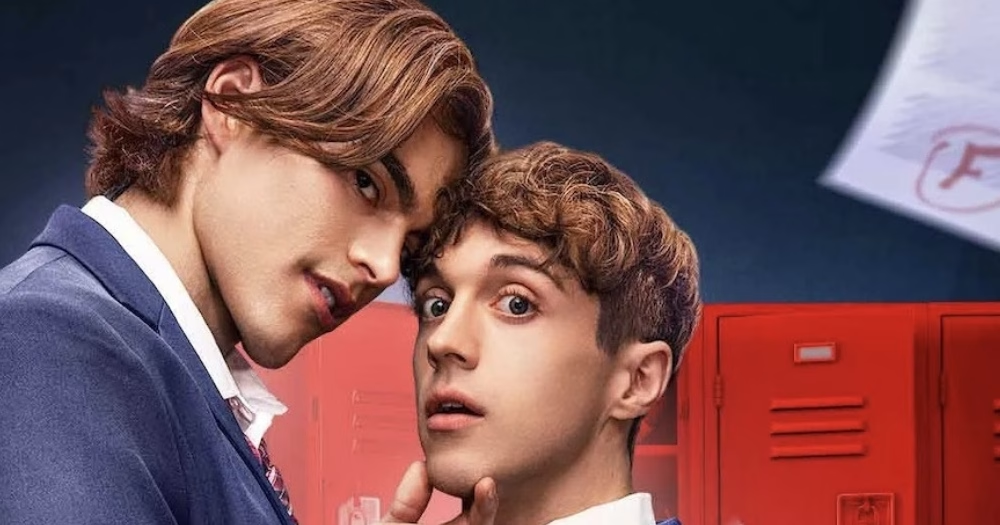
If you are a social media user, you are probably familiar with vertical dramas. They have been flooding the advertising space on TikTok, YouTube and Instagram. Usually taking the form of a drama series, often a romance-centred story, they are specifically constructed for viewing on a mobile device. Each episode is typically 30 seconds to a minute long and presented in a vertical format for easy viewing.
A single series can contain over 50 episodes, with each ending on a cliffhanger designed to entice viewers to keep scrolling and coming back for more. Having proven to be a highly successful format, many of these dramas now tell queer stories.
With the continued rise of short-form, attention-grabbing content, it was perhaps only natural for traditional episodic storytelling to adapt to new forms of media consumption. Rather than asking viewers to watch an entire series, the dramas bring episodic programming into a scrolling experience.
Stemming from dramas coming out of China, the trend began to build momentum with the increased viewership of short-form content during the Covid-19 pandemic. With low production costs and fast turnarounds, the format has created a fast-growing industry, with companies like My Drama and CandyJar specialising in the format.
Although many platforms offer an annual subscription fee, others have adopted a payment structure more commonly associated with mobile gaming. Viewers can purchase digital coins to unlock individual episodes. Each episode ending on a cliffhanger is not just a story device, but a tool used for monetisation.
Despite having relatively low production costs, many of the companies invest heavily in advertising, targeting ad space on popular, heavy-traffic platforms like TikTok and Instagram. The advertisements blend almost seamlessly into the user’s feed, appearing as another piece of short-form content, rather than an ad for a streaming platform.
Many of these dramas also subscribe to the idea that sex sells, using provocative clips to lure viewers into following the link.
With the success of queer romance drama Heated Rivalry, it is hard not to notice similarities between the HBO series and some of these vertical dramas, often relying on similar tropes such as ‘enemies to lovers’ and ‘forbidden love’.
With titles such as Objection! I’m Not Gay!, Pool Boy, Wrestling with Love and How I Made the Alpha Mine, one has to wonder what these queer narratives are trying to say. Dealing with themes of masculinity, secret love, domination, power dynamics and sexual tension, are these dramas telling relevant queer stories, or are they just selling a fantasy of ‘gay men’?
The low-budget, heightened performances and steamy scenes used in these advertisements can, at first glance, make some of these dramas appear to be softcore adult content. Whether this is a fair assumption or not, the line between romantic drama and sexual fantasy is quite deliberately blurred.
View this post on Instagram
Is the sexualisation of the genre problematic or just harmless fun? Have these series become the modern technological equivalent of the romantic novella: a trashy romp made for escapist entertainment rather than realism?
There is nothing inherently wrong with an audience desiring fantasy, but when a narrow viewpoint is continually pushed by the algorithm, the conversation becomes more complicated.
Relying on familiar stereotypes such as hyper-masculine characters, dominant and submissive dynamics, secret desires and eroticised relationships is not inherently problematic. But when these become some of the most visible depictions of gay relationships in a fast-expanding form of media, it raises another important question: who is being left out?
The quieter, everyday queer narratives are not commonly seen in these vertical dramas. Would the algorithm be capable of pushing a more grounded depiction of gay life? If not, who exactly are these dramas made for? Are they aimed at a queer audience or anyone who clicks the link? In that case, where does representation sit in the list of priorities?
The primary goal for these companies is not necessarily an accurate portrayal, but engagement. More clicks means more engagement. More engagement means more money. The drama ceases to be a representation and becomes just a product.
For better or worse, the algorithm has become a part of online queer storytelling. The question is no longer if it influences these stories; it does. The question should be, how much influence will we allow it to have?
© 2026 GCN (Gay Community News). All rights reserved.
Support GCN
GCN is a free, vital resource for Ireland’s LGBTQ+ community since 1988.
GCN is a trading name of National LGBT Federation CLG, a registered charity - Charity Number: 20034580.
GCN relies on the generous support of the community and allies to sustain the crucial work that we do. Producing GCN is costly, and, in an industry which has been hugely impacted by rising costs, we need your support to help sustain and grow this vital resource.
Supporting GCN for as little as €1.99 per month will help us continue our work as Ireland’s free, independent LGBTQ+ media.