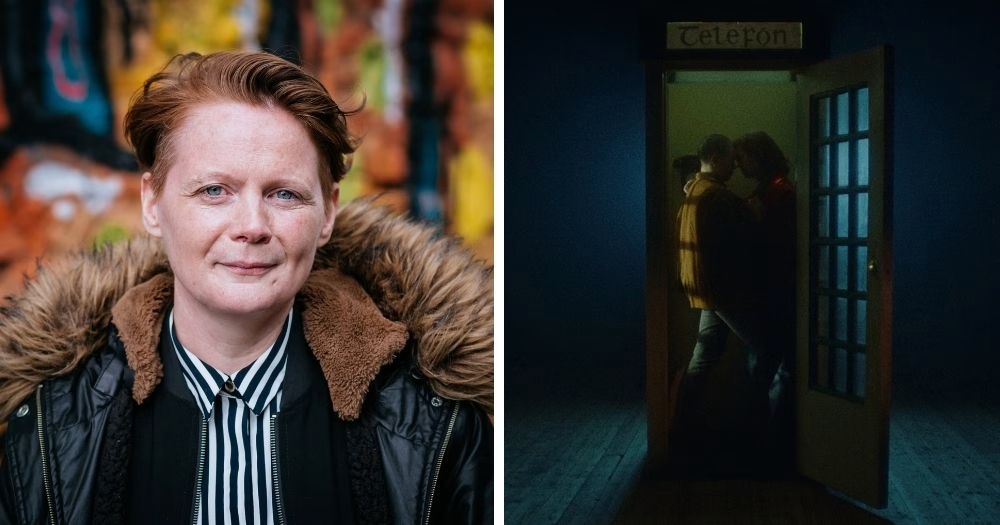
In 2019, Dublin Lesbian Line celebrated its 40th anniversary as a helpline providing confidential guidance to callers in need. An intimate evening of discussion, poetry and music marked the occasion, with Irish filmmaker Cara Holmes in attendance.
The original founders of the service, alongside current volunteers, shared their personal experiences of the power of listening. Since 1979, the helpline, and other lesbian lines across the country, have answered the phone with kindness and patience, providing sound advice on issues ranging from sexual health, relationships, homophobia and loneliness to anyone who calls.
When Dublin Lesbian Line was established, Ireland was a deeply conservative country. The influence of the Catholic Church loomed large, casting a shadow of shame and conformity. Sex was not discussed, divorce was illegal, contraception had only just been made available to married couples and homosexuality between men was criminalised.
Irish lesbians were afraid of the consequences of living freely, at risk of losing custody of their children, their livelihoods and their homes if they were to come out. Often callers to the lesbian lines were too scared to speak. Many simply remained silent in the knowledge that someone who cared was listening without judgement on the other side.
At a time when lesbianism was invisible and homophobia visceral, Dublin Lesbian Line was a vital beacon of hope.
As the anniversary celebration in 2019 came to a close, Cara Holmes approached Joni Crone, a previous helpline volunteer and activist. Crone was the first lesbian to come out on Irish TV when she appeared on The Late Late Show in 1980, putting herself at risk to demonstrate that a life without shame was possible. The two swapped numbers and Holmes parted that night with the knowledge that she would devote her next project to documenting the contribution of Ireland’s lesbian lines to the country’s queer history.
Over the next years, Cara Holmes jokes that she completed an unaccredited “PhD in the Lesbian Line,” spending hundreds of hours gathering the testimonies of the original helpline volunteers. As is often the case with lesbians, Holmes’ search for the original operators became something of a community affair. One conversation led to the uncovering of five more potential sources as trust was earned and stories were shared of what it was like to grow up gay in a very different Ireland.
Holmes describes how it felt right to gather the testimonies over a series of phone calls with each participant. An intimate connection was formed, just as in the dynamic of a caller to the Lesbian Line and the volunteer. Holmes shares, “There’s something intimate about a phone call. You’re not distracted by what another person looks like, and you can focus purely on the voice alone and really connect with each other.”
Holmes loved the time spent researching what was her own history as a queer Irish woman: “I was all in, completely fascinated by the Lesbian Line and the volunteers… I was shocked that I hadn’t known these stories before, hadn’t known the names of these people who had fought so much for our rights… On the other hand, I was also overwhelmed by 40 years of all these amazing stories.
“How could I possibly narrow this down to fit into a narrative?… I felt a real pressure to do the history justice, but at a certain point you have to accept the impossibility of including every angle in one film.”
The fruits of Cara Holmes’ labour is Lesbian Lines, a touching documentary which skillfully weaves the testimonies of the original operators alongside dramatised scenes with younger actors playing out the experiences described within the logbooks of the helpline. A rich tapestry of docufiction, home footage and scanned ephemera of flyers, event posters and intimate photos creates a vivid sense of a community forming in real time, protecting and supporting each other in a hostile society.
The film clearly elucidates how the simple act of picking up the phone and really listening to each other can be an act of quiet resistance. As people got in touch with the lines, they were directed to gatherings of lesbians around the country to meet in person and find meaningful connections. Friendships were made, protest groups formed, people fell in and out of love, and joy was found amongst the struggle.
Within the film, a helpline volunteer aptly summarises the central predicament facing every chronicler of social movements. If the people making the history knew that they were doing so at the time, they would probably keep better records.
The grassroots nature and limited resources of the lesbian lines and the budding queer community at the time mean that much evidence has been lost as the helplines moved venues and personal records were dispersed. Holmes describes how “at the start (of the filmmaking process) I assumed there was no archive, which was sad but almost liberating.”
Knowing that any archival material was in the ether, Holmes urged the volunteers to rummage through their own personal archives. Gradually, boxes of polaroids of hazy evenings, VHS tapes of protest marches and photocopied zines were uncovered from below beds, under fridge magnets and in dusty sheds. Previously unseen footage of a legendary, all-island dyke Fantasy Ball is a personal highlight. Holmes and I are in agreement that this night alone should be the focus of an entire feature-length film.
The testimonies and archival material Holmes and the volunteers have gathered within Lesbian Lines is an invaluable record of Irish lesbian history that would otherwise disappear. Holmes hopes the film will be a starting point to a wider archival effort to document Irish queer history before it’s too late, encouraging everyone to explore and preserve their own personal archive.
Currently, all of the material used in the documentary – over 100 hours of conversations with volunteers, flyers from events, DIY publications, photos and the original logbooks of the lesbian lines – are all without a permanent home that would allow others to discover more stories hiding within these important records of Ireland’s queer history.
With the transformative power of listening to each other, a central message of Lesbian Lines, several community screenings will be held across the country with the aim of bringing people of different generations together for lively debate and discussion. As Holmes describes, “This project is not just about learning from queer elders; older people are very curious, they want to be part of the conversation and learn from young people too.”
While only a handful of volunteers appear in the end product, Holmes is eager for the viewer to understand that there are hundreds of others who make up the wider lesbian lines network. As with much progressive social change, there is no one hero. Rather, a million small acts of kindness and bravery carried out by lesbians across the country created a cumulative tangible force that changed Ireland for the better.
Lesbian Lines, directed by Cara Holmes, is released in cinemas across Ireland from October 8. The Dublin Lesbian Line is open on Monday and Thursday from 6:30pm to 9pm to all those in need of support.
© 2026 GCN (Gay Community News). All rights reserved.
Support GCN
GCN is a free, vital resource for Ireland’s LGBTQ+ community since 1988.
GCN is a trading name of National LGBT Federation CLG, a registered charity - Charity Number: 20034580.
GCN relies on the generous support of the community and allies to sustain the crucial work that we do. Producing GCN is costly, and, in an industry which has been hugely impacted by rising costs, we need your support to help sustain and grow this vital resource.
Supporting GCN for as little as €1.99 per month will help us continue our work as Ireland’s free, independent LGBTQ+ media.