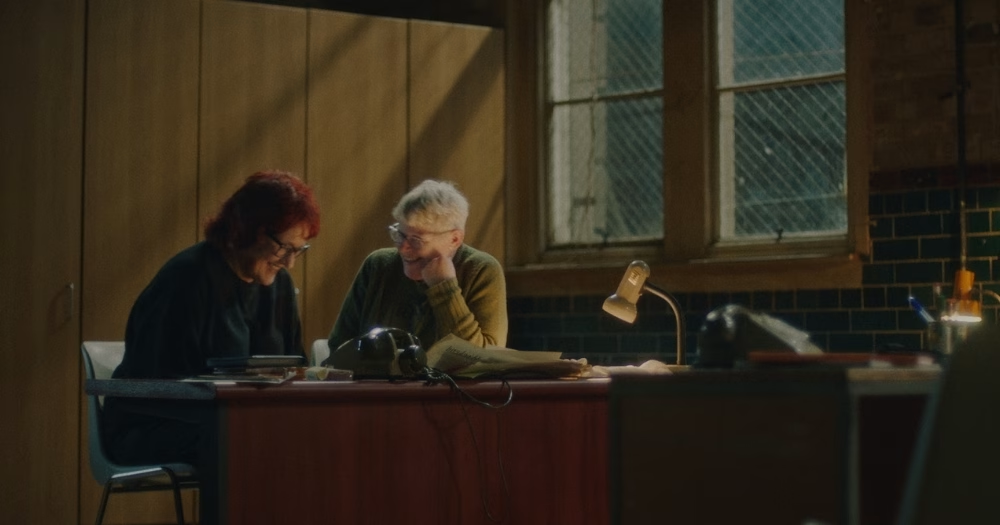
On Thursday, July 30, Cara Holmes’ Lesbian Lines celebrated its Dublin Premiere as part of GAZE International LGBTQIA Film Festival. The sold-out screening was hosted in the Light House Cinema and was met with a standing ovation from those lucky enough to secure a ticket.
The documentary uncovers a hidden chapter of Irish LGBTQ+ history through an underground network of lesbian telephone helplines. The conversations, preserved in handwritten notes, offer a remarkable record of a pivotal time when women were fighting for equality in a deeply restrictive and conservative society.
Blending documentary with dramatic performance, Holmes brings this little-known history vividly to life through an ensemble of former helpline volunteers and actors. Many of these contributors were in attendance at GAZE, and some took part in a post-screening Q&A.
Another person in the audience was current Dublin Lesbian Line Chair Val Hourigan, who reflects on the film below:
Last night, at GAZE Film Festival, I watched Cara Holmes’ extraordinary documentary Lesbian Lines. I went expecting to be moved. As the current chair of Dublin Lesbian Line, how could I not be? This is the history of an organisation I now have the honour of helping to steward: a history that began in 1979 and will reach its 50th year in 2029. But I was not prepared for the depth of what I felt in that room.
GAZE did more than screen a film. It brought generations of our community together and created a space in which our shared history felt alive, urgent, intimate and present.
There was a particular atmosphere in the cinema, difficult to describe without making it sound sentimental. It was warm and joyful but not uncomplicated. It was the feeling of being surrounded by people who understood that what we were watching was not simply a documentary about the past. It was part of the story of how we came to be here. How we came to be able to sit together, openly and proudly, watching lesbian lives take up an entire cinema screen. How we came to have language for ourselves, spaces of our own and the freedom (however incomplete) to build lives rooted in love, friendship, desire and community.
Afterwards, listening to Cara Holmes, Joni Crone, Marina Forrestal, Louise Walsh, Ruth McCarthy and Helen Slattery speaking about their experiences made the evening more powerful still. They were not distant historical figures. They were there in the room with us: laughing, remembering, disagreeing, filling in the gaps and telling the stories in their own voices.
There is something profound about hearing history spoken by the people who made it. Not a polished version. Not a tidy story of inevitable progress. Real history, carried in people’s bodies and memories: the fear, the humour, the exhaustion, the arguments, the friendships and the extraordinary amount of work it took to make something where previously there had been nothing.
Sitting there, I felt part of something much broader and much older than myself. I felt connected to a lineage.
Many queer people do not inherit an obvious queer lineage through our birth families. We may not grow up hearing stories about the lesbian aunt who found community, the trans grandparent who lived on their own terms or the gay cousin who fought alongside others for change.
Queer people have always existed in our families, of course, but so many of their stories were hidden, euphemised or erased. They were the unmarried aunt, the lifelong friend, the person who moved away, or the person about whom nobody spoke. So we have often had to find our ancestors elsewhere.
We find them in archives, in photographs, in protest banners and handwritten meeting minutes. We find them in half-remembered stories told in pubs and community centres. We find them in organisations that have outlived governments, moral panics and funding crises. We find them in the names of people who took risks before we were born, so that our lives might contain more possibility than theirs did.
The women in Lesbian Lines are part of my queer lineage.
They did not pass down a family name, a house or a physical resemblance. They passed down something more important: the possibility of a life. They showed that lesbians could find one another, organise together and refuse the isolation and oppression imposed upon them. They built a network of voices stretching across Ireland, reaching into homes, marriages, hospitals, rural towns and private moments of despair.
Sometimes the person who called could not speak at all. Still, somebody stayed on the other end of the line.
For me, the lines create an almost unbearably powerful image: one woman in a hostile world picking up a telephone and another woman defying society answering.
It may sound like a small act. It was not.
At a time when Irish society gave lesbians almost no public language through which to understand themselves, the line told women that they existed. It told them that they were not uniquely broken, sinful or alone.
It gave them the name of a social group, the possibility of meeting another lesbian or simply the experience of speaking honestly. Those conversations changed lives, and many of them saved lives.
Those women took the tools available to them and invented a new way to reach people whom society had deliberately isolated. They put stickers on walls and in telephone boxes, organised rotas, took calls in bathrooms, kept logs, and held other women’s fear while carrying plenty of their own.
They built not only a helpline but an underground infrastructure of lesbian survival, and they did it together.
One of the comments Marina made after the screening is with me as I write: this was never the work of one or two exceptional people. It was the work of a community.
That matters because we have a tendency to turn social change into a story about individual heroes. We remember the person who stepped onto the stage, but not always the people who made it possible for them to stand there. We remember the public declaration, but not the meetings, arguments, lifts home, cups of tea, fundraising, phone rotas and years of quiet organising beneath it.
Movements need courageous individuals. But courage is very often produced and sustained by community.
Joni Crone’s appearance on The Late Late Show in 1980 remains an astonishing act of bravery. At 26, she went on the country’s dominant television programme and publicly said that she was a lesbian. She did so in an Ireland where that visibility could have cost her work, relationships, safety and any control over who knew the most intimate facts of her life. She used that moment to tell people that lesbians existed and to let isolated women know that there was somewhere they could call.
I had the opportunity to meet Joni after the screening. It is difficult to explain how much that meant to me.
I was standing in front of a woman whose courage helped create the conditions in which I can now live openly. I could introduce myself as an openly lesbian woman and as chair of Dublin Lesbian Line, an organisation she helped bring into public consciousness almost half a century ago. The distance between her Ireland and mine seemed to collapse.
I want to say thank you, not politely or ceremonially, but fully.
Thank you for taking risks you should never have been required to take. Thank you for speaking when silence would have protected you. Thank you for refusing the shame that an entire country tried to place upon you. Thank you for finding one another. Thank you for staying on the phone. Thank you for organising meetings when there was no guarantee anyone would come. Thank you for building spaces whose benefits you could not be certain you would live to see. Thank you for fighting so hard for lives that many of us now get to live.
View this post on Instagram
There is a photograph somewhere in almost every queer person’s life that could not have existed a generation earlier: a wedding, a Pride march, a family gathering, a kiss shared without checking who is watching. There are conversations we have casually now that once required extraordinary courage. There are friendships, organisations and communities we enter without fully knowing the labour that made the door visible, never mind opened it.
None of this arrived by accident. None of it was given to us because Ireland gradually became kinder of its own accord. It was fought for deliberately, persistently and collectively. That is why our gratitude cannot end with applause.
It is tempting to watch a film like Lesbian Lines, honour the women involved and leave feeling reassured by a story of progress. We can imagine history as a straight road from repression to freedom, feeling fortunate to have been born near the end of the journey. But there is no end of the journey.
Progress is not permanent; rights can be hollowed out, public opinion can be manipulated. Communities can become complacent or fractured. People can enjoy the freedoms won by earlier movements while distancing themselves from those whose lives remain politically inconvenient.
To inherit a queer history is to inherit a queer responsibility. For younger generations (and I include myself in that), the question cannot only be: how brave were they? It has to be: what does their bravery require of us?
We have so much for which to be grateful. But gratitude without action is simply admiration.
We cannot thank previous generations for fighting and then decide that fighting is no longer our responsibility. We cannot celebrate the risks they took while building lives organised entirely around our own comfort. We cannot accept the benefits of solidarity and then withdraw that solidarity from others as soon as it becomes socially or politically difficult.
Now it is our turn to do the work.
Doing the work means more than posting the correct words on social media when a crisis is trending. It means joining organisations, protesting, giving time, boycotting, donating money, lobbying, sharing skills and taking responsibility for keeping community infrastructure alive.
It means doing the unglamorous work: answering messages, stacking chairs, writing policies, taking minutes, checking on people, resolving conflict and returning the next day. It means learning our history, not to trap ourselves in it, but to recognise the strategies used against queer people when they return in new forms.
It means challenging racism, misogyny, ableism and class exclusion within our own spaces rather than congratulating ourselves for being progressive because we are queer. It means building spaces that rural people, migrants, disabled people, working-class people and people of colour can genuinely enter and shape, not merely spaces in which they are theoretically welcome.
It means refusing respectability politics: the idea that some of us can purchase safety by proving that we are reasonable, presentable and harmless while allowing the most marginalised members of our community to be treated as expendable.
And right now, urgently, doing the work means standing unequivocally with trans people.
Trans people are being required to justify their humanity in public again and again. Their healthcare, safety, participation in public life and right to understand their own identities are treated as debates in which everyone is invited to speak except them. They are described as threats, problems and dangerous influences. Their lives are reduced to headlines, hypotheticals and political opportunities.
Lesbians should recognise this machinery.
Our communities know what it is to have our lives discussed by politicians, churches, doctors and journalists who claim greater authority over us than we possess over ourselves. We know the language of contamination, danger and protection. We know what happens when the public is encouraged to see a minority not as human beings but as a social problem.
Recognising that history should not make us cautious. It should make us fierce.
Solidarity with trans and non-binary people cannot be whispered, qualified or delayed until it is convenient. For me, this is not an abstract political position.
I recently lost a friend. The day before the screening, I was tearfully telling someone in my life about their death, and the first words out of their mouth were: “Are they a boy or a girl? Why are you calling them ‘they’?” In a moment when I was grieving (when the only humane response was compassion), my friend’s identity was treated as a problem to be interrogated.
That moment impacted me. It reminded me that transphobia is not confined to newspaper columns, political campaigns or anonymous accounts online. It enters our homes, our friendships and even our moments of deepest vulnerability.
Doing the work means challenging it there, too, including when it comes from people we know and love. It means refusing to allow lesbian identity or lesbian history to be used as a weapon against trans people. It means ensuring that our organisations are not merely nominally inclusive, but actively safe. It means supporting trans-led organisations, defending access to healthcare and making it clear that attempts to divide lesbians from trans and non-binary people will not succeed.
Above all, it means remembering that behind every so-called debate is a person: someone’s friend, someone’s child, someone deeply loved and someone whose dignity should never be conditional.
It also means accepting that solidarity may cost us something. It may create discomfort. It may mean losing approval, entering conflict or speaking before we feel perfectly prepared.
The women who created the Lesbian Lines did not wait for courage to become comfortable. We should not confuse their bravery with fearlessness. They were afraid. They acted anyway, and they acted together. That is the inheritance they have given us: not a demand that every individual become a hero, but proof that ordinary people working collectively can alter what is possible.
We do not all have to appear on national television. But we all have a phone we can answer, metaphorically or literally. We all have some part of the work we can take on.
In 2029, Dublin Lesbian Line will turn 50. I want that anniversary to be a celebration worthy of the women who built it. But the greatest tribute we can offer them is not simply to preserve the organisation as a monument to the past. It is to remain faithful to the radical purpose at its heart: finding the people whom society has isolated and building a line of connection towards them.
The women in Lesbian Lines did not know us; they could not picture our individual lives, but they fought for the possibility of us. They created spaces for people they had never met. They took calls whose consequences they may never know. They laid stones on a path that many of us now walk so easily that we can forget somebody had to place them there.
I do not want to forget.
I want Joni, Marina, Ruth, Lou, Helen, Cara and all the women who built, sustained and preserved this history to know that what they did matters to me. That their courage reaches across the decades. That I feel it in my life, in my friendships, in my love and in the community I am privileged to serve.
I want them to know that we see them. I want to say thank you, and then I want those of us who came after them to roll up our sleeves.
They answered the call for us. Now it is our turn.
View this post on Instagram
To stay up to date with Dublin Lesbian Line, follow their Instagram or Facebook. Another sold-out screening of Lesbian Lines will take place as part of GAZE on August 3. The documentary will release in Irish cinemas later this year by Wildcard.
© 2026 GCN (Gay Community News). All rights reserved.
Support GCN
GCN is a free, vital resource for Ireland’s LGBTQ+ community since 1988.
GCN is a trading name of National LGBT Federation CLG, a registered charity - Charity Number: 20034580.
GCN relies on the generous support of the community and allies to sustain the crucial work that we do. Producing GCN is costly, and, in an industry which has been hugely impacted by rising costs, we need your support to help sustain and grow this vital resource.
Supporting GCN for as little as €1.99 per month will help us continue our work as Ireland’s free, independent LGBTQ+ media.