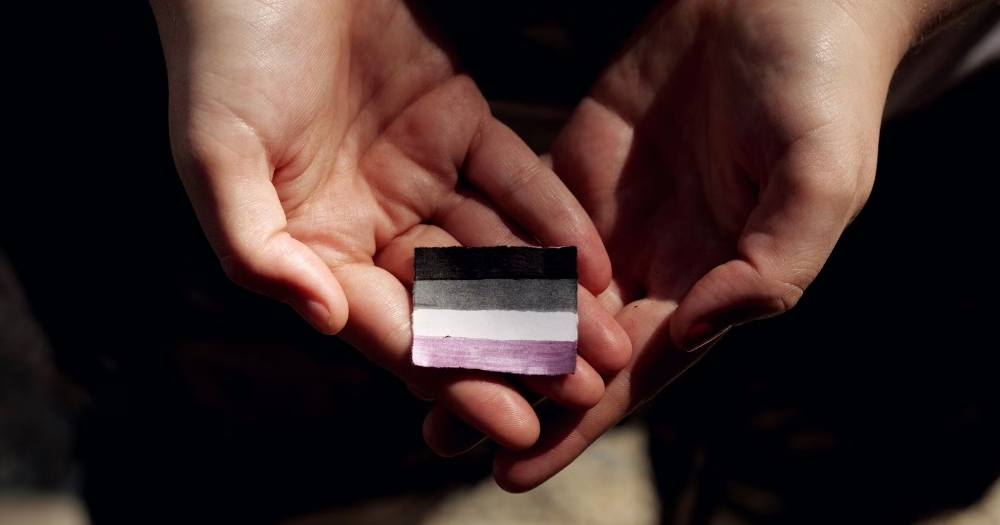
October 25 to 31 marks Ace Week, a time to raise awareness around the experiences of people who identify as asexual. According to Outright International, asexual is “An umbrella term used to describe people who experience little to no sexual attraction toward others, regardless of their gender”. In terms of education and media about LGBTQ+ identity, asexuality remains one of the most underrepresented areas of the queer community.
One common misconception is that asexual people experience no sexual attraction at all, and while this is true for some, the identity is also considered to be part of a fluid spectrum. As ShoutOut explained in their post about Ace Week: “Being asexual looks different for everyone (…) There is no single way to be ace”.
Other identities on the ace spectrum include graysexual, meaning to experience limited sexual attraction, and demisexual, meaning to experience sexual attraction only towards people you have an emotional bond with. It should also not be misconstrued as celibacy, which refers to a person’s choice not to engage in sexual activity.
Additionally, being asexual is distinct from aromantic (shortened to aro), which refers to having little to no romantic attraction to others. Although the two can overlap, being aro does not necessarily make a person ace, and vice versa. ShoutOut added, “Some ace people experience romantic attraction, want relationships, or enjoy physical affection. Others don’t”.
Furthermore, the term allosexual (allo) refers to the opposite of asexual: people who do experience sexual attraction.
View this post on Instagram
The asexual flag was first created in 2010 by the Asexuality Visibility and Network (AVEN), and the design included four horizontal stripes of black, grey, white and purple. The black represents asexuality, the grey represents grey and demisexuality, the white represents sexuality, and the purple represents community.
Recently, a report was published by Outright International titled Asexual People’s Human Rights, in collaboration with numerous international activists. The report found a concerning prevalence of discrimination and violence against asexual people internationally, stating: “According to the 2024 Ace Community Survey, an online survey dominated by respondents from North America and Western Europe, 32% of 1,667 respondents had been verbally harassed, while 19% had experienced bullying in person or online.”
This discrimination also exists within the queer community, as one asexual advocate from Hungary in the report shared, “The biggest problem is that because we live in a very allonormative society (assumption that all human beings experience sexual attraction), even in circles where gay people are accepted, lesbians are accepted, we do not talk about asexuality being a totally valid orientation.”
Another finding was that asexual people can face severe barriers in accessing healthcare due to it being stigmatised as a form of sexual dysfunction in clinical environments. The study states, “Some asexual people report being prescribed medication to increase their sex drive, which could demonstrate the lack of practitioner awareness about asexuality.”
It continues, “A 2018 study in the U.S., where the DSM (Diagnostic and Statistical Manual of Mental Disorders) applies, found that more than a third of the 136 adult asexual respondents reported being misdiagnosed by doctors with a medical condition.”
Outright International calls for human rights organisations, LGBTQ+ movements and policymakers to “develop strategies to advance the inclusion of asexual issues in their work.”
Allosexual people, both inside and outside the queer community, can be allies to asexual people by informing themselves on the terms, understanding that asexuality is a spectrum and listening to ace experiences. Claims that ace people are confused or have just not found the right person yet actively contribute to the isolation and discrimination that Outright International’s report discusses.
View this post on Instagram
If you are interested in asexual representation in literature, Heartstopper author Alice Oseman has an insightful and heartwarming YA novel called Loveless, which centres an ace protagonist.
You can read Outright International’s full Asexual People’s Human Rights report here.
© 2026 GCN (Gay Community News). All rights reserved.
Support GCN
GCN is a free, vital resource for Ireland’s LGBTQ+ community since 1988.
GCN is a trading name of National LGBT Federation CLG, a registered charity - Charity Number: 20034580.
GCN relies on the generous support of the community and allies to sustain the crucial work that we do. Producing GCN is costly, and, in an industry which has been hugely impacted by rising costs, we need your support to help sustain and grow this vital resource.
Supporting GCN for as little as €1.99 per month will help us continue our work as Ireland’s free, independent LGBTQ+ media.