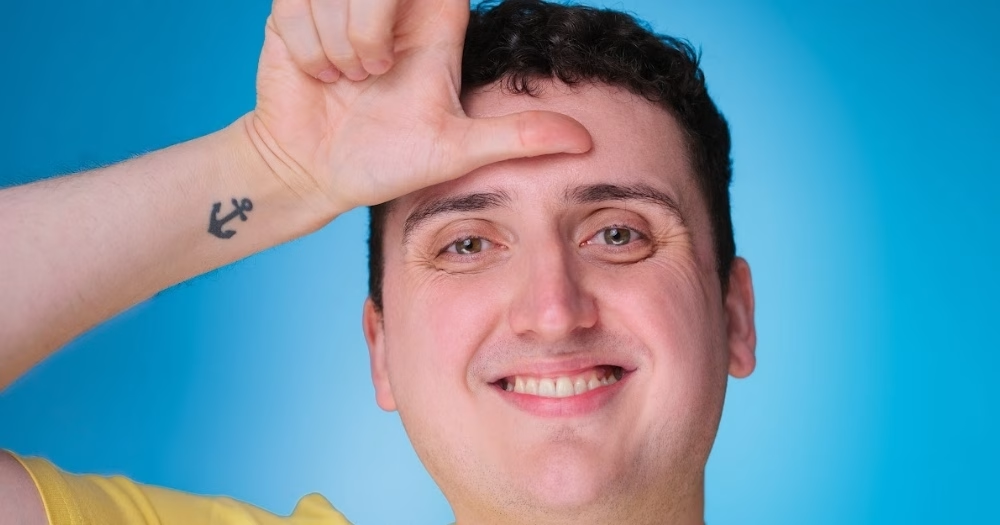
Conor Burke’s Gleek of the Week is showing at the 2026 Dublin Fringe Festival from September 8 to 12. Inspired by the hit TV show Glee, it is a joyful musical about finding hope and optimism even when the world begs you to stop singing.
Ahead of the festival, Conor Burke shares how the teen series inspired the production.
It was April 2020, we were one month into the pandemic, and I was incredibly bored. I needed to find ways to entertain myself, when I noticed something curious – people had started to talk about Glee again.
It was an odd thing for me to observe purely because, personally, I had never stopped talking about Glee. Even though it ended in 2015, it had always lingered in my life – I repeatedly dressed up as a Dalton Academy Warbler for Halloween, and the music still dominated my Spotify top 10.
In a moment of inspiration, coupled with profound boredom, I decided to set up a podcast centred around the show. I called it Glee-Cap (a portmanteau of Glee and recap, of course), and I got to work.
Each week, I was joined by a different guest who would watch an episode of the show with me, and we would break down every expensive musical performance, dramatic plot line, and snarky one-liner uttered by the legendary Sue Sylvester.
Glee was totally camp and primary colour, and in many regards, it was its own genre. It existed in a slightly heightened universe just left of centre to our own, but the characters that inhabited it were grounded in a truth that you couldn’t help but relate to.
And ironically, much like the glee club members the show was centred around, it was also deeply misunderstood. Glee taught me a valuable lesson in making me realise that art being inherently joyful does not mean that it’s inherently bad – and art being inherently sombre does not mean it’s inherently meaningful.
What struck me most about the making of the podcast was that everyone had something to say about the show, and if you were someone of a particular age, you probably had a story about the impact it had on your life, too.
It was a total love letter to pop culture and a celebration of the underdog. Of course I adored it – it would be almost bizarre if I didn’t. It entered my life at the perfect moment, creeping its way into my subliminal mind and nestling there – making sure that my adolescent self was protected from all the bad things going on around me.
Glee aired its first episode all the way back in May of 2009, and the final episode aired in March of 2015. Up until 2012, it was the most popular teen television show on air, and one of the most popular TV shows in the world.
Since then, we have somehow veered away from the joyous and jubilant, and focused all our attention on the gritty and grounded. There’s room for both, yes, but in many ways, we have gone from glee to glum, and it feels like we’re reverting.
Perhaps teenage television shows could be used as a perfect conduit for us to examine where we’re at as a society. How did we get from ‘Don’t Stop Believin’’ to ‘Everyone is miserable and emotionally unavailable’?
At some point in the past decade, we have all collectively decided that earnestness is humiliating, optimism is naive, and the only acceptable way to portray adolescence is through a blue filter and a nervous breakdown being portrayed by a group of actors who all look like supermodels.
Today, to be seen to be joyful is to be seen to be cringe. To be seen to be an optimist is to be seen to be an idiot. We must not let anyone see our wide-eyed, bushy-tailed approach to life because it’s not worth a thing in today’s social and cultural currency.
Today, you have to be seen to be either exclusively nonchalant or completely apathetic about everything. A TV show where people express themselves through song is just not going to cut it.
But Glee was queer. And it was gay. And it had its finger on the pulse of social and cultural discourse. It never claimed to be perfect – but at least it was daring enough to address some things that most other mainstream TV shows were not.
It was ahead of its time, and it was smart. It was satirical, and it was in on the joke – a lot of people just didn’t get it.
And Glee was a ridiculous show, okay? Of course it was. But at least it believed, wholeheartedly, that life might be better if you dared to join a show choir and commit to perfecting a box step.
Our show at the Dublin Fringe Festival, Gleek of the Week, is a celebration not only of Glee but also of the art that we take comfort in. The one that offers us hope, brings us joy, and changes our lives, even when that art is centred around a group of singing teenagers.
View this post on Instagram
© 2026 GCN (Gay Community News). All rights reserved.
Support GCN
GCN is a free, vital resource for Ireland’s LGBTQ+ community since 1988.
GCN is a trading name of National LGBT Federation CLG, a registered charity - Charity Number: 20034580.
GCN relies on the generous support of the community and allies to sustain the crucial work that we do. Producing GCN is costly, and, in an industry which has been hugely impacted by rising costs, we need your support to help sustain and grow this vital resource.
Supporting GCN for as little as €1.99 per month will help us continue our work as Ireland’s free, independent LGBTQ+ media.