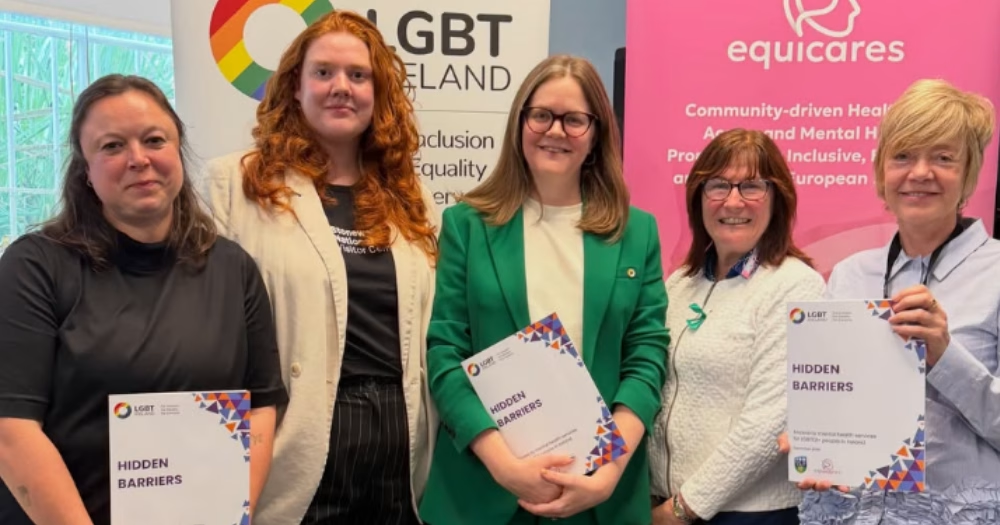
LGBT Ireland has recently released a new research report titled Hidden Barriers: Access to mental health services for LGBTQI+ people in Ireland in collaboration with University College Dublin (UCD). The report is a part of their EQUICARES campaign to reduce mental health inequalities faced by the queer community.
One area of focus was investigating LGBTQ+ people’s knowledge of support services in Ireland. The report found that 70% of respondents had learned about mental health services through word-of-mouth rather than via official information and signposting.
One interviewee in the report explained: “If you don’t know [a suitable provider], where do you really begin? What do you Google?… [you are] much more likely to ask around and get a recommendation than to Google ‘trans friendly therapist Dublin.’… It just feels like it carries more weight.”
This finding reveals a significant vulnerability for queer people who do not have a support network.
Hidden Barriers also reveals a considerable lack of trust towards mental health services among LGBTQ+ people. 40% of queer respondents reported that they found mental health services trustworthy, in contrast to 60% of cisgender, heterosexual respondents.
This figure was lower in terms of trans respondents, with only 13% agreeing that they trusted mental health services. The source of this lack of trust is related to negative experiences of services that were not educated or trained on LGBTQ+ issues.
Another notable finding identified that cost was a large barrier for LGBTQ+ people in accessing mental health services. The report states: “Almost 50% of LGBTQI+ respondents report they have delayed or avoided mental health care due to cost in the past 12 months, compared to 25% of cisgender, heterosexual respondents”. The figure was higher among trans respondents, with 65% avoiding mental health care due to cost.
What is evident from Hidden Barriers is that trans and gender non-conforming individuals in Ireland face disproportionate challenges in accessing mental health services, as well as finding those that are informed on their lived experiences.
LGBT Ireland’s Research Lead for EQUICARES, Dr Mina Fey, added: “The key findings confirm what we already knew anecdotally: there is a lack of clear information about LGBTQI+-competent mental health providers, no standardised training for providers, and a lack of trust in mental health services among LGBTQI+ people. High costs and long waiting lists disproportionately affect those who are already most disadvantaged, particularly trans people.”
In a social media post about the report launch event, LGBT Ireland shared, “Dr Mira Fey spoke about the report’s findings and emphasised the importance of this data being used as evidence by policymakers, mental health providers, and community organisations alike.”
They continued, “This was followed by a panel discussion with mental health practitioners and LGBTQI+ support workers, who shared their reflections on the findings and the steps needed to create more inclusive and accessible mental health supports in Ireland.”
View this post on Instagram
Hidden Barriers: Access to mental health services for LGBTQI+ people in Ireland is funded by the European Union, and the full report can be accessed here.
© 2026 GCN (Gay Community News). All rights reserved.
Support GCN
GCN is a free, vital resource for Ireland’s LGBTQ+ community since 1988.
GCN is a trading name of National LGBT Federation CLG, a registered charity - Charity Number: 20034580.
GCN relies on the generous support of the community and allies to sustain the crucial work that we do. Producing GCN is costly, and, in an industry which has been hugely impacted by rising costs, we need your support to help sustain and grow this vital resource.
Supporting GCN for as little as €1.99 per month will help us continue our work as Ireland’s free, independent LGBTQ+ media.