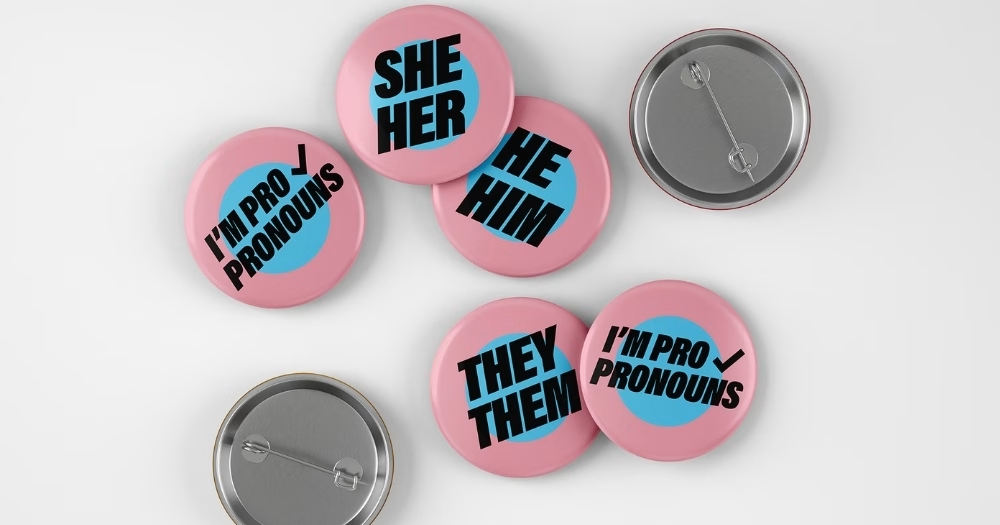
Founded in 2018, International Pronouns Day is annually marked on the third Wednesday of October. This year, it falls on October 21, offering an opportunity to raise awareness about the importance of respecting and using a person’s pronouns.
Pronouns are words used to replace a noun or a noun phrase. Some examples are ‘I’, ‘you’, ‘he’, ‘she’, and ‘they’, or ‘mine’, ‘yours’, ‘his’, ‘hers’, and ‘theirs’, among others.
A common misconception is that only trans, non-binary or gender diverse people use pronouns. However, everyone has a preferred way in which they are referred to, often linked to our sense of identity.
Pronouns are usually assigned to us at birth, determined by what genitals we have. But gender is something we navigate and discover throughout our lives, meaning that the words people use to identify us can sometimes not feel right.
Change in life is inevitable, and there are countless instances in which we accept and adapt to new ways people identify. For example, if someone takes their spouse’s name when they marry, people quickly make the effort to adjust. The same should be done if a person’s gender or pronouns change.
Using someone’s pronouns is a sign of basic respect. Of course, it can take some getting used to, especially if you have known them for a long time or if they use language that you are not familiar with. However, with a little practice, it becomes second nature.
Using ‘they/them’ pronouns as a gender-neutral option has become more common in recent years. But using these words to identify a singular third person has been in practice for much longer than that. For example, if someone you didn’t know sent you a letter, it wouldn’t be unusual to say, “I don’t know who they are” or “I don’t know them”. Using ‘they/them’ is easier and more natural than one might initially think!
Some people also like to use a mix of different pronouns like ‘he/they’, ‘they/she’ or ‘he/she/they’. This means that they are happy for you to use any of these options to identify them. It can also be very affirming for the person if others make the effort to use a mix of the pronouns, rather than just sticking to one.
While ‘he’, ‘she’ and ‘they’ are some of the most common pronouns, some people use alternatives called neopronouns. Examples of these include ‘ze/hir/hirs’ or ‘xe/xem/xyr’. These can be used in place of traditional options, for example: “Xe wants to go to the shop.”
Additionally, there are some people who prefer not to use pronouns at all, and would instead like to be identified by name only.
In order to respect a person’s pronouns, there are a number of steps you can take.
Firstly, don’t assume anyone’s pronouns; if you’re ever unsure, it’s ok to ask. You can also create spaces in which people feel safe and encouraged to share. For example, if you meet someone new, you can say your name and pronouns, inviting others to do the same.
In a workplace setting, people often have pronouns in their email signature. Even if you think your pronouns are easy to determine, making them visible to others helps to normalise the conversation.
While we don’t always get it right the first time, the important thing is to show respect by trying. Everyone has had to learn new language at some point, and it’s not as daunting as it may seem. Give yourself permission to try and fail, and ask questions when necessary. It is an important sign of respect, not towards LGBTQ+ people, but to everyone you meet.
© 2026 GCN (Gay Community News). All rights reserved.
Support GCN
GCN is a free, vital resource for Ireland’s LGBTQ+ community since 1988.
GCN is a trading name of National LGBT Federation CLG, a registered charity - Charity Number: 20034580.
GCN relies on the generous support of the community and allies to sustain the crucial work that we do. Producing GCN is costly, and, in an industry which has been hugely impacted by rising costs, we need your support to help sustain and grow this vital resource.
Supporting GCN for as little as €1.99 per month will help us continue our work as Ireland’s free, independent LGBTQ+ media.