After failing to source tickets in its previous sold-out run at the Dublin Fringe Festival, I felt very lucky to have gotten a space for the LGBTQ+ pub crawl and walking tour TRACES OF A WORLD-TO-BE as part of its second run with the Irish Architecture Foundation’s Open House Festival. I was eager to experience the queer history tour myself, which promised time-travelling characters and freshly-pulled pints.
On the way to the meeting spot, my friend and I found ourselves walking alongside a mullet in a long green coat. In my friend’s eyes I saw the same thought: “Are all three of us queers on our way to the same thing?” Yes, yes we were.
When we finally said hello, we realised we knew each other, and as Barnardo Square filled with people, I spotted a few other familiar faces on the tour, too. While Dublin is small, queer Dublin is even smaller, which TRACES OF A WORLD-TO-BE would soon show has always been true.
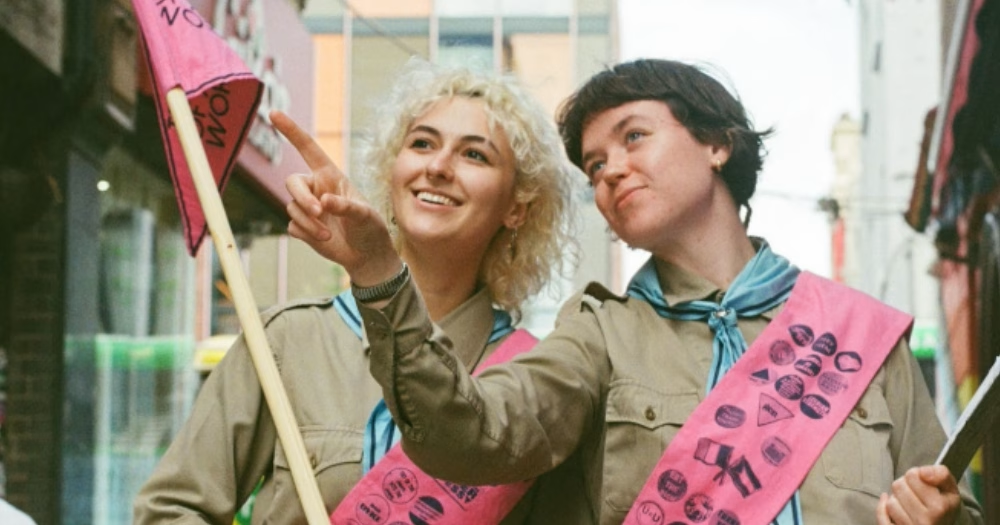
Our tour guides, Hana Laine Flamm (she/her) and Emma Hurson (they/them), are affable and confident, and I feel secure in their time-travel abilities. Both wear tartan skirts, white shirts, baby-blue neckties, navy jumpers, and a pink sash across their chests. These sashes sport their pronouns and quotes such as “LESBIAN STRENGTH!” and “WE WILL DANCE AGAIN”.
Flamm and Hurson also both carry clipboards; one carries a flag. The attention to detail in their costumes is immediately charming.
View this post on Instagram
After briefly setting the scene for 1980s Ireland as grey, economically depressed and socially repressed by the church, our time-travelling tour guides point across the road to Brogans. Back in the 1980s, it used to be the Viking Inn. This was the first intentionally gay bar in Ireland, described by an old guidebook as a “very fine house of ‘cheer'”.
A photo is passed around. I delight in looking up and down between the past and the present, as nothing has changed and yet everything has. (There were, we are told by our guides, other non-official bars such as Bartley Dunne’s, which was, despite denials by its owner until his death, known to be “overrun by homosexuals”. At this, we all laugh.)
Each location we visit on the Dublin LGBTQ+ pub crawl introduces a character or a story; at the Viking Inn, we hear of Eamon, who would walk past, afraid to be seen entering. He finally plucked up the courage one night, only to be recognised inside by someone whom he knew from home. At this I think, “typical”.
At the Turk’s Head on Parliament Street, a few doors down from present-day queer favourite, Street 66, we learn of meetings for Ireland’s first trans-femme social group, the Friends of Eon. Then we hear of the difficulty lesbians had in securing a reliable location for a disco in a male-dominated pub scene. When the first ‘women’s disco’ finally secured a Monday night slot, the organisers invited all 61 lesbians they knew of on the island. 65 lesbians showed up.
An ad for the disco is passed around: a symmetric black-and-white cartoon of two women facing each other, and a short, punchy description of a ‘women’s disco’.
I try to imagine myself in the ’80s. I do fear that without the internet, my original queer space, this ad would have scared me, angered me, brought on disgust. I want to believe I would have been brave enough to be one of those four new lesbians trailing along to the disco. Maybe after walking past a few times like Eamon, I might have finally plucked up the courage to head in.
Despite the popularity of the women’s disco, it was shucked from bar to bar as each publican grew tired of the association. Finally, in JJ Smyth’s, the organisers found a place to host their disco for over a decade.
It is here that we meet an ’80s lesbian in the flesh, clad in a full Canadian tux. Liz, played by Aoife Sweeney O’Connor (they/them) of Cabaregg, recounts a particularly memorable mishap after a disco at JJ’s, which splits the crowd in both sympathy and laughter.
Aoife’s command of the audience and their comedic timing leave our cheeks warm. We end our tour at the most famous of all Dublin’s queer pubs: The George.
Dame Lane, the alley behind The George, used to hold a fire escape that spilled club-goers out from the sweaty dancefloor and into the sweet kiss of cool air. “Something out of a movie” is how we hear this scene described.
While I wasn’t there for this showing, I know the modern remake: the fire escape might be gone, but the queers are still here, smoking a cigarette, thinking vaguely of chips and Madonna. In a city whose community spaces are drying up, whose nightlife is constantly under threat, whose young people are squeezed from every angle, it is easy to forget that yes, this place is something out of a movie.
In between the vape shops and phone screens, we still find each other. We have always found each other. However, we have not always had the space to be with each other or to be ourselves.
Now, the echo of TRACES OF A WORLD-TO-BE brings that realisation to every street I walk down. Told with care and good humour, these stories left me curious to learn more of Flamm’s research, upon which the tour is based. It is easy to see a Dubliners–type play based around the different characters of the tour, or a TV show that centres an episode around a single establishment and the stories that fold in and out of time and place.
Throughout the tour, Flamm and Hurson encouraged the crowd to think of where we spend our time as queer people. What spaces do we inhabit in Dublin? Where do we flourish, meet lovers and new friends? What traces are we leaving for the next world to find?
View this post on Instagram
To stay up to date with Dublin LGBTQ+ pub crawl TRACES OF A WORLD-TO-BE, check out their Instagram.
© 2026 GCN (Gay Community News). All rights reserved.
Support GCN
GCN is a free, vital resource for Ireland’s LGBTQ+ community since 1988.
GCN is a trading name of National LGBT Federation CLG, a registered charity - Charity Number: 20034580.
GCN relies on the generous support of the community and allies to sustain the crucial work that we do. Producing GCN is costly, and, in an industry which has been hugely impacted by rising costs, we need your support to help sustain and grow this vital resource.
Supporting GCN for as little as €1.99 per month will help us continue our work as Ireland’s free, independent LGBTQ+ media.