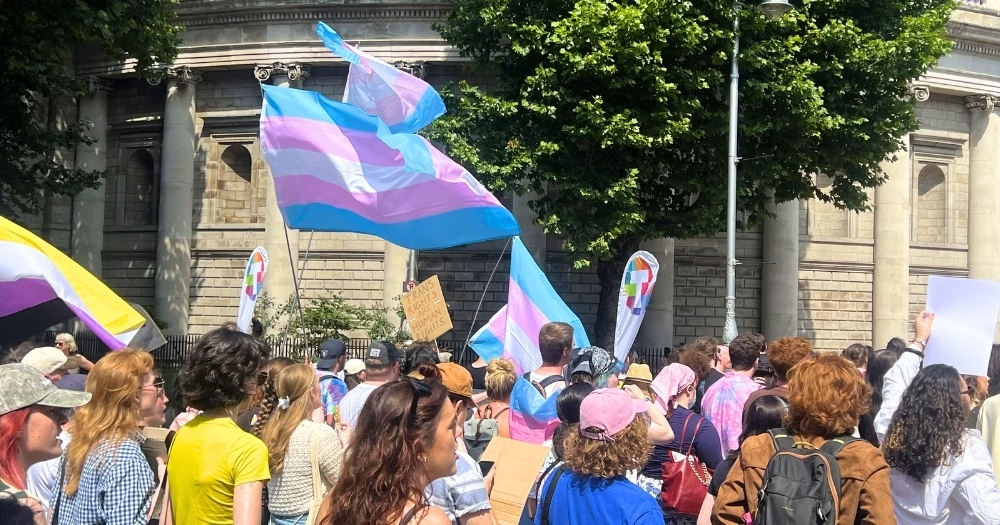
The Professional Association for Trans Health Ireland (PATHI) and Trans Healthcare Action (THA) have resigned from the working group to develop a new model of gender healthcare in Ireland, citing concerns about the lack of involvement of the trans community, failure to include international best practice and accountability. Some LGBTQ+ organisations, such as TENI, LGBT Ireland and Belong To, are still part of the working group, having stated that they will “continue working towards this shared vision from within this structure.”
The state of trans healthcare in Ireland is currently under intense scrutiny due to the decade-long waiting lists and barriers to accessing care. For years, activists have been calling for a reform of the current system, advocating for a model based on informed consent and bodily autonomy for trans and gender diverse people.
A number of Irish LGBTQ+ organisations have been involved in the development of a new model of care, as part of a working group formed by the Department of Health. Two of those organisations have recently announced they are resigning from the working group, stating that the draft model does not align with the values of their organisations.
In an open letter directed to the chair of the working group and gender healthcare clinical lead, Dr Karl Neff, PATHI stated that the decision to resign from the working group was taken with “great disappointment”.
“We cannot in good faith continue to participate as we do not feel the draft Model of Care thus developed aligns with the values of PATHI or what we envision as the future of gender healthcare in Ireland,” the letter reads.
PATHI highlighted how the draft Model of Care that was circulated to members of the working group failed to incorporate the experiences of directly-impacted trans people, thus leaving out “important voices” that should have informed the development of new gender healthcare services.
Moreover, PATHI stressed that the current draft model “makes few references to international evidence-based standards” while making more extensive reference to the Cass Review, a document that has been “widely criticised by international medical bodies, academic voices, and LGBTQ advocacy groups.”
PATHI also expressed concerns about the fact that “there is reference to evidence in the draft, of which sources have not been made available to members of the working group in advance of this draft being developed.
“Overall, given lack of incorporation of international standards beyond the heavily disputed Cass Review, lack of transparency of sources of evidence, and lack of incorporation of community feedback suggest a disingenuous tokenistic approach to both of the key pillars named at the outset – the evidence base and the experience base.”
The association also highlighted how “the largest failure of the development process is a fundamental misunderstanding of the meaning of depathologisation.”
In addition to multiple failures in the development process of the model of gender healthcare, the trans organisation also expressed concerns over what is included in the draft, including the “overly complicated” structure of the proposed clinical pathways that could lead to “significant delays to care and waiting lists that may potentially cause harm”.
“The number of appointments involved and the extent of assessment amounts to not only an unacceptable level of gatekeeping but also a strictly unnecessary and pedantic approach,” the group stated. “It also does not appear to encourage clinicians to continue treatment protocols commenced elsewhere, which may further restrict care and cause delays.”
Finally, the group stated that the draft model of care fails to take accountability for the broken trust of the trans community. “Given the degree to which trust has been broken with the trans community by the current model, PATHI strongly believes a collaborative governance approach is needed if there is to be a positive relationship between the HSE and trans communities across Ireland,” they stated.
PATHI reiterated their commitment to advocate for full access to appropriate care for all trans and gender diverse people in Ireland. “By appropriate healthcare, we mean care that is free, safe, timely, person-centred, accessible in community and primary care settings, based on informed consent, and self-determined — following the needs of the community and international best practice.
“We would welcome the opportunity to work with the HSE, the Department of Health, community and professional groups, and most importantly, the prospective service users, to develop a model of care grounded in these principles. This working group has not provided that opportunity,” the letter concluded. Read the full letter here.
Similarly, Trans Healthcare Action (THA) announced their resignation from the working group with a statement published online. The group wrote that they did not believe that “the development of the model has followed its stated values of experience and clinical evidence, respect, inclusiveness or compassion.”
View this post on Instagram
“We cannot continue to support a project that is incompatible with our values, our vision, and our principles,” the statement further reads. “While this project has not worked out, we remain open to co-operation on future initiatives which would allow us to meaningfully collaborate on improvements to Ireland’s gender-affirming healthcare provision.
“Trans people should be able to access care locally, in primary care settings, from clinicians who respect and support us to make our own decisions,” they wrote. Read the full statement here.
A grassroots trans-led organisation, Trans Healthcare Action has recently partnered with Sexual Health Centre Cork to develop Kindred Clinic Cork, Ireland’s first peer-led gender healthcare service pilot.
The clinic highlights the potential of care grounded in the local community, developing a model that could be scaled and replicated across the island. The peer-led project is based on the principles of self-determination and bodily autonomy.
TENI, LGBT Ireland and Belong To are three of the LGBTQ+ organisations that are still part of the working group to develop the new model of gender healthcare. In a statement released today, they shared: “In recent weeks, THA and PATHI have made the decision to step away from this group. We completely support and respect their decision. Their departure reflects a deep commitment to their principles, and we stand in full solidarity with them.
“TENI, LGBT Ireland, and Belong To have chosen to remain on the working group at this time. We are staying to continue working towards this shared vision from within this structure,” the statement further reads. “We know this process is ongoing and far from perfect. For now, we will continue to engage directly to build a model of care that respects trans people and acts in the best interests of the community.
“While our approach to this specific working group looks different right now, our shared goal remains the same. We will continue to work as one movement to build a compassionate healthcare system that meets the needs of trans people in Ireland,” the statement concluded.
TENI Executive Director Daire Dempsey also said, “As a trans person attempting to navigate the healthcare system, I know first-hand how it functions. Like so many of us, I waited years on the waiting list and sat through irrelevant, pathologising and invasive questioning in assessments, just to get the healthcare I needed.
“We need to fix this crisis for everyone on a waiting list, everyone being mistreated within gender services, everyone paying for private services, everyone DIYing, everyone without access to any healthcare at all – for all of us.
“As the national trans organisation, we are committed to fighting for gender-affirming care that is depathologised, patient-centred, and accessible to all. We joined this process to get the best possible outcome for our community, to advocate and negotiate and push for change, and we stay committed to that goal,” Dempsey stated.
“By working with us to develop high-quality services for our communities, the HSE and the Department of Health have a real opportunity here to make Ireland a frontrunner in international best practice, human rights and equality.”
© 2026 GCN (Gay Community News). All rights reserved.
Support GCN
GCN is a free, vital resource for Ireland’s LGBTQ+ community since 1988.
GCN is a trading name of National LGBT Federation CLG, a registered charity - Charity Number: 20034580.
GCN relies on the generous support of the community and allies to sustain the crucial work that we do. Producing GCN is costly, and, in an industry which has been hugely impacted by rising costs, we need your support to help sustain and grow this vital resource.
Supporting GCN for as little as €1.99 per month will help us continue our work as Ireland’s free, independent LGBTQ+ media.