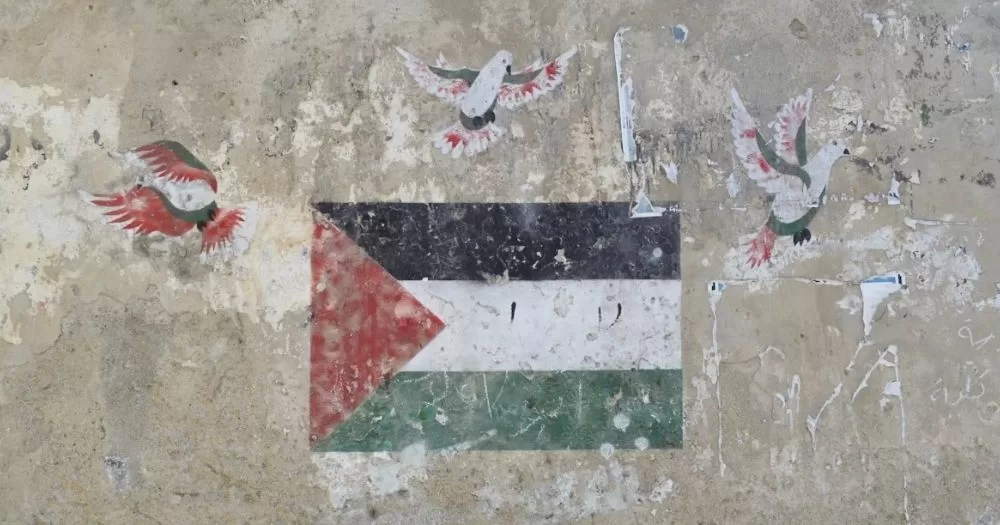
Since Israel launched its genocidal assault on Gaza in October 2023, over 70,000 Palestinians have been killed, with many more being injured and now suffering starvation. As the devastation unfolded, one of the main strategies employed by Israel to justify its actions was pinkwashing, namely positioning the nation as a protector of LGBTQ+ rights against a supposedly backward and “uncivilised” Palestinian society, where same-sex activity is still illegal. However, this narrative completely erases the queer history of Palestine and the impact of colonialism that, like in many other parts of the world, has left a legacy of institutionalised homophobia.
If we skip back in time all the way to the Bronze Age, we come across the first instances of queerness in the history of ancient Palestine and the Levant. Back in those days, queerness was not only already present, but it was also divine. It took the form of Melqart, the storm god of the sea, and his beloved Eshmun, a mortal healer. The myth tells the story of how Eshmun became immortal after he died and was brought back to life through Melqart’s grief.
The pair were revered from the Phoenician coasts to the valleys of ancient Palestine, with people honouring them with festivals of music and offerings. Priests and participants would drape themselves in fine clothes and reenact the lovers’ reunion.
Among their followers were the galli, priests who worshipped the Asiatic deity Cybele (or Agdistis), known as the Great Mother of the Gods. The galli are known as one of the first examples of genderqueer identities in history, as they were described in ancient texts as eunuchs attired in female garments who sometimes underwent “self-emasculatation”.
The land where Palestinian people now live experienced millennia of transformation. Among the biggest of these changes was the rise of Western colonialism, as well as growing Islamic dominance. Homosexuality became proscribed in Palestine in 1936 under the British Mandate Criminal Code. This means that the experience of institutionalised homophobia that queer Palestinians face today is directly linked to the legal frameworks inherited from British occupation.
The narratives employed by Israel in its attempts to mask genocide as a supposed fight for queer liberation completely ignore this historical context, as well as the fact that some people in Palestine are queer and have been among those who’ve been killed, injured and displaced by Israel. Moreover, queer visibility cannot be discussed without considering the broader context where freedom of speech and expression are continuously limited by occupation, apartheid, and now genocide and starvation.
© 2025 GCN (Gay Community News). All rights reserved.
Support GCN
GCN is a free, vital resource for Ireland’s LGBTQ+ community since 1988.
GCN is a trading name of National LGBT Federation CLG, a registered charity - Charity Number: 20034580.
GCN relies on the generous support of the community and allies to sustain the crucial work that we do. Producing GCN is costly, and, in an industry which has been hugely impacted by rising costs, we need your support to help sustain and grow this vital resource.
Supporting GCN for as little as €1.99 per month will help us continue our work as Ireland’s free, independent LGBTQ+ media.