It’s important to ensure that everyone is represented in literature, especially the young people in our lives. Whether children feel different because of their LGBTQ+ identity, disability, race or otherwise, having characters like them in the books they read can be hugely impactful.
With that in mind, here are some great titles for kids that can help them feel seen. From physical disabilities to those who experience the world through a neurodivergent lens, there is something here for everyone.
Hopefully, this list of books with disability representation helps you find a new read for the children in your life. Let’s jump in!
A Day with No Words by Tiffany Hammond
View this post on Instagram.
In this picture book, readers are brought into the life of Aidan, a young boy with non-verbal autism. As the story progresses, readers are shown how the family communicates with each other using methods outside of the spoken word. Aidan uses a tablet, tapping picture buttons to convey what he means.
Inspired by the author’s own experiences, A Day with No Words shows us the unique ways people communicate in an attempt to break down the stigma surrounding those who don’t use words.
Review: “A lovely slice-of-life story… [that transports] readers into [Aidan’s] perspective, employing various color tones, metaphoric images, and ‘camera’ angles to reflect the deep expressiveness contained in every page… Autistic families will feel seen – and heard” – Booklist.
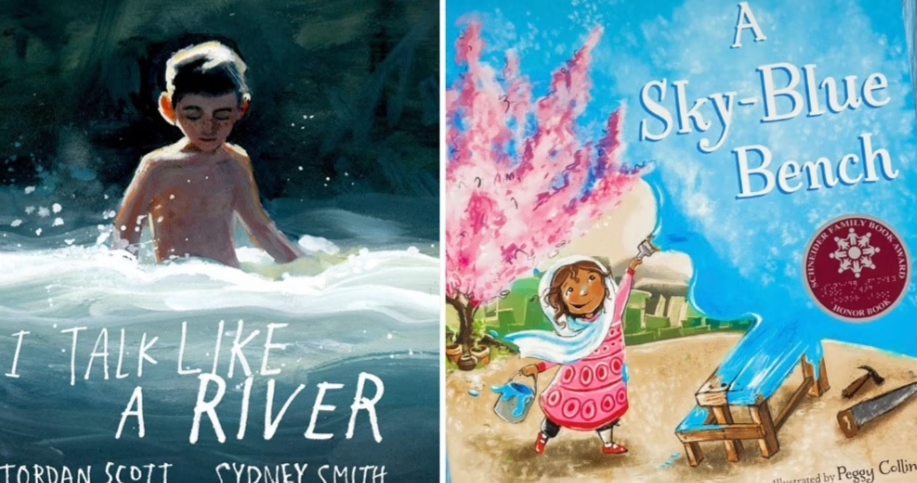
I Talk Like a River by Jordan Scott
View this post on Instagram.
Next on our list of children’s books with disability representation is “A book for any child who feels lost, lonely, or unable to fit in.”
This book follows a young boy who is struggling with his stutter. He shows the audience how he is feeling isolated, alone, and incapable of communicating in the way he’d like. His father, seeing his struggles, took him for a walk by the river, helping him find his voice along the way.
This story will resonate with compassionate parents everywhere, recognising a father’s ability to reconnect a child with the world around them.
Reviews: “A brilliant way of thinking about a stutter.” – Ed Sheeran; “This wrenching and beautiful book will give succor to children who stutter and expand the hearts of those lucky enough to take fluency for granted.” – The Wall Street Journal.
Mama Car by Lucy Catchpole
View this post on Instagram.
Told from the point of view of a young child, this story gives a beautiful insight into how children with disabled parents view the world: “The Mama Car has big wheels and a soft cushion. It can take you outside and anywhere and right back home again.”
This sweet story provides us with an understanding of the everyday adventures and the comfort of a loving family with disabled parents. It provides some much-needed representation for these parents as well.
Review: “Themes of love and caring for each other shine through this cosy and empathic text. A great story to use to talk with young children about ability differences in families… This loving and enjoyable picture book is a strong choice for preschool collections.” – School Library Journal.
Can Bears Ski? by Raymond Antrobus
View this post on Instagram.
Can Bears Ski? is a heart-warming children’s book about a little bear, Boy Bear, and his dad, Dad Bear. Together, they go on a journey to find out if Boy Bear needs hearing aids.
Boy Bear feels the rumble of his dad’s voice and the shuffling of the curtains. On the way to school, Dad Bear informs him that he has just ignored his friend and then asks him if ‘Bears can ski?’ Is that what Dad Bear said, or is Boy Bear having hearing difficulties? Join Boy Bear and Dad Bear on their journey to find out if bears can ski.
Review: “I would highly recommend the book for the whole family, especially for anyone supporting their child the same way as Dad Bear. We absolutely adore this book, and it has fast become a bedtime favourite in our house.” – Sia.
Sam’s Super Seat by Keah Brown
View this post on Instagram.
A joyful picture story book about a young girl with cerebral palsy going back-to-school shopping with her friends. The story celebrates the beauty of self-love, the power of rest, and the necessity of adequate seating in public spaces.
Sam loves herself, learning, and making her friends and family laugh. She also loves a comfortable seat and naming them. After a morning of trying on new outfits and imagining what the school year might bring, Sam gets tired. The new seat she meets isn’t so nice and has her thinking that maybe this wasn’t the best idea after all.
Review: “Sam and her super seats charmed me, and I liked the fun fashion through line of this back-to-school/love-yourself picture book. I’ve never seen school shopping portrayed in quite such a positive, affirming, jubilant way. Plus, it models both meeting your own and your friends’ needs with patience, joy, and personality.” – Danielle Davis, author of To Make and Zinnia and the Bees
A Sky-Blue Bench by Bahram Rahman
View this post on Instagram.
In war-torn Afghanistan, it’s schoolgirl Aria’s first day back after her accident. Even though she is excited, that is dampened by the worry surrounding sitting on the floor all day with her new prosthetic “helper leg”.
Just as she fears, she is so uncomfortable that she can’t focus on the classes. Deciding that she can do something about this, Aria seeks out the carpenter in the old city, collects the materials, and learns to build her own bench.
Bahram Rahman uses this book not only to offer disability representation but to show the resilience and determination of young children – especially young girls – who face barriers in education. In the author’s note, he also introduces an age-appropriate discussion of land mines and the impact they have on children in those nations.
Review: “This book just clutched at my heart and I felt invested in Aria’s story and so warmed by the resolution.” – Shifa Safadi.
A Walk in the Words by Hudson Talbott
View this post on Instagram.
In this book, the author, Hudson Talbott, explores the struggles he faced in his childhood as a slow reader. By using the words he knew as stepping stones, he was able to let the stories draw him in.
Through the realisation that everyone goes at their own pace, he learns that he’s not alone; lots of brilliant people were slow readers, too. With this story, the author takes us on a journey of self-acceptance.
Review: “This story is going to be a lifeline for so many readers! The power of seeing yourself in this particular story is going to keep readers on their reading journey.” – Michele Kent.
The Same but Different by Molly Potter
View this post on Instagram.
Using everyday examples, clear explanations, and colourful illustrations, Molly Potter explores how we’re all unique. As well as exploring the similarities we share, this book encourages children to broaden their perspectives and rejoice in their differences.
The last section of this book explores things that are absolutely true and how we all deserve the same rights.
Review: “Featuring an ensemble cast of visibly diverse children, this colourful book explores ideas of difference and shared experiences, reflecting on how everyone is different but can find common ground and common feeling. A good starting point for conversations about inclusion.” – The Bookseller.
Wonderfully Wired Brains by Louise Gooding
View this post on Instagram.
Louise Gooding, through her writing, provides us with a friendly, positive introduction to neurodiversity, explaining how different brains work, think, and process the world around them.
She goes on to explain that these unique abilities should be celebrated, not shied away from. In her writing, she also comprehensively explains various diagnoses – including ADHD, Autism and Dyslexia. Focusing on the strength of these diagnoses, she debunks common misconceptions and stereotypes.
She has also made the book neuro-inclusive. Through careful selection of fonts and colours, she has chosen a combination of the two to accommodate a wide range of neurodiverse readers.
Review: “This vibrant book is written by neurodivergent author and neurodiversity champion Louise Gooding. It is an excellent tool to help children understand both themselves and their peers. The language is clear and positive, complemented by colourful illustrations to show how no two brains are the same and that all brains should be celebrated.
“It’s full of facts and figures as well as brief biographies of some well-known neurodiverse personalities. It covers all different aspects of neurodiversity, from dyslexia to ADHD. There are some self-help pages on brain care and next steps, as well as a very useful glossary to help decode some of the complex vocabulary. As ever with DK, it is a great book which is incredibly helpful for both home and school.” – Tash Hyde, Read for Good.
Barbara Throws a Wobbler by Nadia Shiree
View this post on Instagram.
Barbara Throws a Wobbler is a highly engaging and educational book. It is ideal for preschoolers, as it is a useful tool for explaining feelings and emotions in a fun, creative way. The book validates their feelings by showing that even a little cat can become overwhelmed by a series of small annoyances.
Readers have made note of how they appreciate the way the book helps children name their emotions. One customer mentioned its effectiveness in calming episodes of dysregulation.
Review: “I bought this for my three-year-old grandson, and every time he feels upset about something, he asks for [the book] so he can look at the final page and point to what [emotion] he is feeling.” – Catherine.
The Perfect Fit by Naomi Jones
View this post on Instagram.
This book is about fun, friendship, and finding your place. It is great for children who are learning about shapes, colours and friendship.
Reviews: “This joyful and appealing story is an entertaining and imaginative exploration of shapes as well as a warm-hearted affirmation of the many human rewards of individuality, inclusion, and friendship.” – Pam Norfolk, Lancashire Post.
“This is the ideal introduction to shapes, disguised as a touching story about belonging and cooperation. A simple concept, but very nicely done.” – Sally Morris, The Daily Mail.
That concludes our list of some amazing children’s books with disability representation. Happy reading!
© 2026 GCN (Gay Community News). All rights reserved.
Support GCN
GCN is a free, vital resource for Ireland’s LGBTQ+ community since 1988.
GCN is a trading name of National LGBT Federation CLG, a registered charity - Charity Number: 20034580.
GCN relies on the generous support of the community and allies to sustain the crucial work that we do. Producing GCN is costly, and, in an industry which has been hugely impacted by rising costs, we need your support to help sustain and grow this vital resource.
Supporting GCN for as little as €1.99 per month will help us continue our work as Ireland’s free, independent LGBTQ+ media.