This article is part of GCN’s new Amach le Bród (Out with Pride) series, to combat anti-LGBTQ+ misinformation and platform underrepresented voices. The project was funded by the Coimisiún na Meán News Reporting Scheme.
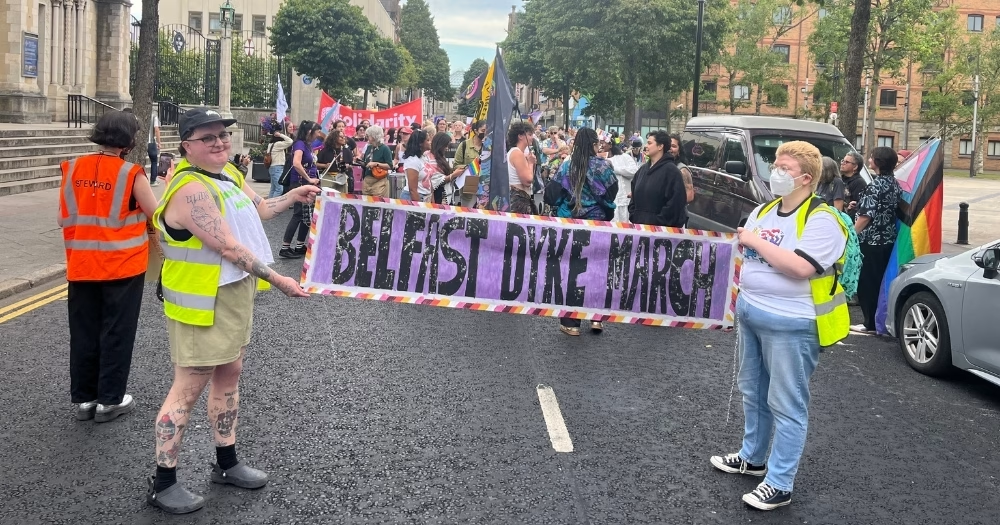
The first-ever Belfast Dyke March took place on Friday, July 24. The historic event was organised by a small team of volunteers, with a strong focus on the power of grassroots, radical, community activism.
A large crowd gathered in Writers Square at 6:45pm for pre-march speeches, the first coming from a representative from QPOC Belfast. She acknowledged the historic occasion, sharing, “Today we’re marching together, and tomorrow the real work begins”.
The rep went on to outline the importance of ensuring people of colour are included in queer spaces. “May Belfast’s first Dyke March be remembered not simply because we walked these streets together. May it be remembered because this is the day that we made a promise to one another that our liberation will be anti-racist, that our liberation will be trans inclusive, that it will be intersectional, that it will be accessible, and that it will be international. That none of us will be left behind,” she said.
View this post on Instagram
The following speaker was a representative of Red Umbrella Éireann. She criticised the Nordic Model approach to sex work, saying, “The only way to work within the law is to work alone with no support, with no outside help, and this is obviously unsafe. Sex workers are left to choose between working legally or working safely, and this is a choice nobody should have to make.”
She called for decriminalisation, as well as the introduction of a legal model that “puts sex worker safety first and foremost”.
Similarly, another speaker, who has been a sex worker on and off for over a decade, pushed for increased visibility and representation.
“Despite us playing a massive part on the front lines of the queer liberation movement, year after year, there is little to no mention of our involvement during Pride, especially on this island and especially in Belfast,” she shared. “We often hide in the shadows for fear of violence and rejection, but we are many, and I promise that whether you know it or not, someone you love is or has been a sex worker.”
After the speeches, the crowd moved to the street and prepared for Belfast’s first Dyke March to commence. It travelled from Writer’s Square, down Donegall Place and to the endpoint at City Hall, with participants chanting, “Say it loud, say it clear, all dykes are welcome here”, “Whose streets? Our streets”, “Free, free, Palestine”, “PSNI, get your ass out of Pride”, “Our body, our choice” and more.
They also carried banners reading, “Pride is a protest”, “Love is a terrible thing to hate”, “Lesbians make history”, “Resist rainbow capitalism” among many other powerful slogans.
View this post on Instagram
There were more speeches at the endpoint outside City Hall, including from Trans & Intersex Pride Dublin, Reclaim the Agenda and Dublin Dyke March. They covered topics spanning trans inclusion, gender-based violence, misogyny, and lesbian and dyke history.
The final speech came from Belfast Dyke March organiser Ruairí, who thanked “every volunteer, every speaker, every friend, parent and lover of dykes who came out and joined us on the streets for Belfast’s first Dyke March.”
He continued: “We at the Belfast Dyke March believe, as many of the speakers reiterated here today, that Pride is rooted in collective action, and we must ask ourselves, just as Sylvia Rivera had done in 1973: What are you doing for gay liberation?
“What are you doing for your disabled members of the community? How are you showing up for your immunocompromised friends? If you’re white, what are you doing for your friends of colour? Have you checked in on your trans community? If you have money to spare, how are you using it? Do you have a skill that you can offer if money is something that you cannot give?”
Ruairí added, “Before I leave you here today, I encourage you to be loud, to be angry, and to get involved and organise… I can’t emphasise enough how important it is for us to stick together.”
He concluded, “Remember, trans healthcare is a dyke issue, housing rights are a dyke issue, disabled care is a dyke issue, the ongoing genocide of Palestine and the femicide in the North are all dyke issues. Let’s stay f*cking united.”
While the march ended there, those who wanted to keep the momentum going could attend a Dyke Picnic the following day in Belfast’s Botanic Gardens. People gathered from 2pm to 5pm on Saturday, July 25, for treats and games, including a tug of war and sack race. What’s more, it was BYOB – Bring Your Own Bouquet!
The picnic bookended a powerful weekend of dyke activism in Belfast, and laid the foundation for many more similar events to come. To stay up to date with Belfast Dyke March, check out their Instagram here.
View this post on Instagram
© 2026 GCN (Gay Community News). All rights reserved.
Support GCN
GCN is a free, vital resource for Ireland’s LGBTQ+ community since 1988.
GCN is a trading name of National LGBT Federation CLG, a registered charity - Charity Number: 20034580.
GCN relies on the generous support of the community and allies to sustain the crucial work that we do. Producing GCN is costly, and, in an industry which has been hugely impacted by rising costs, we need your support to help sustain and grow this vital resource.
Supporting GCN for as little as €1.99 per month will help us continue our work as Ireland’s free, independent LGBTQ+ media.