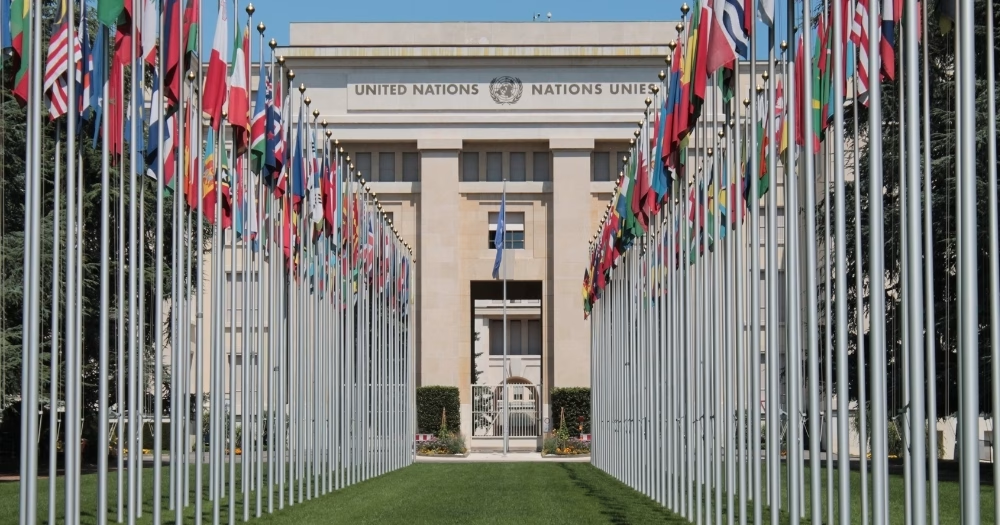
Civil society organisations have highlighted Ireland’s shortcomings in human rights and equality at a meeting with other UN member states. Groups including the Irish Human Rights and Equality Commission (IHREC), Free Legal Advice Centres (FLAC), Irish Council for Civil Liberties (ICCL) and National Women’s Council (NWC) attended the pre-session in Geneva on the morning of Tuesday, August 25.
IHREC told the UN that Ireland must urgently close the gap between its human rights commitments and the lived experience of people across the country. The group’s Chief Commissioner Liam Herrick expressed concerns across housing and socio-economic rights, violence against women and institutional abuse, disability rights, asylum and migration, and climate and environmental justice.
FLAC and ICCL’s joint statement to UN members noted Ireland’s lack of progress in longstanding human rights issues, including the failure of the State to update and improve civil legal aid and anti-discrimination laws. The organisations also expressed concern about potential backsliding on human rights and access to justice in areas like judicial review, where draft legislation runs the risk of blocking disadvantaged groups from asserting their rights in court.
Elsewhere, the NWC highlighted the lack of affordable and accessible childcare as a major barrier to women’s equality. The Council also drew attention to the gender pension gap of 35%; the high levels of poverty for some groups of women like lone parents, Traveller and Roma women, and disabled women; and the low rate of pay for Maternity and other types of Family Leave.
The civil society organisations’ meeting in Geneva comes ahead of Ireland’s UN Universal Periodic Review (UPR) in November. The process, in which the country’s human rights record is examined, occurs every four years.
Liam Herrick of IHREC stated, “We have strong legislation and good policy on paper. But too often, the gap is in implementation and enforcement. Ireland is a wealthy country. That means we have the resources to do better. That wealth should translate into strong human rights outcomes. And when it doesn’t, we need to ask why.”
He added, “It is important not to be complacent, even in countries seen as strong human rights performers. Because increasingly, we are seeing how many of these hard-won rights can be rescinded and denied.”
FLAC’s Policy & Public Affairs Manager Christopher Bowes expressed, “In the five years since the last review of Ireland, the human rights and equality agenda in Ireland has stalled if not regressed.”
Bowes said that FLAC is urging UN member states to “use the UPR process to challenge Ireland to make real progress on human rights and to address longstanding issues which gravely impact the lives and rights of disadvantaged groups.”
Similarly, ICCL Executive Director Joe O’Brien shared, “Ireland is not immune to the global trend of backsliding on human rights and democratic freedoms. The UPR process is a valuable opportunity to look at Ireland’s human rights record in the round, identify shortcomings and push the State to better fulfil the rights of everyone in Ireland.”
O’Brien continued, saying there have been “worrying developments recently” and that Ireland “needs to course-correct and recommit to robustly protecting everyone’s rights and freedoms”.
NWC’s Senior Policy Coordinator Alex Richardson expressed, “We are hopeful that some of the more progressive countries, who consider themselves champions of women’s equality, will pick up on the fact that there is no public childcare, and even places where there is no local childcare at all, in Ireland. The impact this can have on a woman’s life is significant, and many of our partners in the EU would be quite surprised at this lack of infrastructure.”
She added, “In addition to our call for a public childcare system we are calling for concrete action on the gender pay gap and gender pension gap, to increase the rate of pay for Family Leave, and to fully individualise the social protection system so that women are not treated as dependents on their partners.”
Ireland’s United Nations Universal Periodic Review will take place in Geneva on November 10, 2026.
© 2026 GCN (Gay Community News). All rights reserved.
Support GCN
GCN is a free, vital resource for Ireland’s LGBTQ+ community since 1988.
GCN is a trading name of National LGBT Federation CLG, a registered charity - Charity Number: 20034580.
GCN relies on the generous support of the community and allies to sustain the crucial work that we do. Producing GCN is costly, and, in an industry which has been hugely impacted by rising costs, we need your support to help sustain and grow this vital resource.
Supporting GCN for as little as €1.99 per month will help us continue our work as Ireland’s free, independent LGBTQ+ media.