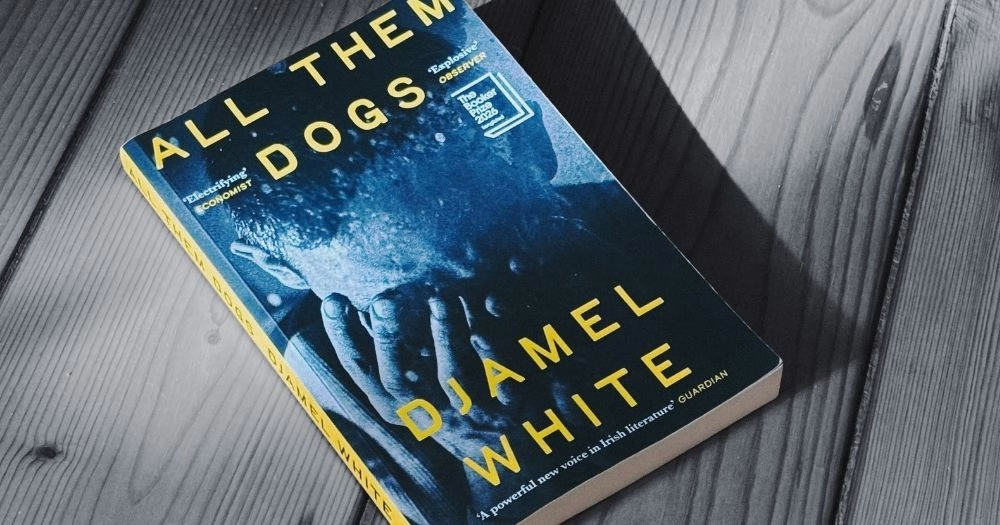
GCN spoke with Djamel White about All Them Dogs, his acclaimed debut novel, which has received widespread praise in Ireland and beyond, including being longlisted for the Booker Prize earlier this year.
Set in Dublin, All Them Dogs centres on Tony, who returns home after several years in the UK and is quickly pulled back into the world he once left behind. There, he meets Darren, also known as Flute, who becomes a kind of mentor. As the two men navigate an increasingly dangerous situation, their relationship begins to move beyond the roles they expected to play.
Being longlisted for the Booker Prize is one of the biggest recognitions a novelist can receive, and White admitted the attention it brought took him by surprise.
“What I’ve been saying about the Booker nomination is that it came six months after the book had been published,” he told GCN. “It made me feel very proud and lucky to be Irish, because I think the reception I got, and the volume of attention it received, came down to this hometown effect of being the only Irish person on the longlist.”
That attention soon sparked renewed interest in the book. White said All Them Dogs sold out within a week, with even the publishers seemingly caught off guard by the sudden demand.
“It made a real material difference to how the novel was doing, and it’s brightened my prospects for follow-ups, so it’s been really gratifying.”
Part of what makes the book immediately recognisable is its distinctly Dublin voice. The dialogue is written in a local vernacular, something White knew could potentially narrow its audience rather than expand it.
“When you make a decision to write in a certain way of speaking, you do expect it to have a niche audience or a niche target readership,” he explained.
That made readers’ responses from outside Ireland particularly interesting to him.
“It’s curious to see what other people get out of it and what they might miss or, in the best instances, what they don’t miss, when they manage to get the full experience out of it as an outsider. That feels really good.”
Tony’s voice was also the starting point for the entire novel. White originally wrote him in a short story before the character became the centre of All Them Dogs.
“It was always Tony, and his voice was pretty consistent from the get-go,” he said. “That was the first thing I had. I was writing this monologue in his voice, and that carried me through the initial few pages of the short story that eventually became the novel.”
Much of Tony’s behaviour throughout the novel is shaped by the men around him and, perhaps, those who have failed him. His father is absent, while his older brother offers little guidance or affection.
For White, it is less about Tony’s direct relationship with his father and more about “who has filled that void that was left there.”
Tony repeatedly seeks approval from other men, even when that approval leads him into dangerous situations.
“He’s constantly chasing that feeling of being accepted and feeling like he belongs in the company of other males,” White said.
When asked whether Tony is ultimately searching for a reliable male figure, White put it more simply: “It’s somebody who makes him feel like he’s worth a shit, because his brother hasn’t and his father definitely hasn’t.”
Tony feels safest with Flute (Darren), and that closeness begins to create another kind of tension.
“I thought about it, but I was going to see where it went and see if it worked. I wasn’t going to force it,” White said.
The tenderness between the two characters is deliberately restrained. White said it was difficult to allow softer moments without making them feel inconsistent with the voices and personalities he had already established.
“You’re constantly trying not to have any moment of tenderness feel out of left field, unnatural, sudden or random,” he explained. “You don’t want their voices to betray the voices that you’ve already established. You want it to be true.”
When Tony and Flute are back around other men, their walls rise again. White believes much of that performance is conscious, though Tony has internalised it so much that he continues even when nobody is watching. When asked how much of their masculinity is performative, he replied, “Probably all of it.”
He points to another character, Fanny, as one of the few around whom both men can relax.
“She’s the one person that they don’t have to perform to,” he said.
When Fanny is gone, however, Tony and Flute begin performing for each other again. Tony even behaves as he imagines the men he admires would expect.
“He actually does the worst things that he does in this novel when he’s on his own,” White explained, “and he’s acting in accordance with how he thinks whoever his mentor figure at the time would want him to.”
The title All Them Dogs was also something that developed gradually. The novel was originally called Blue Opal, the car Tony drives, and a place where Tony and Darren can, at times, let their walls down. But White and his agent eventually decided it did not quite work.
For White, the sound of a title is as important as its meaning.
“It’s an audible thing because it’s the title that travels through word of mouth, so getting that right is essential.”
All Them Dogs appeared almost incidentally in an email before his agent suggested returning to it.
When asked about media influences, White cited filmmaker Guy Ritchie and crime writer Elmore Leonard as points of inspiration for the novel. White wanted the book to have the intensity of a thriller without sacrificing its emotional depth.
“I wanted to maintain a kind of literary sensibility using these really propulsive genre mechanisms,” he explained. “I wanted it to read like a thriller, but also carry an emotional punch.”
The ending, meanwhile, came more organically. White had considered several possibilities but said the version that appears in the published novel is essentially the first ending he wrote.
Once he arrived there, he knew it worked.
View this post on Instagram
Although certain character stories feel complete for now, White has not entirely ruled out returning to the world of All Them Dogs. Rather than revisiting Tony directly, he is more interested in some of the peripheral characters.
“I’d definitely like to,” he said, “but maybe not in a way that’s satisfying to fans of the book.”
There has also been interest in adapting the novel for television, although White stressed that nothing has been officially confirmed.
“There’s a group of people who are hoping to get it turned into a TV show,” he said. “There are some misleading lines, so fingers crossed.”
If an adaptation of All Them Dogs does happen, White would rather not fan-cast it himself. He likes the idea of the project developing into somebody else’s interpretation of the characters, and would especially welcome the possibility of unknown actors being discovered through it.
He pointed to Paul Mescal’s breakout role in Normal People as an example, saying he would prefer that possibility to simply filling the cast with established names.
Before wrapping up, we asked White what he had been reading himself.
He had just finished Larry McMurtry’s sprawling Western Lonesome Dove, a book currently enjoying renewed popularity.
“It’s 900 pages, and it reminded me of how it used to feel to read when I was a child, pure escapism and just getting lost in this huge, sprawling world with all of these beautifully realised characters.”
Despite generally avoiding books simply because they are trending, White said he was glad the novel’s popularity finally persuaded him to pick it up.
“It’s really left an impact on me. I literally finished it today, and there was this huge sigh when I turned the final page because you’ve just gone on such a journey.
“It was the only thing I’d been reading for the last while, so it was really intense. And that’s something kind of really unique to reading.
“It just reminded me why I love books.”
© 2026 GCN (Gay Community News). All rights reserved.
Support GCN
GCN is a free, vital resource for Ireland’s LGBTQ+ community since 1988.
GCN is a trading name of National LGBT Federation CLG, a registered charity - Charity Number: 20034580.
GCN relies on the generous support of the community and allies to sustain the crucial work that we do. Producing GCN is costly, and, in an industry which has been hugely impacted by rising costs, we need your support to help sustain and grow this vital resource.
Supporting GCN for as little as €1.99 per month will help us continue our work as Ireland’s free, independent LGBTQ+ media.