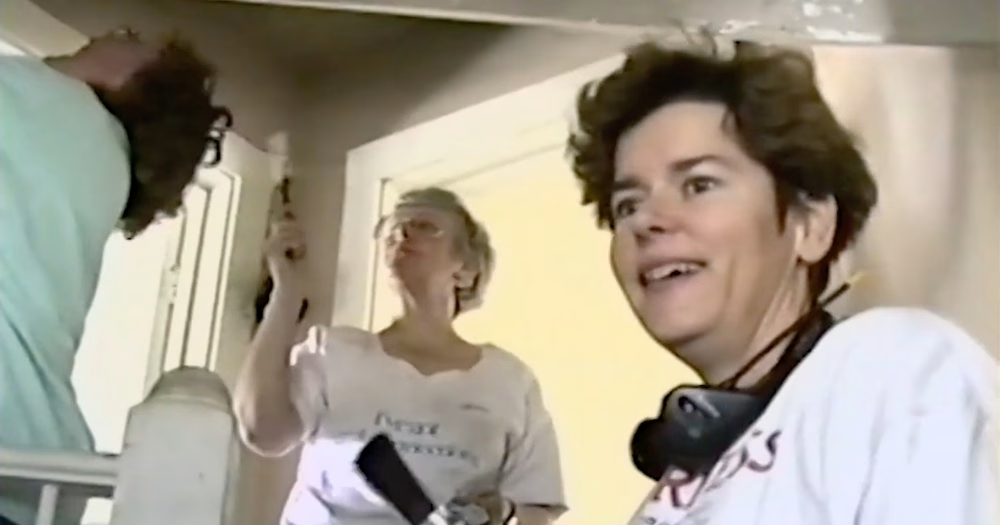
1990s Missouri is not the first place one thinks of when it comes to lesbian urban communities. At that time, discrimination, abuse or ostracism for being out was certainly rife. Furthermore, discriminatory financial policies made it difficult, sometimes impossible, for women to apply for a loan or mortgage without a male signature. Despite this, Womontown, a lesbian community which lasted as an organised endeavour from 1990 to 1995, created a space where they could live safely and openly.
When Andrea Nedelsky and Mary Ann Hooper moved to Longfellow in Kansas City in the late ’80s, the area was suffering from rampant antisocial behaviour. The pair described being heckled and hearing gunshots near their home.
Economic constraints limited their housing options, and one evening, they wondered, “What if we could just walk hand in hand, freely, down the street, a bunch of lesbians all in this neighbourhood,” prompting their vision of an intentional women’s urban community.
To build Womontown, they needed to bring women in, help them take ownership of the community whilst changing the culture and atmosphere of the area to one that was accepting and open.
They put advertisements in the Lesbian Connection magazine to spread the word about this project. They corresponded with women to convince them to move to the area, letting them stay with them while they visited. Women relocated from other parts of the city and even from other states across the country.
They encouraged women to buy rather than rent. This was, on the one hand, because of the economic benefits, as the housing was affordable and buying provided security from rent increases. On the other hand, it meant lesbian women had the freedom to have their partner over without worrying about their landlord or needing to ask permission.
When direct ownership of housing was not an option, they became involved in the management of apartment buildings. They persistently contacted landlords, built relationships, and showed them that lesbians were good tenants. Sometimes they managed apartment buildings for free. This enabled them to screen potential renters and prevent bad tenants from moving in.
Aside from taking ownership, changing the atmosphere and creating a collaborative and safe environment was crucial to the plan. The women helped new arrivals to Womontown with unloading moving trucks and remodelling their homes. Security was improved by walking their dogs at night, guarding the streets and buying old postal vans that they parked outside empty homes, so it looked like someone was there.
The movement was not without backlash. Some of the straight residents complained as they falsely believed the women would turn their kids gay. Whilst they received support from the LGBTQ+ community and allies, some accused them of being “separatists”. One resident noted opposition was sometimes quite “vicious”.
After 1995, the community ended as an organised effort. It required sustained effort and organisation which resembled a full-time job on top of their careers. Whilst another resident, Barbara Lee, endeavoured to take over the tasks, it remained a large burden which, as the community grew larger, made it difficult to align goals and coordinate achieving them.
Although the project was short-lived, it was successful in establishing a lesbian led community in an area and at a time that discriminated against them. At its height, it consisted of 24 houses, 14 apartment buildings and 80 women. The determination of Womontown’s founders proved that lesbian-led communities are possible and can thrive despite oppressive patriarchal barriers.
Whilst attitudes have become more accepting towards the lesbian community, Womontown shows the importance of carving out our own spaces and making our communities an accepting and safe place to be.
© 2026 GCN (Gay Community News). All rights reserved.
Support GCN
GCN is a free, vital resource for Ireland’s LGBTQ+ community since 1988.
GCN is a trading name of National LGBT Federation CLG, a registered charity - Charity Number: 20034580.
GCN relies on the generous support of the community and allies to sustain the crucial work that we do. Producing GCN is costly, and, in an industry which has been hugely impacted by rising costs, we need your support to help sustain and grow this vital resource.
Supporting GCN for as little as €1.99 per month will help us continue our work as Ireland’s free, independent LGBTQ+ media.