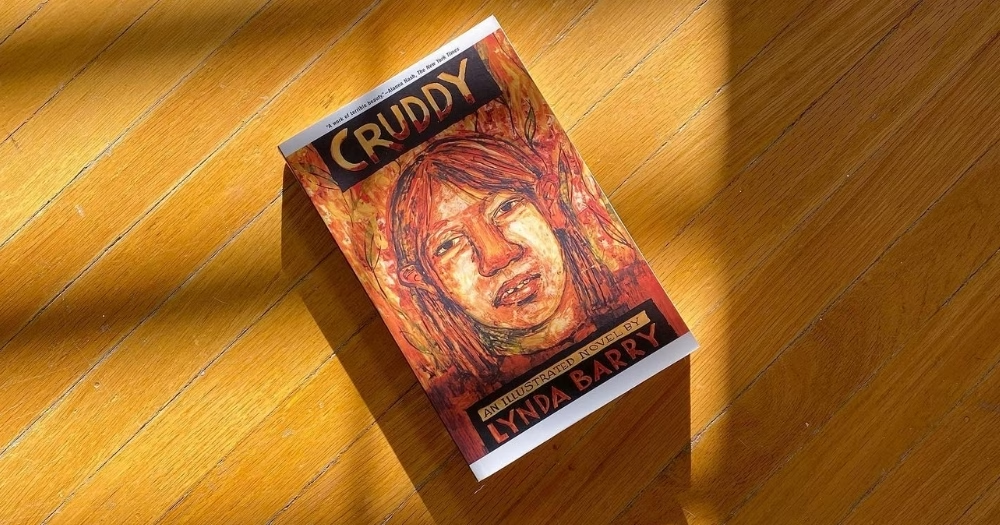
Lynda Barry’s coming-of-rage novel Cruddy is a fucked up fable chock-full of nightmare logic, dreamlike strangeness, absurdist flourishes and, in the author’s own words, “murder galore.”
The 1971-based tale is narrated by a suicidal and acerbic teen misfit: Roberta Robeheson. Identifying as The Author, Roberta recounts her lurid and queasy story of traumatic chaos, endured at the hands of the Father, a serial murderer and drifter. It’s the fifth anniversary of the Lucky Chief Motel Massacre, when years earlier, Roberta and her dog Cookie (the only survivors) were found wandering the desert and caked in blood.
In the present, Roberta makes the decision to tell her first and final story. Cruddy is grimly prefaced by a childish suicide note imploring us not to blame the drugs or frenemy Vicky Talluso. This is before we even begin to get the measure of Roberta’s grimly realised world. The grim tone is offset by Roberta’s oddball attitude, her sardonic descriptions, Barry’s breathtaking zine aesthetic and a protagonist whose matter-of-fact approach to everything will make you scream with laughter and squirm with horror. Her descriptions immerse you in her world, one of abject poverty, the depths of human depravity, her dog Cookie and a boy she has a crush on. A deadpan reference describes the latter as having a face resembling a deer.
Cruddy is a story that speaks for and to outsiders, people who’ve lived on a knife-edge and survived getting cut up like chicken meat, readers who identify with strange childhoods defined by precarity in fiction and find a kind of sanctuary in navigating these bizarre literary landscapes. Roberta’s neighbourhood reads like Southern Gothic reimagined by Todd Solondz, and with Cruddy, the book feels like one of constant accumulation: diary entries, maps, notes, bizarre observations and mutilated corpses.
I often revisit Cruddy. The first time I read the novel, I’d finally met a very strange and very funny new friend. We shared similar life trajectories: we both grew up in single-parent families, both oddballs, annoying sisters, flea-bag strays sprawled on the couch, violent men, othered, and dirt-poor. So, I feel an obligation to reconnect with Roberta every so often.
But it was more than this. Roberta’s compulsion to make lists, watch late-night horror and use humour to avoid a dreadful tug down into darkness were all character traits I could relate to. I admired Roberta and I understood her. Her intelligence, empathy and imagination made her one of the most extraordinary characters I’d encountered. So, yeah, Cruddy (published by Picador in 1999) is a novel I revisit, and it’s a story that’s had a life-defining impact for me as a reader.
I’ve yet to read another novel offering such a demented (and monstrously funny) representation of childhood, of marginalised children slipping through the cracks, face first, right down into an overflowing garbage ravine.
Roberta’s voice is shaped by a childhood logic steeped in blood, her story unfolding in dual timelines with the character shifting genders, moving through ominous spaces and showing the reader an America filtered through her hilariously skewed lens, one populated by grotesque adults, weirdos languishing in criminal nowhere’s, poverty-addled neighborhoods with men on the porch singing, in their underwear, accumulated trash on the curbs, “fish-faced” girls, dogs riddled with mange, Nightmare Theatre and Ouiji-board conversations.
Roberta gives us a tiny glimpse of the fractured and liminal world she reluctantly inhabits: “I stared out the window and watched the land change like it had a mental illness.”
Cruddy was then, and remains now, a cult novel. Barry’s unique form and style may have proved off-putting to mainstream readers and publishers in the late 90s. To me, it was not off-putting; Roberta’s survival tactics of humour and deflection served as a sort of trauma-insulator, tactics readers here will no doubt be acquainted with.
Like Roberta, Cruddy could be read as an accumulation of influences. It invites comparison with work by Scott Heim and Iain Banks, the animated show Daria and Solondz’s dark tale of adolescence, Welcome to the Dollhouse (if crossed with Sam Peckinpah). Most notably with Banks’ barbaric Bildungsroman The Wasp Factory. Barry captures the sheer strangeness of life within the purgatorial cesspool of Roberta’s life – spaces occupied by deviants, freaks, misfits and the frequently psychopathic. Cruddy also invites comparison with The Wasp Factory’s sensibility and emphasis on grotesquery. Writing Cruddy was Barry’s own way of processing the world’s ugliness and capacity for cruelty. However, Barry’s work stands firmly on its own blistered, gnarled feet.
Shared themes are distorted childhoods, violence, and twisted family dynamics. Both Frank and Roberta invent their own internal mythologies to make sense of a grimy, cruel universe. Frank’s Sacrifice Poles are a gruesome form of reclamation, a way to mark territory and gain a degree of control. Roberta’s approach to journaling is predominantly a reinvention of her own past, another way of reclaiming her own narrative before sharing it with the world. The Fathers in both texts are as far from an archetypal nurturing role model as Princess Diana is from Denis Nilsen. Both father figures in the novels go to extremes in shaping both children: Roberta is empathetic and less damaged than Frank, who has a baroque flair for murder and collecting animal parts, personal additions to his mythology.
Barry has never cited any of the books/movies listed as direct influences for Cruddy, yet The Wasp Factory shares a subplot which is undeniably similar to Roberta’s childhood forced masculinity. Banks’ 1980s novel is a litany of grotesque imagery with a central character who is borderline psychopathic. The reveal in the closing pages of Frank’s “grotesque” gender was intentionally designed to shock and appal the reader. This was gender identity examined through a mid-80s lens in a Grand Guignol novel, so of course it was going to be problematic.
Cruddy and Roberta-as-Clyde landed differently. Barry’s portrayal of gender is far more sympathetic. We know Roberta’s father is forcing her into a male identity more closely aligned with Cruddy’s internal logic: a topsy-turvy story of the established turning upside down, of the Father’s evil necessity, the madness of it all. It never felt as dehumanising as a strange boy on a windswept island, with the author implying their gender identity has directly resulted in a kamikaze descent into serial murder and monstrosity.
“Ask a burning question, get a burning answer.” – Roberta
Lynda Barry’s process when writing Cruddy was on par with Roberta’s unorthodox dialogue, friends and bad life choices. Barry’s zine aesthetic in novel form was one of the first of its kind. It was great art masquerading as bad art. Barry, being a comic, could not write Cruddy on a computer. In an interview with Mary Miller, she explained how the book came alive: “I used construction paper and made fifteen or twenty of these little booklets, which worked well except that I could only get a few bits on each page.”
Cruddy is one of the greatest books of the 20th century and its legacy can be seen in successive cinema, comics and literature. Daniel Woodrell’s Winter’s Bone has a similar, crime-fuelled trajectory involving a teenage girl who owes a debt to Cruddy. Alice Sebold delved into supernatural territory with The Lovely Bones, another unconventional voice, with a murdered girl narrating her story from the afterlife. A.M. Holmes dived into the heart of darkness with The End of Alice by exploring a particularly callous teenage girl who happened to be a budding paedophile. But it is Laura Albert (writing as J.T. LeRoy) who conjures, through her fiction, a world that hews close to Barry’s 1971 and Roberta’s world, well-rounded and hellish and yet with characters capable of redemption. These are books of genuinely horrible beauty.
Cruddy is thoroughly unique, a book I wholeheartedly embraced as a latchkey kid in rural Ireland in the late 90s. It disheartens me that it never received wider recognition or isn’t more well known today. Roberta was that rare thing in literature for me: someone I identified with and embraced wholeheartedly.
She may not have identified as queer, but she was definitely an outcast I could root for and she always allowed her freak flag to fly. But who can be sure? Maybe one day the remaining characters in Cruddy are going to come looking for Barry and force her at knifepoint to pen a sequel. “Always expect the unexpected, and whenever possible, BE the unexpected.”
For more book recommendations, check out this link.
© 2026 GCN (Gay Community News). All rights reserved.
Support GCN
GCN is a free, vital resource for Ireland’s LGBTQ+ community since 1988.
GCN is a trading name of National LGBT Federation CLG, a registered charity - Charity Number: 20034580.
GCN relies on the generous support of the community and allies to sustain the crucial work that we do. Producing GCN is costly, and, in an industry which has been hugely impacted by rising costs, we need your support to help sustain and grow this vital resource.
Supporting GCN for as little as €1.99 per month will help us continue our work as Ireland’s free, independent LGBTQ+ media.