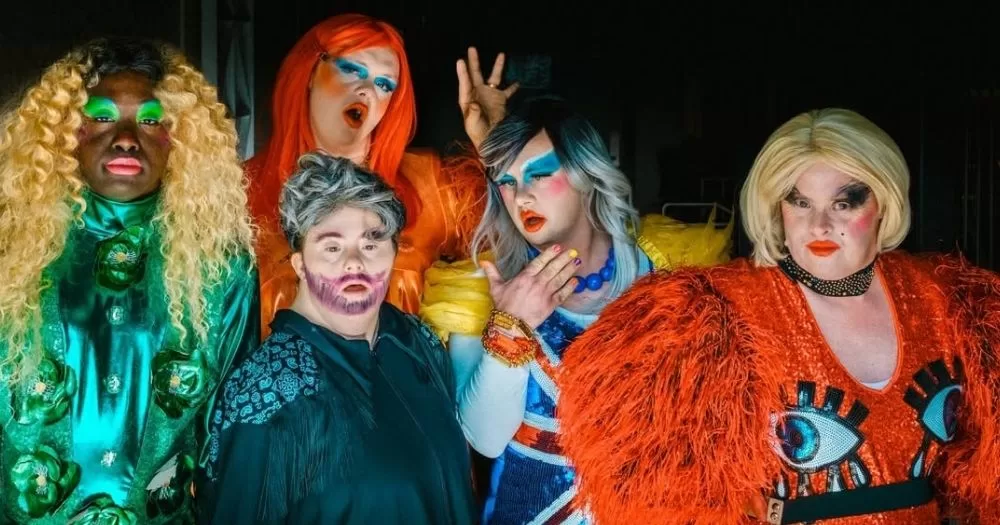
Drag Syndrome is a drag group with a difference. As a group of British drag kings and queens made up of people with Down syndrome, they challenge preconceived ideas about gender, sexuality and disability.
As their website says, “The starting point is the art. Before Down Syndrome, before extra chromosome, before disability, before anything.” The show’s lead organiser and choreographer, Daniel Vais, created it to “encourage arts organizations and performance troupes to ‘open up’ to [including] people with ‘learning disabilities’”. It is not a charity project; it is about changing perceptions by giving exposure to people who don’t usually get it.
The troupe includes Otto Baxter, an award-winning actor and filmmaker. Creator of movies like The Puppet Asylum, a gruesome Victorian romp inspired by Jack the Ripper, A Nightmare on Elm Street and, crucially, his own experience of living with Down syndrome. The award-winning Shakespearean actor, who started performing when he was eight, was no stranger to the stage before joining the troupe, but believes the act has helped improve his confidence and self-esteem. “I’ve really enjoyed being a drag – I definitely got more confident and I’m more comfortable,” he shared. He performs as Horrora Shebang or Madame Shebang in some circles, a name inspired by his love of horror films “and that I go out with a bang!”
The group also includes drag kings like Ruby Bond, aka Justin Bond. Reflecting on her drag experience, Ruby said, “I’ve always been performing on stage. I’ve performed in shows, but drag is easier because I can do whatever I want.” On her drag persona, she says, “I wanted to be a handsome guy, with muscles. I don’t have muscles, but it’s what I wish to be.”
According to Down Syndrome Ireland, there are approximately 9,000 people in Ireland with Down syndrome. Down syndrome is a lifelong genetic condition where individuals have an extra chromosome that changes the way the brain and body develop from the very early stages and affects each individual’s physical and mental development differently.
View this post on Instagram
While considered a disability that has varying levels of severity, Daniel Vais prefers to uphold the idea that people with Down syndrome have a mindset needed for outstanding artistic creation. “I use improvisation in all of my choreography,” he said, “and artists with Down Syndrome are the masters of improvisation. So the misconceptions that may surround them completely disappear after the performance. [Audiences] see that it’s a top-level performance — the dancers just have Down Syndrome.”
“Drag is about transformation,” said Vais. “It allows you the space to explore sexuality and gender in a society that doesn’t normally allow you to do so. And when you transform, your voice is heard.”
Drag’s place in forwarding LGBTQ+ rights has been well-documented. Drag queens and kings from all around the world have challenged gender norms and fought for equality by creating visibility, from New York’s Stonewall Riots in 1969 with the likes of Marsha P. Johnson to Ireland’s Marriage Equality and Panti Bliss. Being loud and fabulous allows the Drag Syndrome troupe to control a room and perhaps challenge audience preconceived ideas about individuals with Down syndrome.
The group has travelled the world, including Iceland, Norway, Sweden, Germany, Canada and the US and has performed at Pride events in the UK. Last year, they even performed at RuPaul’s DragCon UK.
© 2026 GCN (Gay Community News). All rights reserved.
Support GCN
GCN is a free, vital resource for Ireland’s LGBTQ+ community since 1988.
GCN is a trading name of National LGBT Federation CLG, a registered charity - Charity Number: 20034580.
GCN relies on the generous support of the community and allies to sustain the crucial work that we do. Producing GCN is costly, and, in an industry which has been hugely impacted by rising costs, we need your support to help sustain and grow this vital resource.
Supporting GCN for as little as €1.99 per month will help us continue our work as Ireland’s free, independent LGBTQ+ media.