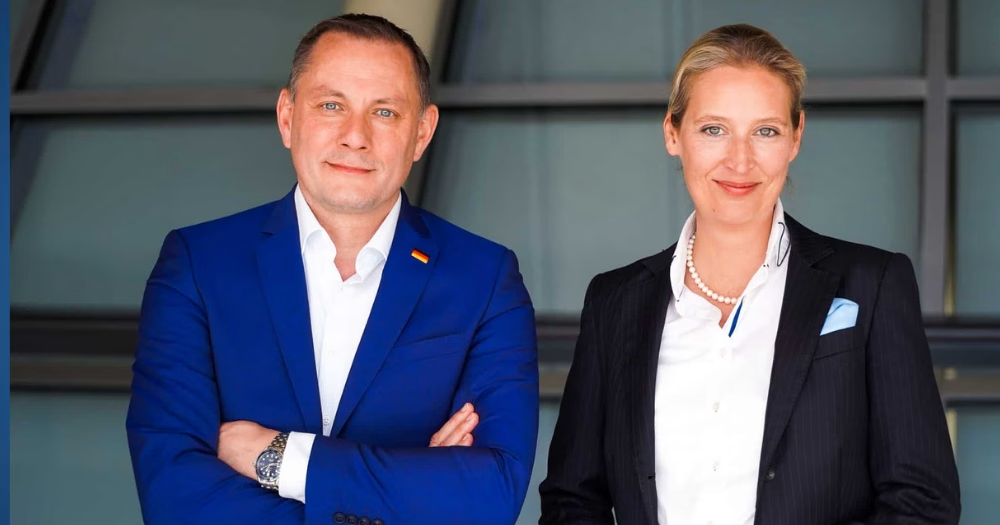
Germany’s far-right Alternative für Deutschland (AfD) party has won an election in the eastern state of Saxony-Anhalt, securing 43.8% of the vote and 39 of the state parliament’s 83 seats. For Alice Weidel, the AfD’s openly lesbian national co-leader, the result could represent a watershed moment for a party that remains deeply controversial over immigration, nationalism and its positions on LGBTQ+ rights.
Weidel, who lives with her partner and is raising two sons, has become one of the most recognisable faces of Germany’s far right. Her personal life sits in striking contrast with parts of the political platform of the party she leads. The AfD opposes same-sex marriage, supports civil unions instead and has sought to roll back some LGBTQ+ protections.
Yet Weidel has remained a powerful figure within the AfD, campaigning on immigration, nationalism and opposition to Germany’s mainstream political establishment. She has called for the “large-scale repatriation of foreigners” and has promoted claims associated with the so-called ‘Great Replacement’ theory, a discredited conspiracy theory alleging that white populations are being deliberately replaced by immigrants.
Her political positions have repeatedly attracted controversy beyond Germany’s borders. In a conversation with Elon Musk, Weidel claimed that Adolf Hitler was not right-wing and described him as a communist and socialist. Historians reject that characterisation, pointing to the Nazi regime’s violent persecution of communists, socialists and other political opponents.
Alice Weidel has also sparked backlash over Germany’s approach to remembering the Holocaust, describing the country’s culture of remembrance as a “guilt cult” and criticising what she called the repeated association of the AfD with the Nazi past. Weidel’s own grandfather was Hans Weidel, a member of the Nazi Party and the SS, as well as a prominent military judge appointed directly by Adolf Hitler,
The party’s success in Saxony-Anhalt is therefore particularly significant given the AfD’s history and its current classification by domestic intelligence authorities in the state as “right-wing extremist”.
Founded in 2013 as a party focused largely on economics, the AfD shifted increasingly toward immigration and nationalism during the 2015 refugee crisis, when Germany admitted more than one million asylum seekers.
Its latest success has been driven in part by the party’s strong performance in east Germany. But winning the election does not automatically give the AfD power. With 39 seats, it remains short of the 42 needed for a majority in the 83-seat parliament. No far-right party has governed a German state since the end of the Second World War.
© 2026 GCN (Gay Community News). All rights reserved.
Support GCN
GCN is a free, vital resource for Ireland’s LGBTQ+ community since 1988.
GCN is a trading name of National LGBT Federation CLG, a registered charity - Charity Number: 20034580.
GCN relies on the generous support of the community and allies to sustain the crucial work that we do. Producing GCN is costly, and, in an industry which has been hugely impacted by rising costs, we need your support to help sustain and grow this vital resource.
Supporting GCN for as little as €1.99 per month will help us continue our work as Ireland’s free, independent LGBTQ+ media.