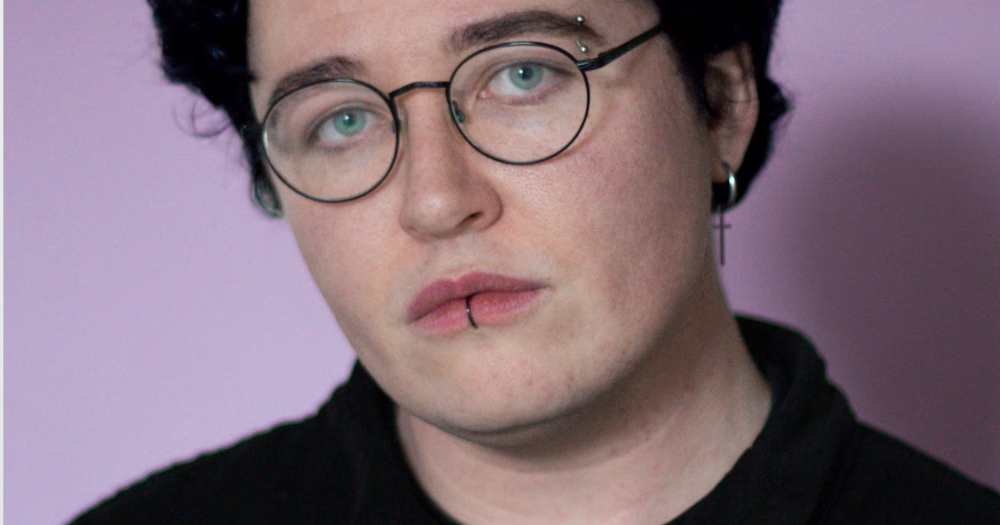
For trans filmmaker Hiram Harrington, horror is more than blood, fear and the things that go bump in the night. It’s a way of exploring trauma, identity, survival and the messy realities of queer life. From his independently made short Bean to upcoming projects like Goodnight Girl and SHINE ON, BLACK SUN, Hiram is carving out space for strange and unapologetically queer stories.
GCN caught up with him to talk filmmaking, horror, queer representation and the fight to get unconventional stories onto the screen.
What first drew you to filmmaking, and when did you realise it was something you wanted to pursue professionally?
Hiram Harrington: I wish there were a more chic or sexy or mysterious way to put it, but I owe my interest in film to being a very mentally ill child.
Neither of my parents are from an artistic background, but both were really into a good story, wherever it may have come from. At bedtime, they’d read us classics like Rumpelstiltskin or Goldilocks, sure, but they’d just as easily tell us about Jesus turning loaves into fishes, or the full plot of A Nightmare on Elm Street from memory. The latter, particularly, drove me to many sleepless nights, and yet, I’d ask to hear it again and again.
I was diagnosed with OCD at a very young age. The way it presented itself made me deeply, obsessively afraid of everything. When I was around eight years old, I walked in on my parents watching Alien (right as John Hurt’s chest burst open), and it absolutely wrecked me. Couldn’t sleep, couldn’t be in the dark, couldn’t be alone. My parents forbade me from watching another horror film, but, as with most kids, the second your parents tell you no just makes you more curious.
I began to seek out and watch the goriest, scariest, most disturbing films I could find, almost to prove to myself that I could do it. Despite the initial slew of nightmares, I found the more horror I watched, the less scared I was of the world around me.
They filled me with such adrenaline, such excitement. I’d never felt that kind of full-body escape from reality before. If the people on the screen could survive that, then so could I.
Filmmaking didn’t occur to me as a career option until the end of secondary school. I’d been planning to become a forensic pathologist (a little too much passion for The X-Files and Silence of the Lambs as a teen), but the subsequent decade’s worth of study made me reevaluate.
I asked myself then: what makes me happier than anything in the world? The answer, obviously, was films. They were my refuge.
Turns out, I didn’t want to investigate the world’s horror firsthand, but I did want to tell stories about the people who did. Now, all I want to do is capture and share that same feeling of full-body escape from reality.
View this post on Instagram
Can you tell us about your creative process?
Hiram Harrington: It’s hard to nail an exact process, as every project requires something different of you. I also work a couple of jobs to pay rent when the creative work doesn’t, so it’s hard to keep a set routine. Utterly glamorous, I know.
Usually, ideas will hit right as I’m about to fall asleep, so I thoroughly abuse my notes app. When it comes to really beginning work on a project, I’m extremely tactile. I tend to write everything longhand into a notebook before it ever makes it to the screen. Sticky notes, scribbles, flashcards, sketches. It all helps because I’m a notorious overthinker, and writing in pen means I can’t just delete it in a fit of frustration.
I like to do short treatments to find where I’m missing pieces, then I structure the story’s skeleton, then I try to have fun adding the flesh. From there, it’s redrafting and redrafting and redrafting ad infinitum until someone takes it off me.
I’m inspired as a writer and director by pain, whether that’s internal or external. My work so far has been concerned with the impact of trauma on human behaviour, of imperfect people trying to find a way to keep living despite what they’ve been through.
I do draw from my own experiences of violence, but I’m equally inspired by books, television, other films, and creepy little internet stories. If I’m feeling particularly stuck on something, I’ll return to my favourite films to shake my brain loose. Depending on the day, that could be anything from Tetsuo: The Iron Man or Titane, to Boyz In The Hood or Legally Blonde.
What opportunities and challenges do you see for independent filmmakers today?
Hiram Harrington: The major challenge for independent filmmakers in Ireland, and especially for queer filmmakers, is a real lack of understanding from funding bodies. Anything off-beat, or with an unusual theme or subject matter, or a sense of sexuality, or the taboo (or what they perceive as being taboo), usually languishes at the application stage unless it’s got a bigger name or favourable company backing it up. It’s incredibly frustrating to see brilliantly challenging short films and features coming out of UK funding strands, and none of the same diversity here.
The opportunities I’ve had as a trans writer and director have largely come from within independent and queer spaces. The GAZE Film Festival has done wonderful work with their starGAZE programme led by Evan Horan, Sam Ahearn, and James Hudson, where I’ve met my now-frequent collaborator Alba Fernandez (the award-winning cinematographer and founder of Queer Talent Ireland). It’s also through this scheme that I was mentored by the unbelievably cool Irish horror filmmaker Kate Dolan. I had the opportunity to shadow her as the director on her latest feature SOULM8TE, which was an incredible experience.
This was done through the National Talent Academies (NTA), who do wonderful work supporting upskilling through shadowing opportunities. They are doing Trojan work to give minority artists experience on large-scale sets. Earlier this year, I shadowed director Giulia Gandini on episodes one to four of the Pageboy/Element Pictures production The Rachel Incident. The NTA specifically sought out a trans person for this shadowing position and others, which was an exciting step towards developing more trans creatives in the country.
View this post on Instagram
Can you tell us more about upcoming project(s)?
Hiram Harrington: The most recent work I’ve done has been directing the nine-minute short film Bean. It’s a fun and sad and gross little short film written by Síofra O’Meara (who recently featured in the GAZE award-winning film Lesbian Lines), and starring her alongside Kate Brosnan, as two friends whose relationship starts to unravel over the sight of a baked bean.
We just premiered the short in competition at the Galway Film Fleadh, and have been bowled over by the response to it. It’s non-linear and ends abruptly, so we weren’t sure what audiences would think, but the reactions so far have been shockingly good: it’s disquieting, but tender, and weirdly funny in moments.
We were the only short in our block made entirely independently; Kate, Síofra and I put what money we had together to make sure everyone was fed, and everyone got paid something for their work. We shot it in one tiny flat, over two tight days, so it’s a testament to what you can achieve when working with good people.
What made Bean particularly special was the all-queer crew behind it. Alba Fernandez was the director of photography, and set the tone with an all-queer camera team. As we continued to crew up, we realised that everyone we were getting involved with was queer too. It meant there was an atmosphere of understanding on set – like a common language we all spoke that we so rarely get to speak on sets.
We spent over three years trying to get it made through traditional funding strands, getting no after no. We worked with producers along the way, who helped us shape the project to some degree, but ultimately, we decided to self-produce the final film as a trio.
Bean will screen at more festivals this year, so keep an eye out for me in the nearest smoking area to the cinema. We have a few confirmed, so keep your eyes peeled for the announcements!
View this post on Instagram
What’s the story you’re still hoping to tell that you haven’t had the chance to yet?
Hiram Harrington: The nature of wanting to do strange and challenging work means there’s a lot I haven’t had the chance to make yet, but lord, I’m determined.
There’s one particular story, Goodnight Girl, that’s held a place in my heart for a long time. It’s a series about four estranged queer friends who are yanked back to their small Irish hometown when one of their former friend group, a trans woman, dies suddenly. They quickly realise her bigoted parents plan to bury her as a man, and so, concoct a doomed heist to steal her body and have their own funeral for her. It plunges the local community into chaos in their wake, pitting chosen family against biological family in a fight that no-one can really win.
I’m a big horror guy in my own right, and so after shadowing Kate Dolan on Soulm8te and Lee Cronin on Lee Cronin’s The Mummy, I am also developing a number of spookier projects. My first feature SHINE ON, BLACK SUN is currently in development with Evan Horan at Keeper Pictures, which centres on a father’s desperate search for his teenage daughter who has been taken in by the leader of an online doomsday cult. Until recently, the film was part of Screen Ireland’s Perspectives programme (though sadly, no trans-led projects made it to the second round of the scheme).
I’m also developing a short horror film with Ali Doyle at Mental Pictures, entitled DINNER! WITH! SKINNER!, which Kate Dolan is attached to as executive producer. That’s really what I’m hoping to make next: a gory, gross horror about a traumatised transgender man who discovers a late-night cannibal cooking show and begins to reenact the recipes on himself. Just something a little light-hearted, you know?
From childhood horror films to queer stories of grief, trauma and survival, Hiram Harrington is interested in what happens when people are pushed beyond their limits, and what it takes to keep going. With Bean heading to more festivals and several new projects in development, there’s plenty more to come from Hiram. If his work is anything to go by, it won’t be afraid to get weird, uncomfortable or a little bit bloody along the way.
© 2026 GCN (Gay Community News). All rights reserved.
Support GCN
GCN is a free, vital resource for Ireland’s LGBTQ+ community since 1988.
GCN is a trading name of National LGBT Federation CLG, a registered charity - Charity Number: 20034580.
GCN relies on the generous support of the community and allies to sustain the crucial work that we do. Producing GCN is costly, and, in an industry which has been hugely impacted by rising costs, we need your support to help sustain and grow this vital resource.
Supporting GCN for as little as €1.99 per month will help us continue our work as Ireland’s free, independent LGBTQ+ media.