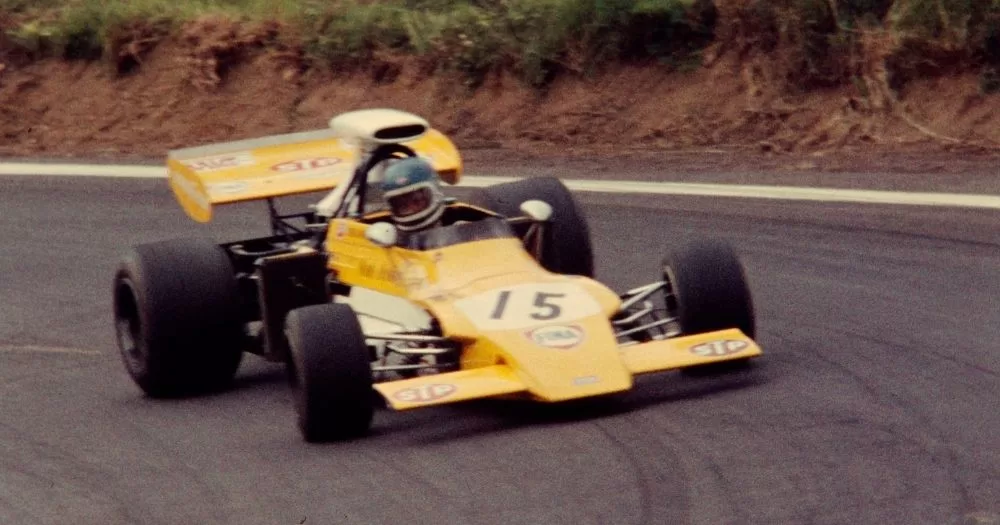
The Melbourne Grand Prix, which starts the 2026 season on March 8, has got us thinking of the racing driver icons in the LGBTQ+ Formula 1 community that paved the way for greater inclusivity in this fast-paced environment.
Two years ago, Ralf Schumacher, a former German F1 driver, came out as a gay man on social media, and the world went wild. But three drivers paved the way for LGBTQ+ racers in Formula 1 before him.
These drivers have shattered barriers in the traditionally conservative sport and still inspire future generations about the importance of inclusion, even in communities with few openly out individuals.
Mike Beuttler
View this post on Instagram
Beuttler, the British Formula 1 driver, was born in Cairo, Egypt. He is often described as the first gay driver, although many of those who knew him describe him as ‘semi-closeted’ as he had never publicly expressed his sexuality.
He had raced in Formula 3 from the late 1960s, graduating to Formula 2 and then to One in 1971. He’d raced in the 1971 Canadian Grand Prix, and the highest scoring of his career had been the 1973 Spanish Grand Prix, in which he’d taken a wonderful seventh place.
He retired from racing at the age of 34, and very little was known about his private life throughout his career, although it is known he eventually moved to Los Angeles, where he died of complications related to AIDS at age 48.
Mário de Araújo Cabral
View this post on Instagram
Cabral was regarded as an outstanding driver for Portugal throughout the late 50s. He had never wished to pursue a full-time racing career, but drove for several Grand Prixes throughout the late 50s, before retiring in 1975.
Throughout his career, he was involved in somewhat of a scandal when Jack Brabham claimed Cabral had collided with him and caused an accident which almost claimed the Australian’s life; however, Cabral has since denied this and said Brabham was the one trying to overtake.
He’d briefly served in the National Service in Angola as a paratrooper and was the first Portuguese driver to start a Formula 1 race. In 2009, at age 75, he came out as bisexual.
Lella Lombardi
View this post on Instagram
Lella Lombardi was an Italian racing driver who was openly lesbian throughout her career, and was also the second woman in the world to have qualified for Formula 1.
Lombardi is an icon for women everywhere, as she has conquered the male-dominated sport and shaped how people view women in racing. She was the youngest of three children, and after her karting experience, she got her first car at 25, which she’d raced in the Formula Fonza series.
After becoming the second woman to qualify for a Grand Prix, she raced and scored half a point at the Spanish Grand Prix in 1975, and also competed at the German Grand Prix and the United States Grand Prix.
Throughout her career, she had been in a same-sex relationship and was openly advocating for the LGBTQ+ community, paving the way for not only female drivers but LGBTQ+ drivers into the usually ‘masculine’ sport.
Ralf Schumacher
View this post on Instagram
The most famous LGBTQ+ Formula 1 driver is by far Germany’s Ralf Schumacher. He’d come out in 2024, sharing a photo of himself and his partner on social media and on February 10, 2026, he announced they were engaged.
The reception had been overwhelmingly positive, including a warm message from his 22-year-old son from a previous relationship. Schumacher raced for over 10 years from 1997 to 2007 and won six Formula 1 Grand Prix.
He eventually became a mentor for young drivers at Mercedes-Benz, and in 2019, he became a co-commentator for Formula 1 races on Sky Deutschland. Throughout their careers, these four have surely helped foster a more inclusive and accepting environment in Formula 1 for LGBTQ+ drivers.
© 2026 GCN (Gay Community News). All rights reserved.
Support GCN
GCN is a free, vital resource for Ireland’s LGBTQ+ community since 1988.
GCN is a trading name of National LGBT Federation CLG, a registered charity - Charity Number: 20034580.
GCN relies on the generous support of the community and allies to sustain the crucial work that we do. Producing GCN is costly, and, in an industry which has been hugely impacted by rising costs, we need your support to help sustain and grow this vital resource.
Supporting GCN for as little as €1.99 per month will help us continue our work as Ireland’s free, independent LGBTQ+ media.