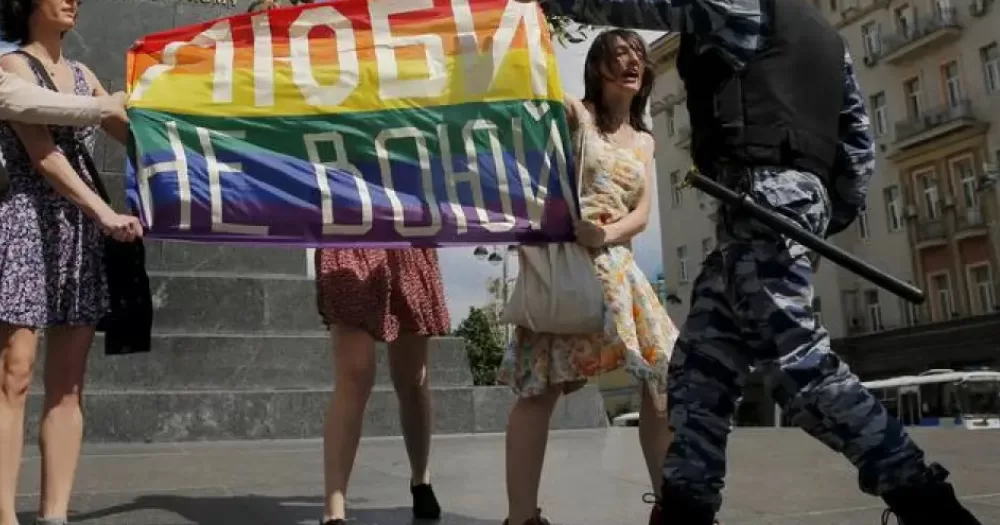
A court in Saint Petersburg has labelled the Russian LGBT Network as an “extremist” organisation, effectively banning its activities and exposing anyone linked to it to potential prosecution. The decision marks a significant escalation in Russia’s long-running campaign against LGBTQ+ groups.
The ruling was issued by the St Petersburg City Court following closed hearings requested by the Justice Ministry. The case was concluded within two months, mirroring a series of similar decisions targeting other LGBTQ+ organisations across the country. Among those previously labelled “extremist” are Coming Out in St Petersburg, the nightclub Tochka, Moscow Community Centre for LGBT+ Initiatives, the southwest group Irida, and the queer-themed media project Parni+.
The closed nature of the proceedings has raised concerns about transparency and due process. Critics argue that such rulings further erode civil liberties in Russia, deepening an already hostile environment for LGBTQ+ individuals and organisations.
Under recent Russian policies, the “extremist” label carries severe consequences. Individuals associated with such organisations can face lengthy prison sentences, with charges comparable to those used in terrorism cases. The classification effectively criminalises not only organisational work but also expressions of support for the groups.
Human rights groups have strongly criticised the move. Amnesty International had already condemned the Justice Ministry’s efforts earlier this year, warning that the policy represents a broader strategy by the Kremlin to suppress dissent and marginalise minority groups.
“The designation of the Russian LGBT Network and other organizations as ‘extremist’ are links in the same chain of persecution and injustice by the Russian authorities against LGBTI people,” said Marie Struthers, Amnesty International’s Eastern Europe and Central Asia Director.
“The Russian authorities must immediately stop misusing anti-extremism legislation to repress the LGBTI community, reverse homophobic policies and guarantee the rights to freedom of expression, association and non-discrimination to LGBTI people in line with international human rights law.
“Discriminatory legislation targeting and criminalizing LGBTI people must be fully abolished, and court decisions designating the ‘international LGBT movement’ and individual organizations as ‘extremist’ overturned,” Struthers said.
© 2026 GCN (Gay Community News). All rights reserved.
Support GCN
GCN is a free, vital resource for Ireland’s LGBTQ+ community since 1988.
GCN is a trading name of National LGBT Federation CLG, a registered charity - Charity Number: 20034580.
GCN relies on the generous support of the community and allies to sustain the crucial work that we do. Producing GCN is costly, and, in an industry which has been hugely impacted by rising costs, we need your support to help sustain and grow this vital resource.
Supporting GCN for as little as €1.99 per month will help us continue our work as Ireland’s free, independent LGBTQ+ media.