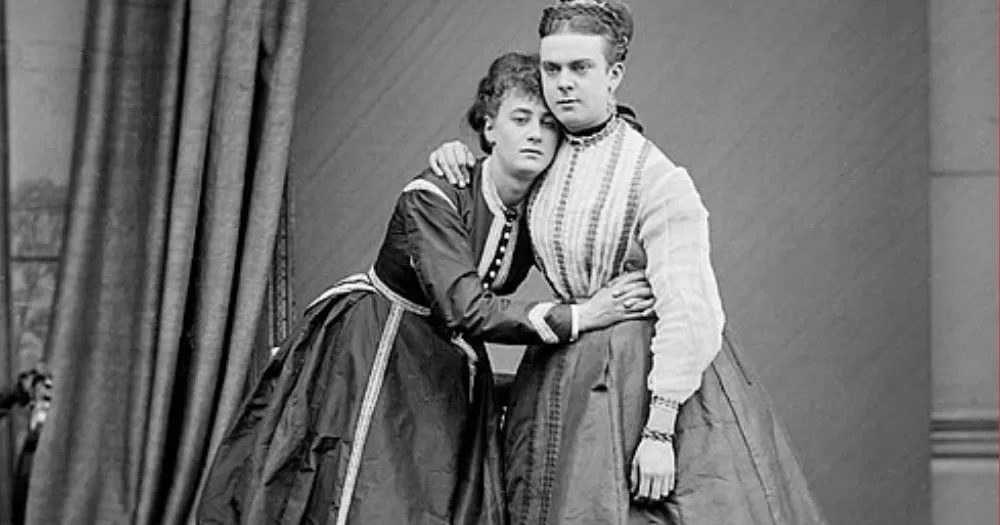
In 1871, a pair who called themselves ‘Stella’ and ‘Fanny’ made headlines amid a storm of scandals. The alter egos of the middle-class Londoners Thomas Ernest Boulton and Frederick William Park remain pinnacles of LGBTQ+ history in the Victorian era, at a time when being a member of the community was deemed not only unacceptable, but illegal.
So, who were they? Well, Thomas Ernest Boulton was the son of a wine merchant, born on 18th December 1847, and the eldest child among his siblings. Growing up, Boulton was often mistaken for a girl by many around him. During the trial of the two men, Boulton’s mother was called in to testify, saying that from the age of six her son had shown a ‘liking for assuming female characters’.
His parents were indulgent of Boulton’s passion for cross-dressing. And even though he’d worked in an Islington branch of the London and County Bank, which he resigned from shortly after starting his job, his passion was for theatre.
Boulton was gay, and to his friends, he was known as Stella and sometimes went by Miss Ernestine Edwards. He was first arrested in 1867 with his friend Martin Cummings in Haymarket, where they were wearing dresses and soliciting men for sex; however, no charges were brought.
Frederick William Park was the third son of Alexander Park, the Master of the Court of Common Pleas. His other brother, Harry, was arrested when he was 16 for homosexual activity and had been very open with his brother about it.
Frederick was called ‘Fan’ and ‘Fanny’ growing up by his brother, and ended up becoming a regular cross-dresser, often challenging the historical norms of LGBTQ+ communities at the time.
While there are no records of their meeting, Fanny and Stella became very close friends very quickly, often going out together, and those who saw them believed them to be women. In their drag, they even attended the 1869 Oxford and Cambridge Boat Race, went shopping together and ate at restaurants. To store their dresses, cosmetics, and other items, the two had also rented a small flat of their own.
In the late 1860s, both were part of a theatre troupe and appeared on stages all over England; they always took female roles and dressed accordingly. In 1868, they were joined by Lord Arthur Clinton, a member of Parliament for Newark, with whom Boulton shared an on-stage kiss and had a relationship.
Their behaviour had drawn the attention of the police, and the pair had been under surveillance for over a year before their arrest on April 28, 1870. On the evening in question, Boulton and Park, along with their two friends, Hugh Mundell and Cecil Thomas, went out together.
Boulton and Park were both in drag and went to the Strand Theatre, where they reserved a box. There, they were charged with “conspiring and inciting persons to commit an unnatural offence”. All the while still in drag, the men were brought before the Bow Street Magistrates’ Court.
The two men were subject to an invasive physical examination without their consent, and the following week, a crowd of around a thousand gathered outside the courts when the men were there, disappointed to see them in male attire.
During the trial, no worthwhile evidence was presented, and while the prosecution tried to portray their lifestyle as proof of homosexuality, they failed, and the men were quickly found not guilty of their charges, with a minor indictment for Boulton and Park.
All the witnesses produced by the prosecution during the trial had spoken out in favour of both and stated that they were men in drag, which was not illegal at the time.
Boulton and Park have appeared in several plays and stories over the years. Although they are less well-known than Oscar Wilde, they hold an important place in LGBTQ+ history and community, with their stories immortalised in Neil McKenna’s book, Fanny and Stella, the Young Men Who Shocked Victorian England.
© 2026 GCN (Gay Community News). All rights reserved.
Support GCN
GCN is a free, vital resource for Ireland’s LGBTQ+ community since 1988.
GCN is a trading name of National LGBT Federation CLG, a registered charity - Charity Number: 20034580.
GCN relies on the generous support of the community and allies to sustain the crucial work that we do. Producing GCN is costly, and, in an industry which has been hugely impacted by rising costs, we need your support to help sustain and grow this vital resource.
Supporting GCN for as little as €1.99 per month will help us continue our work as Ireland’s free, independent LGBTQ+ media.