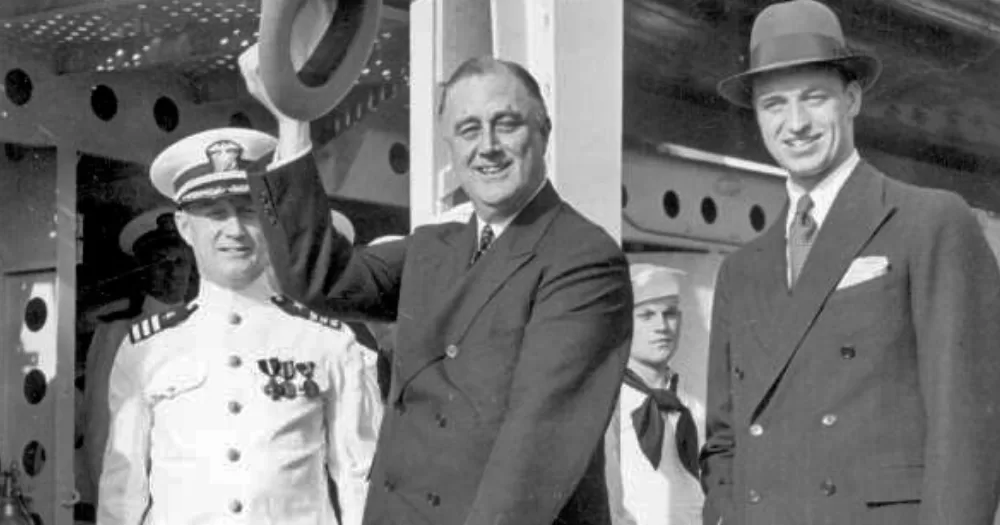
Long before he became synonymous with the US presidency, Franklin D. Roosevelt was entangled in a controversial and largely forgotten gay Navy entrapment operation that casts a stark light on early 20th-century attitudes toward sexuality in the United States.
In March 1919, 14 young Navy recruits were summoned in secrecy to a basement room at the Newport Naval Training Station in Rhode Island. There, they were briefed on a covert mission: to infiltrate and expose what officials described as “immoral conditions” within the Navy and the surrounding civilian community. Under the authority of the Office of Naval Intelligence and the Assistant Secretary of the Navy, Roosevelt himself, these men were instructed to act as decoys, engaging directly with suspected gay men to entrap them.
The operation, later referred to as ‘Section A’, relied on deception and, in many cases, engaging in sexual activity. Testimony explained by Sherry Zane, the author of ‘I did it for The Uplift of Humanity and The Navy’: Same-Sex Acts and The Origins of The National Security State, 1919–1921, revealed that participants, a majority aged between 16 and 19, were purposefully untrained and were encouraged to decide for themselves how far they would go to secure convictions.
“It wouldn’t just take one time, like the covert op would have sex with someone like three or four times before they would get the person,” Sherry Zane told The 19th. In total, the Navy spent $50,000 on Section A, the equivalent of more than $1 million today.
The result was a wave of arrests, with more than 20 sailors and 16 civilians charged. Many were imprisoned, some for 20 years, and many were dishonourably discharged. There was also a notable difference in treatment for men who were referred to as ‘bottoms’ and men who were referred to as ‘tops’.
Public backlash followed. A 1921 Senate investigation condemned the tactics as “reprehensible,” arguing they violated basic rights and ethical standards. Yet Roosevelt’s role in authorising and overseeing the operation faded from mainstream historical narratives, rarely addressed in popular accounts of his life.
This sits uneasily alongside Roosevelt’s later personal and political associations. He maintained a close relationship with Sumner Welles, a senior diplomat whose sexuality was an open secret in Washington circles. Even after a scandal involving Welles in 1940, Roosevelt initially resisted calls for his dismissal.
Adding further nuance is Eleanor Roosevelt’s personal life. Her deeply affectionate correspondence with journalist Lorena Hickok has led many historians to interpret their relationship as romantic, or at least emotionally intimate in ways that challenge conventional labels of the time.
Taken together, these threads reveal a contradiction at the heart of the former American president. The same figure celebrated for expanding freedoms and reshaping government also played a role in enforcing one of the era’s most invasive moral crackdowns. This operation laid the groundwork for the still-very-complicated relationship between the military and the LGBTQ+ community.
© 2026 GCN (Gay Community News). All rights reserved.
Support GCN
GCN is a free, vital resource for Ireland’s LGBTQ+ community since 1988.
GCN is a trading name of National LGBT Federation CLG, a registered charity - Charity Number: 20034580.
GCN relies on the generous support of the community and allies to sustain the crucial work that we do. Producing GCN is costly, and, in an industry which has been hugely impacted by rising costs, we need your support to help sustain and grow this vital resource.
Supporting GCN for as little as €1.99 per month will help us continue our work as Ireland’s free, independent LGBTQ+ media.