
The European Commission has proposed a ban on social media access for under 13s, as well as restrictions on digital technology for children under 15. The proposed ban also outlines “safe access” obligations for platforms.
The move comes after the Commission faced pressure from several members of the bloc to take action on social media access for children. Over 20 countries worldwide have taken steps to introduce some form of restrictions. In 2025, Australia became the first country in the world to ban social media for under 16s.
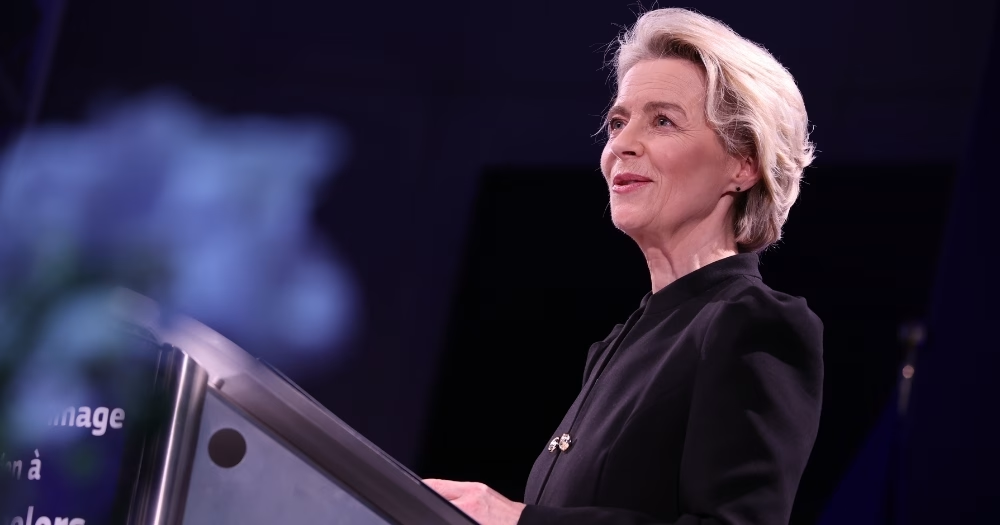
The announcement was made on Wednesday, September 16, when, in her State of the Union address, European Commission President Ursula von der Leyen spoke about the proposed ban.
Under the new rules, social media access would be completely banned for those under the age of 13. The legislation would also introduce restrictions on access for under-15s, such as limited features and time restrictions.
Von der Leyen also stated that on Thursday, the Commission will propose a new Kids Act, which would reverse the burden of proof, so that social media platforms would have the onus of proving that they are safe for minors. The new legislation will also target AI chatbots and online gaming.
Announcing the ban, von der Leyen said, “What we are witnessing is a great capture of our children. A capture of their attention, their focus, their minds. This is depriving children of their childhood.”
She added that children need “time to grow into themselves, to grow up with others”.
“But when a child has a smartphone, all of this is taken away. Day and night, parents see the cost: loss of sleep, anxiety, even self-harm,” she said.
Von der Leyen stated that the Kids Act will have a “gradual and differentiated approach”.
“I am aware that many perceive the power of big tech as overwhelming and impossible to roll back. I disagree,” she said. “Europe has the power to act. It is us who decide the rules, not Big Tech.
“We do not have to accept addictive features. We do not have to accept children being drawn into ever more extreme content. We do not have to accept that girls have their photos used for AI-generated sexualised images.”
The European Commission President said that social media will need to prove they are safe, “because it is not about our minors accessing social media. It is about when and how do we allow social media to access minors.”
Von der Leyen also spoke about the AI Act, which she described as “a crucial piece to put in place guardrails”. However, she also said that Europe needs to “massively boost” its computing capacity.
“We need to stay in the race. Because this is crucial for our independence. So we need to massively boost our computing capacity. And we will set out our ideas for how to achieve this in a clean and efficient way,” she said.
“Our approach is clear: We want AI. We want AI to create more value more responsibly. And at a lower cost and with less energy consumption. But above all, we want AI with human agency,” she said.
© 2026 GCN (Gay Community News). All rights reserved.
Support GCN
GCN is a free, vital resource for Ireland’s LGBTQ+ community since 1988.
GCN is a trading name of National LGBT Federation CLG, a registered charity - Charity Number: 20034580.
GCN relies on the generous support of the community and allies to sustain the crucial work that we do. Producing GCN is costly, and, in an industry which has been hugely impacted by rising costs, we need your support to help sustain and grow this vital resource.
Supporting GCN for as little as €1.99 per month will help us continue our work as Ireland’s free, independent LGBTQ+ media.