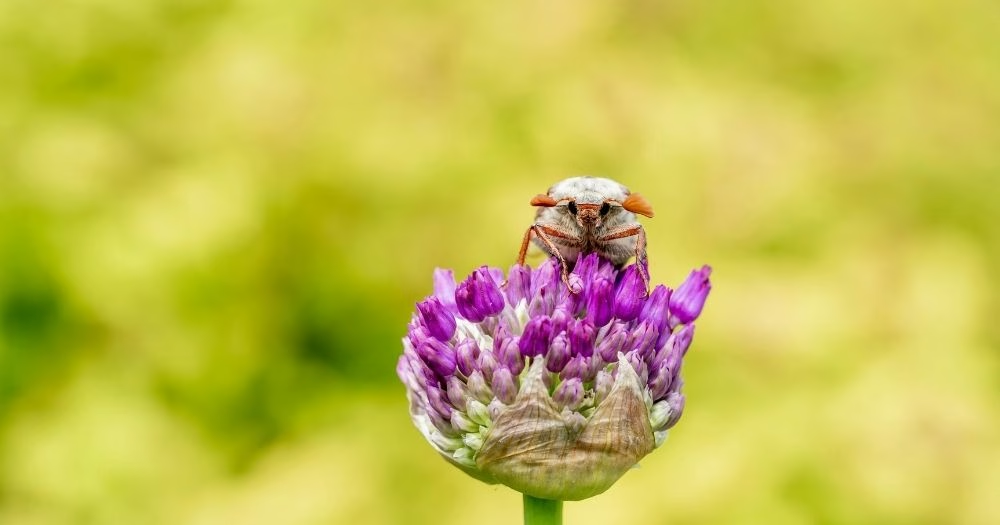
No bigger than an average-sized matchbox, these little bugs caused mass gay panic in the 19th century. Adequately named cockchafers, the bugs were discovered to be having gay sex with one another in 1834 by German school teacher August Kelch. One bug was a larger common cockchafer, and the other was a smaller forest cockchafer. Now that’s just the biology of mating, one might say, except in this case it wasn’t as simple as that.
Not only was it unusual that the cockchafers were attempting to mate across species, but both beetles appeared to be males. Male cockchafers typically have larger, fluffier antennae, but it was possible for female cockchafers to have been born with male antennae. Due to this fact, August Kelch was quick to believe that the two bugs were a more likely pairing of a male and a female with a male antenna.
After a dissection of the two beetles, Kelch discovered the truth, disproving his previous theory. Both cockchafers were indeed males. One of the bugs used its aedeagus, better known as its penis, to penetrate through the reproductive opening, pushing the receiving cockchafer’s aedeagus back into its own body cavity.
It was thought that it could be a dominance move by the larger of the two beetles, but in 1879, Russian entomologist Carl Robert Osten-Sacken noticed that sometimes it was the smaller cockchafer that was the dominant partner. A few years later, in 1896, French entomologist Henri Gadeau de Kerville even suggested that some male cockchafers may prefer other males.
@connor_the_ecologist Now we’ll never know why animals engage in homosexual behaviour, it could be that they just aren’t that great at distinguishing between each other, but I’d argue that for cockchafers, that position of them in that illustration perhaps requires some coordination…? Homosexual behaviour has been observed in thousands of species, which isn’t to say they have identities like we do nowadays, but as a behaviour it is quite natural. If you go back to Greek times, homosexual behaviour is less of an identity and more a recreational activity. #queerecology #bugs #nature #beetles #lgbtq ♬ original sound – Connor the Ecologist
Homosexuality is quite a prevalent phenomenon in the natural world. Lesbian seagulls were found off the coast of California in 1972. They were deemed to be lesbian after biologists noticed couples incubating unusually high numbers of eggs. Female western gulls can typically only lay two to three eggs per nest, but these birds had six to seven eggs, meaning that nests were cared for by two female birds. The research was later published, leading to a large public outcry with various newspaper articles debating whether the findings were “a waste of money”.
These birds and beetles are only small examples of homosexuality being found in nature, as thousands of species have exhibited the same habits. Consequently, if homosexuality is natural in nature, doesn’t that mean it’s also natural in humans? It would thus disprove the deeply homophobic belief that being gay is “unnatural”, and that’s where the Victorian panic really set in.
© 2026 GCN (Gay Community News). All rights reserved.
Support GCN
GCN is a free, vital resource for Ireland’s LGBTQ+ community since 1988.
GCN is a trading name of National LGBT Federation CLG, a registered charity - Charity Number: 20034580.
GCN relies on the generous support of the community and allies to sustain the crucial work that we do. Producing GCN is costly, and, in an industry which has been hugely impacted by rising costs, we need your support to help sustain and grow this vital resource.
Supporting GCN for as little as €1.99 per month will help us continue our work as Ireland’s free, independent LGBTQ+ media.