This article is part of GCN’s new Amach le Bród (Out with Pride) series, to combat anti-LGBTQ+ misinformation and platform underrepresented voices. The project was funded by the Coimisiún na Meán News Reporting Scheme.
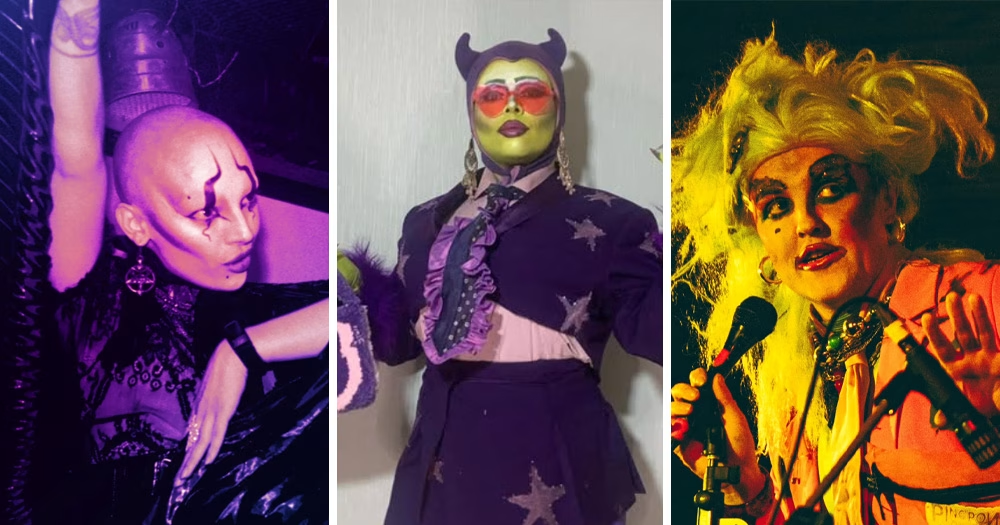
When we hear the word ‘drag’, many of us conjure up images of queens in sequined body suits, with full glamour beats and flowing wigs. This, however, is just one modum apparatus of the glorious drag spectrum. Beyond the lacefronts and the glitter, many artists use drag to push boundaries, moving beyond a human lens while embracing the monstrous, the fantastical and the animal. Often called ‘creature drag’, this form of artistry has come into its own in Ireland, with many performers showcasing their art across the underground scene.
Someone who knows this art form all too well is avant-garde performer Goblins Goblins Goblins, who first began experimenting with drag at a college freshers event.
“There was a drag show you do every year, and I entered and I got paired with my friend Emma,” he says. “Neither of us were very good at makeup, so from the beginning I was like, ‘Can we make me look scary as opposed to pretty?’”
Goblins’ first time performing drag on stage, doing a Kate Bush number, no less, proved successful, and he subsequently competed year after year. From there, he caught the drag bug and began experimenting further before carving out a unique drag identity, and a name to match.
“There’s a video of [alt-right conspiracy theorist] Alex Jones ranting about Hialry Clinton that an Irish person remixed, so it’s just him saying Goblins a lot,” he says of his drag name origin.
Today, Goblins’ drag repertoire consists of a colourful cast of characters, inspired by the pop culture he was drawn to growing up; think The Chronicles of Narnia and The Sims.
View this post on Instagram
Doctor Count Evil, another Dublin avant-garde artist, also takes inspiration from pop culture, and, in particular, horror films and video games, an interest that was nourished and supported at home.
“I was raised by a mum who was extremely goth and a metalhead, so I’ve always been in love with monsters,” they say. “And she let me watch a lot of movies that I maybe shouldn’t have watched that early.”
Doctor Count Evil’s penchant for the spooky is evident in their distinct aesthetic today. Think pale-white skin, a few extra eyes here and there and nods to fiction’s most famous monsters. On stage, Doctor Count Evil inhabits this persona further, leaning into strange body positions, eliciting reactions from punters.
“I love it so much when people tell me I’m hypnotic,” they say. “That’s a compliment and that’s exactly what I’m going for.”
View this post on Instagram
Indeed, monsters prove to be fertile ground for inspiration in the realm of creature drag, and this is the case for Khia The Asylum, who channelled a very famous ogre for his first-ever drag performance at last year’s GCN fundraiser, So You Think You Can Drag.
“I really love horror, camp and the bizarre, and The Substance had just come out,” he says. “I wanted to centre my performance on the idea of transformation, and then also at the time, there was the Wicked craze. So, what I ended up doing was a number where I started off as Elphaba from Wicked, and then she takes the substance and turns into Shrek.”
Khia ended up winning the competition, and that success, coupled with the copious amount of green makeup he bought, gave rise to a fully formed drag persona, one that is as inspired by Queen of the Damned as it is by Tracey Beaker.
“My drag is very much inspired by glam horror, but also these nostalgic [elements] blended in,” he says. “That’s what it looks like in my head anyway, whether I actually execute that is another question.”
Given its genre-defying tendencies, creature drag can also be as counter-cultural as it is spooky. Goblins Goblins Goblins believes, after all, that the silly and the political go hand-in-hand.
“When I was younger, I believed that drag had to be political, but then sometimes I think the essence of drag is to be strange and silly, and I don’t think those two things are at odds,” he says. “I guess it’s that weird thing where overall, politics has gotten more conservative again and drag has gotten weirder again – it’s definitely interesting.”
For baby creatures looking to cut their teeth on the scene, Doctor Count Evil is bursting with words of encouragement.
“A lot of people think drag is out of their reach, but drag is not inaccessible,” they say. “You see so many people from all walks of life, with any type of body, with any type of mobility, do drag, and that’s where the spirit really comes from. It’s legitimately just a show of the fact that you exist and that you want to create art.
“Being as authentic and as strange and as out there as possible doesn’t require much. I have done costumes that are legitimately just scraps of something tied together, and I tried my best to make it look good. It might take a while to create a costume or a brand or a number you’re happy with, but all that matters is that you try.
“Maybe it can stay in the bedroom, but if you feel like you can go out there, absolutely do because someone will see you and see a representation of themselves.”
Khia The Asylum encourages the drag creature-curious to experiment as much as possible, encouraging them to get thrifty and “be more busted”.
“People might have a limited view of what drag can be because of what’s presented on TV and in the mainstream, but there’s so much wonderful non-mainstream drag out there. It might not be as prevalent, but it does exist in the smaller spaces,” he says.
“So experiment! Go out there, find these spaces and you’ll find your crowd. A lot of my drag will be mishmashed things from charity shops, so look to charity shops for inspiration, be DIY, be punk and don’t be afraid to look busted. I think we need to fight against the polish.”
View this post on Instagram
© 2026 GCN (Gay Community News). All rights reserved.
Support GCN
GCN is a free, vital resource for Ireland’s LGBTQ+ community since 1988.
GCN is a trading name of National LGBT Federation CLG, a registered charity - Charity Number: 20034580.
GCN relies on the generous support of the community and allies to sustain the crucial work that we do. Producing GCN is costly, and, in an industry which has been hugely impacted by rising costs, we need your support to help sustain and grow this vital resource.
Supporting GCN for as little as €1.99 per month will help us continue our work as Ireland’s free, independent LGBTQ+ media.