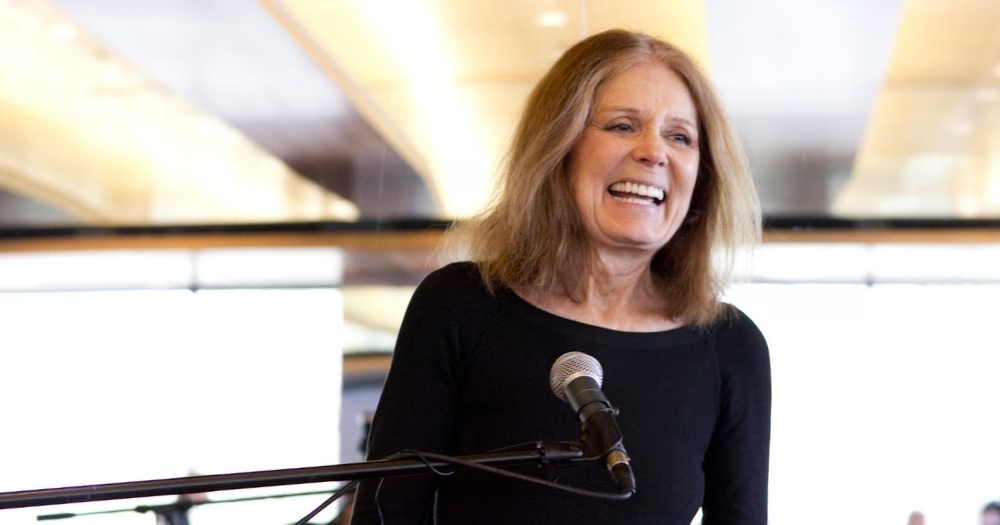

Gloria Steinem, one of the most influential feminist activists and journalists in the US, has passed away aged 92.
Her death was announced in a statement shared by her foundation on social media on September 3. The activist “passed away peacefully at her home” on Wednesday, surrounded by “some of the many who loved her,” the statement read.
Paying tribute to the journalist’s long career and immense legacy, the foundation wrote: “Gloria’s greatest gift was her ability to listen to others, to make others feel seen and heard. Her words, actions, and example gave people permission to be their truest selves. Gloria lived true to her independent spirit, always with curiosity and a great sense of humor.”
View this post on Instagram
Gloria Steinem was born in 1934 in Toledo, Ohio. In 1956, she graduated from Smith College and became a freelance journalist. One of the most memorable moments of her career took place in 1963, when she spent 11 days working undercover as a Playboy Bunny. She wrote an exposé for Show magazine titled ‘A Bunny’s Tale’, documenting the poor pay and sexist treatment she and her colleagues had to endure.
Throughout her life, Steinem was a staunch activist for a number of causes, including campaigning against abortion bans, genital mutilation, domestic violence, the Vietnam and Gulf wars, and the pornography industry. Working tirelessly as a journalist and writer, she went on to become one of the most influential figures in the modern feminist movement, which she believed should embrace all women.
“If you’ve suffered discrimination, you’re sensitive to it on every level,” she told The New Yorker in a 2015 interview. “I learned feminism largely from black women. Women of colour basically invented feminism.”
View this post on Instagram
In 1971, she co-founded feminist media outlet Ms. Magazine, which tackled issues such as abortion, sexism, equal pay and domestic violence. The publication provided an important alternative to the staple magazines aimed at women at the time, which often focused on beauty, dieting, cookery and “supporting your husband” topics.
Throughout her life, Steinem was very critical of marriage as an institution. “Women are not going to be equal outside the home until men are equal in it,” she stated. It was until she was 66 that she decided to wed South African businessman and environmentalist David Bale, the father of actor Christian Bale.
“I hope this proves what feminists have always said – that feminism is about the ability to choose what’s right at each time of our lives,” she said in a statement after the marriage.
View this post on Instagram
Steinem was also a vocal campaigner for LGBTQ+ equality. In 1977, she joined queer activists in Miami to fight against Anita Bryant’s campaign to repeal Dade County’s ordinance prohibiting discrimination against gay people. She also later strongly supported the inclusion of lesbian women in the feminist movement, an issue that arose in feminist circles in the 1970s.
Her advocacy on trans issues was more complicated. In a 1977 article published in Ms. Magazine, she wrote about Renée Richards, a tennis player who had transitioned in the 1970s. In the piece, Steinem wrote: “We ought to be very, very suspicious of the social reasons for transsexuality as well as its big, star-spangled, commercial exploitation.”
View this post on Instagram
Steinem addressed this article later in life, highlighting how her views on the topic evolved as her knowledge deepened. In a 2013 op-ed written for the Advocate, she acknowledged that her understanding of gender had changed significantly since that first article and apologised for the hurt caused by her words.
“I believe that transgender people, including those who have transitioned, are living out real, authentic lives,” she wrote in the op-ed. “Those lives should be celebrated, not questioned. Their health care decisions should be theirs and theirs alone to make.
“And what I wrote decades ago does not reflect what we know today as we move away from only the binary boxes of ‘masculine’ or ‘feminine’ and begin to live along the full human continuum of identity and expression.”
Years later, Steinem stated that the feminist movement and the trans movement are one and the same. “It seems to me to be all the same struggle,” she said.
“We invented the idea of gender. It doesn’t exist. The old languages — Cherokee, Bengali, the oldest African languages — do not have he or she. They don’t even have gendered pronouns. We’re all trying to achieve a world where you are a unique individual and a human being.”
View this post on Instagram
Later on, she advocated for the rights of trans people, signing open letters in solidarity with the community and against the Trump administration and its attacks on trans rights.
Rest in Power, Gloria Steinem.
© 2026 GCN (Gay Community News). All rights reserved.
Support GCN
GCN is a free, vital resource for Ireland’s LGBTQ+ community since 1988.
GCN is a trading name of National LGBT Federation CLG, a registered charity - Charity Number: 20034580.
GCN relies on the generous support of the community and allies to sustain the crucial work that we do. Producing GCN is costly, and, in an industry which has been hugely impacted by rising costs, we need your support to help sustain and grow this vital resource.
Supporting GCN for as little as €1.99 per month will help us continue our work as Ireland’s free, independent LGBTQ+ media.