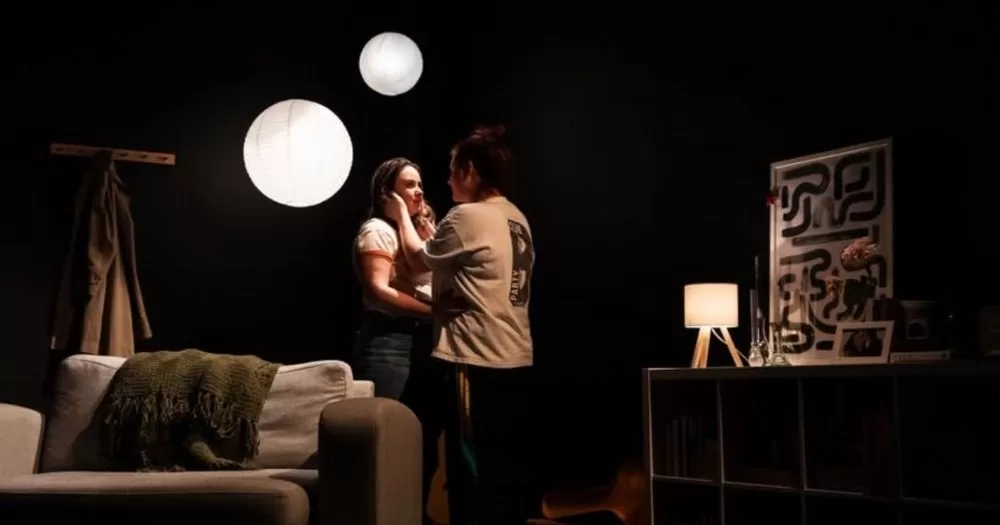
In Vitro, a brand new play written by Aoife O’Connor and directed by Katie O’Halloran, is a powerful theatrical reflection on how Irish law impacts LGBTQ+ families.
The play follows Lily and Sam, who fall in love, move in together and get a mortgage. All appears to go swimmingly for the couple until they decide to start a family, and the thorny relationship between fertility and finances rears its ugly head.
As the play begins its run at Bewley’s Cafe Theatre, we caught up with O’Connor to discuss how the current laws are shaping the experiences of queer families today.
Can you talk about the current situation regarding the rights of queer parents and their children in Ireland?
At the moment, only a small proportion of the queer community has a clear legal pathway that allows both parents equal rights to the child they have together. As of January 2026, couples who can’t both be named on their child’s birth certificate include same-sex male couples, queer couples who used fertility treatment abroad, and couples who conceived through at-home insemination — to name just a few.
Another major issue is adoption. If a child is born using a donor, it’s currently not possible for the non-birth parent to adopt that child in many circumstances. So, for example, if a same-sex female couple conceive at home using a friend’s sperm, only the parent who gives birth has rights. The other mother has none, and no route to adopt her own child.
Right now, the only queer couples who can reliably both be on the birth cert are same-sex female couples who go through an Irish fertility clinic.
Full disclosure: I’m speaking from my own experience of navigating these laws when my wife and I had our child a few years ago, and from consultations with Ranae Von Meding to make sure my play In Vitro reflects the legal reality as accurately as possible. I’m not a legal expert — just someone who learned all of this the hard way.
Will the proposed legislation address these issues and allow everyone in Ireland equal rights to their children?
Unfortunately, no — at least not yet. Firstly, the proposed legislation hasn’t actually resulted in change. This process has been dragging on for years, and further government action is still needed before anyone benefits from amendments to the CFRA Act.
Secondly, even as proposed, the legislation still excludes children conceived using fertility clinics abroad (even if they’re born in Ireland), donor-conceived children born abroad, and children conceived through at-home insemination.
So while there’s a sense of movement on paper, the reality for many queer families remains exactly the same.
How does the legislation create a class divide within the LGBTQ+ community?
This is the core issue I wanted to explore in In Vitro.
Both the current and proposed legislation effectively require queer couples to have quite a bit of money in order to have equal rights to their child. I did the maths based on the clinic we attended: four rounds of IUI with donor sperm — the average number of attempts for a lesbian couple with no fertility issues — comes to €8,495. And that’s for one child. For any future children, the process — and the cost — starts again.
Because of this, many queer couples who can carry a pregnancy end up choosing IVF, simply because the chances of success per cycle are higher. IVF in the same clinic, with two vials of donor sperm and storage, costs €8,895, plus another €1,500 per embryo transfer if the first one doesn’t work. It is quite normal for it to take two or three transfers, bringing the total to nearly twelve grand!
These figures price huge numbers of queer couples out of equal legal protection. Many families are pushed towards more affordable clinics abroad, or towards the only free option available: conceiving at home with a known donor.
The result is a system where equal rights are only available to those who can afford them. And it’s the child who ultimately pays the price, left without legal protection from one of their parents, simply because their family didn’t have thousands of euros to spend on fertility treatments they didn’t need.
Can you share your own experience with IVF?
I naively assumed that marriage equality meant equal rights across the board. So it was a shock to realise just how unequal things still were seven years later when we began the process of starting a family. We discussed lots of ways of having a child, but eventually realised that the only way for us both to have rights was through a fertility clinic. That realisation cast a shadow over what should have been a joyful, exciting time.
One of the most frustrating aspects was how immediately the process became medicalised. What could have been a calm, intimate experience — conceiving at home with donor sperm from a clinic or a friend, taking as many attempts as needed — became a high-stakes numbers game. Appointments, blood tests, timelines, and costs quickly mounted up.
Because donor sperm is so expensive, we chose IVF even though I never wanted the medication or stress. Then, since we had to go through a fertility clinic, we thought in for a penny, in for a pound and opted for reciprocal IVF where I carried my wife’s egg.
We were very clear that we had no fertility issues and asked for a more tailored approach. Instead, it was essentially a copy-and-paste IVF protocol. My wife was given the same level of medication as someone with years of infertility, which resulted in a very high egg count and put her at risk of OHSS, a nasty syndrome linked to the injections given in IVF.
Later, once I was pregnant, I was told by the hospital that I couldn’t go through the midwife-led scheme because reciprocal IVF carries higher risks than an average IVF pregnancy, a detail that had never been disclosed to us by the clinic. Suddenly, my hopes of a home birth were gone, I was prescribed aspirin, and discussions of induction began.
We hired a doula to help keep things as intervention-free as possible (another cost!) and thankfully, I had a healthy pregnancy and delivery. We got a gorgeous human at the end of it all, but the legislation impacted every step of the journey, right through pregnancy and birth choices.
Can you tell us about your upcoming show, In Vitro?
I wrote In Vitro during my Creative Writing Master’s in DCU for the brilliant Marina Carr. I wanted to highlight the invisible discrimination queer couples face when trying to have a baby in Ireland — because, like many people, I had absolutely no idea it existed until I was living it myself.
At its heart, though, In Vitro is a love story. Sam sings at weddings, plays Xbox, and firmly believes multicoloured Christmas lights are the height of good taste. Lily is a primary school teacher who goes to dinner parties, loves oversharing, and is warm white lights all the way. They’re wildly different — and completely perfect for each other. They fall in love, move in together and decide it’s time to start a family. And that’s when the trouble begins.
The play looks at what happens when something deeply personal — wanting a child — collides with something painfully practical: money. Through moments of humour, tension and tenderness In Vitro explores how fertility and finances become entangled for queer couples in Ireland, and how love can be either strengthened and strained under that pressure.
It’s messy, it’s empathetic, and it’s about two people trying to hold onto each other, and their sense of humour, while navigating a system that was never designed with them in mind.
In Vitro runs at Bewley’s Café Theatre until February 21. You can grab tickets here.
© 2026 GCN (Gay Community News). All rights reserved.
Support GCN
GCN is a free, vital resource for Ireland’s LGBTQ+ community since 1988.
GCN is a trading name of National LGBT Federation CLG, a registered charity - Charity Number: 20034580.
GCN relies on the generous support of the community and allies to sustain the crucial work that we do. Producing GCN is costly, and, in an industry which has been hugely impacted by rising costs, we need your support to help sustain and grow this vital resource.
Supporting GCN for as little as €1.99 per month will help us continue our work as Ireland’s free, independent LGBTQ+ media.