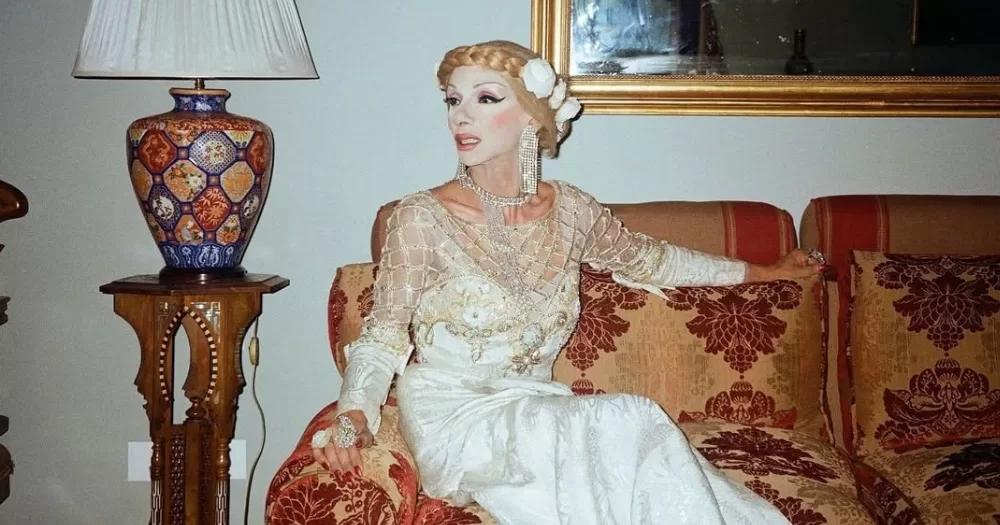
Growing up in Wadi Shahrour, the small Lebanese town famous for producing the iconic singer and actress Sabah, Bassem Feghali was catapulted to stardom when appearing on the national talent show, Studio El Fan, in 1996. His impersonations of beloved Lebanese and Arab performers, including the revered Sabah, whilst in full drag, won him the gold medal and secured him a ten-year contract with the Lebanese television channel LBC.
Alongside his impersonations of celebrities, Feghali boasts a colourful cast of original characters, often based on Lebanese and Arab stereotypes. These include Madame Antika Sursock, a member of the Lebanese Christian social class who values looks and social status above all else and is constantly on the prowl for handsome men to seduce. In contrast, Hala Tamarzof is a young airhead who is always in full, slightly trashy glam and prioritises pop culture and her horoscope.
Feghali’s characters became household names with his spot on the daily programme, the Ramadan Fawazir. The show ran every day during Ramadan and featured Feghali impersonating a different Arab singer every night in a parody of the Arabian Nights, Alf Wayle Bi Layle. This fun, campy segment introduced the art of drag to a mainstream audience watching from home every evening and paved the way for the drag scene in Lebanon today.
Not much is known about the impersonator, beyond the fact that he meticulously prepares for each of his characters, even adopting diet and workout plans to achieve their likeness. His accent work, music, scripts and wardrobe – all curated himself – are exceptional.
Feghali pioneered drag in a strictly conservative society before conversations around sexuality and gender expression were being had. Perhaps surprisingly though, men dressing and performing as women was not new to Arab culture. Particularly in Egypt, the khawal tradition saw men take on female characters in plays that women were barred from participating in. Men belly dancing at celebrations and for entertainment was commonplace.
Seen as continuing on this tradition, Feghali’s familiar and beloved characters were possible thanks to a public that liked his humour and respected his clear talents. Always playing complementary or comedic characterisations of divas, Feghali sustained his wide success by staying apolitical.
Rumours have swirled around Feghali’s sexuality for years, but he keeps a notoriously very low profile, rarely offering interviews and keeping his private life to himself. Public homosexuality would have tested the capabilities of Beghali’s fans and compromised his career as a harmless comedian and performer.
Regardless of Feghali’s careful construction of his work as impartial and inoffensive, his legacy has resonated with the Arab queer community and served as inspiration to modern icons leading the queer movement in Lebanon and beyond.
Hoedy Saad, the drag queen who brought vogueing to Lebanon and organised the first Beirut Ball in 2017, attested to the importance of Feghali’s representation of drag on international television, even if it wasn’t labelled as such. “Drag as an art form, particularly female impersonation, has been in Lebanon for so long, in movies and arts,” Saad said.
“Bassem Feghali is the one we grew up watching, but he never came out as a drag queen. He would say he’s a female impersonator or a celebrity impersonator. Of course he did do drag, but he couldn’t say it back then so that he’s not labeled as gay.” [sic]
Shukri Lawrence, a Palestinian designer and co-director of the label Trashy Clothing, described his impact on pop and Arab culture. “Bassem embodies Arab camp, excess, and kitsch, and introduced it to the mainstream. I would watch Bassem with my family every Wednesday.”
The Lebanese drag scene has been growing with the leadership of queens like Saad and Moustafa Dakdouk, who goes by Latiza Bombe in drag and was featured in Vogue in 2019. Despite reaching such acclaim, Dakdouk shared with The Markaz Review that he is not out to his parents as gay, “let alone if they knew about drag; they would literally kill me.”
In the face of a continuing hostile situation, the scene has displayed serious grit and resilience in maintaining visibility for the queer community and pushing for political and social change. Bassem Feghali, as the first and one of the most booked and successful Arab drag queens worldwide, continues to influence and contribute to their legacy.
© 2026 GCN (Gay Community News). All rights reserved.
Support GCN
GCN is a free, vital resource for Ireland’s LGBTQ+ community since 1988.
GCN is a trading name of National LGBT Federation CLG, a registered charity - Charity Number: 20034580.
GCN relies on the generous support of the community and allies to sustain the crucial work that we do. Producing GCN is costly, and, in an industry which has been hugely impacted by rising costs, we need your support to help sustain and grow this vital resource.
Supporting GCN for as little as €1.99 per month will help us continue our work as Ireland’s free, independent LGBTQ+ media.