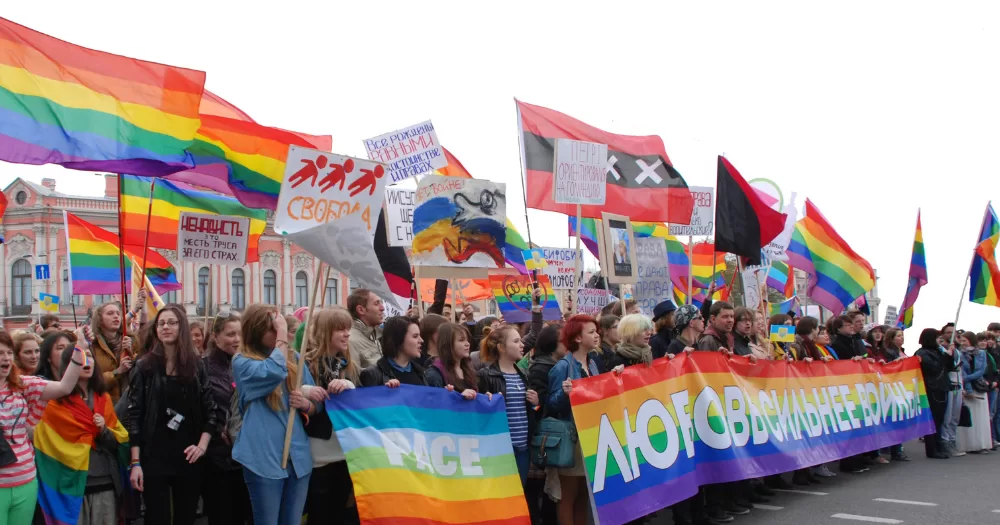
A court ruling in Russia has intensified international concern over the country’s deepening crackdown on LGBTQ+ rights, following the sentencing of a young nightclub owner under sweeping ‘extremism’ laws.
23-year-old entrepreneur Tatiana Zorina was sentenced to four years in a penal colony by a court in Chita. The Ingodinsky District Court found her guilty of “organising the activities of an extremist organisation”, alleging that she used a nightclub in Russia, Tochka, formerly known as Jackson, to promote what authorities describe as the “international LGBT movement”.
This description stems from a 2023 ruling by the Supreme Court of Russia, which labelled the so-called “international LGBT movement” as extremist, despite widespread criticism that no such formal organisation exists. Legal experts and activists argue that the vague classification allows authorities to target individuals and groups at random.
Zorina was arrested in October 2024 after police raided the nightclub. Prosecutors claimed the venue functioned as a space encouraging LGBTQ+ identity and community, which they equated with extremist activity. In addition to her sentence, she has been banned from managing online communities or leading public organisations for four years following her release.
Human rights organisations have strongly condemned the case. Amnesty International described the ruling as emblematic of an escalating misuse of anti-extremism legislation to suppress minority groups. The organisation has called for Zorina’s immediate release and the repeal of laws criminalising LGBTI-related expression and association.
Marie Struthers, Amnesty’s Director for Eastern Europe and Central Asia, commented on the case: “Tatiana Zorina’s sentencing is a stark illustration of how Russia’s abuse of ‘extremism’ legislation has spiralled into outright persecution targeting LGBTI people and their allies.” She stressed that operating a venue intended as a safe and inclusive space should not be treated as a criminal offence, warning that such prosecutions risk legitimising broader discrimination.
According to Amnesty, at least 23 criminal cases have been initiated by the end of 2025 under extremism laws linked to LGBTQ+ activity. Observers say this signals a widening campaign that extends far beyond individual prosecutions, creating a chilling effect across civil society.
Critics argue that the legal framework now effectively amounts to a blanket ban on LGBTQ+ existence in Russia. The country’s broad interpretation of ‘extremism’ has raised growing concerns about violations of fundamental human rights.
© 2026 GCN (Gay Community News). All rights reserved.
Support GCN
GCN is a free, vital resource for Ireland’s LGBTQ+ community since 1988.
GCN is a trading name of National LGBT Federation CLG, a registered charity - Charity Number: 20034580.
GCN relies on the generous support of the community and allies to sustain the crucial work that we do. Producing GCN is costly, and, in an industry which has been hugely impacted by rising costs, we need your support to help sustain and grow this vital resource.
Supporting GCN for as little as €1.99 per month will help us continue our work as Ireland’s free, independent LGBTQ+ media.