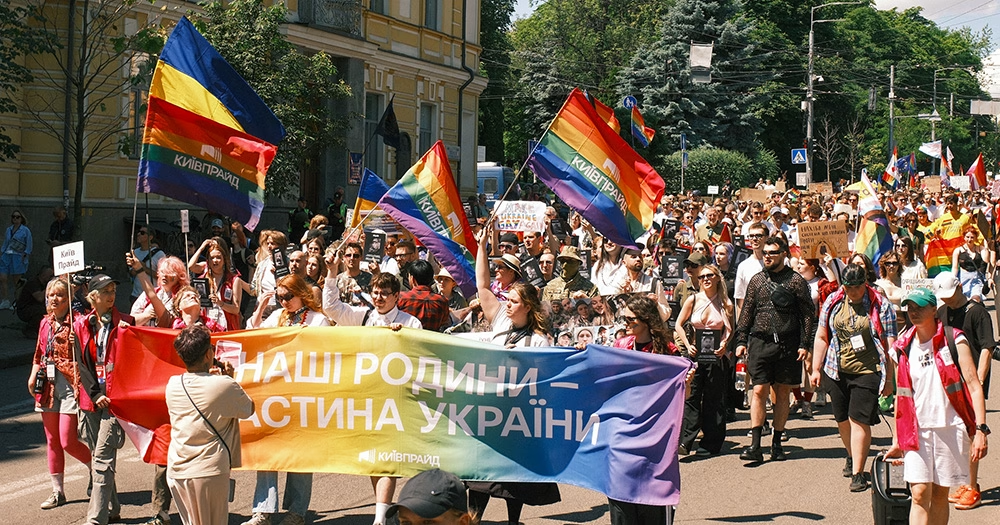
On June 21, Kyiv held its 10th Pride march. The event was the biggest rally that the city has seen, with over 5,000 people in attendance. However, the occasion was brought to an abrupt end as the Russian military launched a missile attack during the closing speeches, leaving organisers no choice but to move the crowd to shelter.
This was not the only disruption during the KyivPride celebrations. In the lead-up to the march, on June 14, the group organised KyivPride Park, drawing around 2,000 people and becoming the largest charitable and educational LGBTQ+ event the country has held.
But in the early hours of the morning on June 15, a Russian drone sparked a fire at the Dormition Cathedral of the Kyiv-Pechersk Lavra. The Dovzhenko Film Studio was also affected in the blaze, destroying much of Ukraine’s oldest film-costume collection.
Some of the costumes destroyed belonged to notable actor Sergei Parajanov, including ones worn in his 1965 film Shadows of Forgotten Ancestors. Parajanov was an actor that was arrested for his sexuality by the Soviet Regime in 1973 and sentenced to five years in prison. The full scale of loss from this attacked may never be fully assessed.
The war between Russia and Ukraine has been going on for over 12 years. The initial attack was in February 2014, when disguised Russian troops covertly invaded and took control of the Ukrainian autonomous republic of Crimea.
In the months after the invasion of 2014, Russian troops seized control of territory in Ukraine’s Donbas region. This led to constant fighting between the locals and the Russian military, resulting in over 14,000 deaths before the full-scale invasion of 2022.
When first asked why Russia was invading Ukraine, President Vladimir Putin stated that Ukraine was committing genocide against the Russian speakers in the Donbas region. These allegations have been internationally discredited, and the invasion is recognised as an attempt to reassert Russian influence over Ukraine and prevent the country from furthering its integration with the European Union and NATO.
Due to the war, large outdoor gatherings carry real risk. To mitigate some of this, KyivPride does not rely on a single march. Instead, a wider programme is organised, including educational and community events and charitable drives.
With the added danger of war, the main focus of KyivPride is the safety of everyone in attendance, requiring weeks of work and cooperation between the city administration and the National Police.
Even with the added risk of war, local LGBTQ+ communities were not going to let it stop them celebrating Pride. On June 21, 5,000 community members and supporters gathered for the 10th Pride march in Kyiv, under the theme ‘Recognise Our Families’. They marched through city for roughly two hours, covering over 1.2 kilometres.
The 10th Pride march in Kyiv was organised into nine columns: a trans column, the UKRAINEPRIDE column, a KharkivPride column, the Ukrainian ballroom community, the NGO Insight, the Mentally.one project, an artistic column, the student parliament of the Educational and Scientific Institution of Philology column, and a column of LGBTQ+ service members, veterans and their families.
Participants in the latter paid tribute to those who had died on the frontlines. Photos of the fallen soldiers were carried by their brothers and sisters-in-arms. Those that had never came out in life had their face blurred during the march.
Around 80 people marched as part the diplomatic column. Representatives from embassies including Sweden, Canada, Germany, Australia, Italy, Norway, Belgium, the United Kingdom, Finland, Spain, Denmark, and France were in attendance. Ambassadors from Canada and the Kingdom of the Netherlands also marched alongside the other representatives from the European Union, the Council of Europe, the World Bank, and the United Nations.
View this post on Instagram
Although the speeches were cut short, this was something the organisers were prepared for. Even with the threat of missile attacks, the event was still safer than it has been in previous years. In 2022, KyivPride held the march underground in the Kharkiv metro because it was too dangerous to be walking the streets.
This year had seen many improvements for the LGBTQ+ community in Ukraine. This was the first year that the city administration published an official statement in support of KyivPride.
Not long ago the community was treated as a fringe of society, but support has continued to grow. Yakima Lavrynets, Co-Organiser of KyivPride and Kharkiv Pride, said, “10 years ago, at my first KyivPride, we were called marginal, both in the Media and by opinion leaders. Today I see more support for LGBTQI+ rights and more respect from Ukrainians.
“It showed at the march too: our opponents came out under slogans about ‘traditional values,’ in balaclavas, and behaved aggressively. And online, it was that behaviour that people called marginal. That says a great deal about how society has changed over these 10 years.”
KyivPride Co-Organiser Yuliia Shypitko added, “After the full-scale invasion, the first KyivPride in the capital took place in 2024, and since then we have watched the scale of our events grow year after year. There are more partners, more allies, and more people ready to come out for Pride and to support equality openly.
“At the same time, our team has barely grown. This year’s KyivPride, the largest Pride in Ukraine, was organised by just six people together with around 60 volunteers. And about 2,000 people came out to our KyivPride Park event and 5,000 to the March.
“That is hugely inspiring, but it also shows how big KyivPride has become, and how much more responsibility this work carries with every year.”
Ukraine is moving away from the values of the quasi-empire it is fighting. On June 11, in answering a question at the launch of a national cultural initiative, President Volodymyr Zelensky spoke in favour of equal rights: “I believe we must speak openly with society about everything, and that is absolutely normal.
“We are all here together, we are defending the state. We are equal, and we have absolutely equal rights, regardless of any prejudices from the 15th century. We are modern people.”
© 2026 GCN (Gay Community News). All rights reserved.
Support GCN
GCN is a free, vital resource for Ireland’s LGBTQ+ community since 1988.
GCN is a trading name of National LGBT Federation CLG, a registered charity - Charity Number: 20034580.
GCN relies on the generous support of the community and allies to sustain the crucial work that we do. Producing GCN is costly, and, in an industry which has been hugely impacted by rising costs, we need your support to help sustain and grow this vital resource.
Supporting GCN for as little as €1.99 per month will help us continue our work as Ireland’s free, independent LGBTQ+ media.