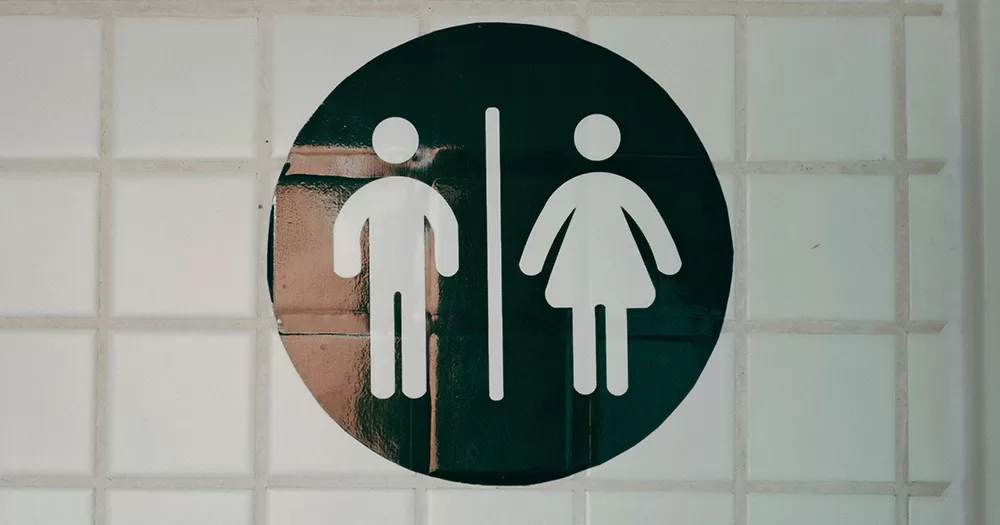
The Equality and Human Rights Commission (EHRC) is updating its Code of Practice to allow for single-sex spaces (such as toilets, changing rooms, and refuges) to be restricted based on biological sex. This comes following the UK Supreme Court’s exclusionary ruling in April 2025 on the legal definition of ‘woman’.
The Code of Practice is expected to be approved by the UK parliament in the coming months. This will very likely lead to trans people being excluded from public life as they will be asked by businesses and public institutions to use facilities and services that don’t match their gender.
The negative impact this will have on the lives of thousands of trans and non-binary people cannot be overstated. They already face widespread exclusion and discrimination, and this will pave the way for more of the same.
While the new Code of Practice around single-sex spaces is often sponsored in the name of “protecting women”, it’s actually dangerous for cis people as well. There are many recorded cases of cis women facing exclusion based on not being deemed “female enough”.
Back in 2016, the American Civil Liberties Union reported that “a Texas woman trying to use a women’s restroom in a hospital was accosted by a man twice her size trying to make sure she was ‘going in the right place,’ all because she was wearing a baseball hat with short hair.”
The woman in question was cisgender, not transgender. A cis woman was the victim of that man’s transphobia and misogyny. I say misogyny because he reduced that woman to the sexist stereotypes of how he thought she should look. Could he always tell? Clearly not!
The Texas incident is far from isolated. Around the same time, a cis woman in Danbury, Connecticut, was washing her hands in a women’s restroom when a stranger called her “disgusting” and remarked that she didn’t “belong here!”
A cis woman was told she didn’t belong in the space. Why? Because she had a pixie-style haircut and baseball cap, which in the stranger’s mind made her something other than a woman.
In Las Vegas in 2023, a cis woman was accosted in a restroom by another woman who aggressively said, “Trans, figure out your identity at home… they better not come out of there… that’s not allowed … that’s a boy, [and] they think this is [OK] because it’s being taught in schools.” Why? Because she had short hair.
In 2025, Florida, a six-foot-four cis woman was fired from her job at Walmart because a customer falsely claimed she was transgender. The woman faced a threat of being beaten up when a man followed her into a female restroom. She believes, “he assumed that I am trans because of my height. It was terrifying.”
Similarly, in 2025, Minnesota, the Advocate reported that an 18-year-old cis girl “filed a gender discrimination case against a Buffalo Wild Wings location after a server reportedly followed her into the bathroom and made her prove she is not transgender.”
This was yet another example of a cis person experiencing appearance-based discrimination; a terrifying and traumatic experience caused by transphobia and misogyny.
The Advocate also reported on another incident that took place the same year in Phoenix, Arizona: “A Black 19-year-old cisgender lesbian from Phoenix is demanding accountability after she was confronted by two male sheriff’s deputies in a Tucson Walmart women’s restroom last week.
“Arizona resident Kalaya Morton, who describes herself as a stud, or masculine-presenting woman, says the deputies were called by a store employee who allegedly assumed she was a transgender woman.”
This is not a US-only crisis. Many incidents in other parts of the world have been reported, too.
In London in 2025, a cis woman was shouted at by a man who accused her of using the wrong bathroom. While in a queue to use the facilities, a man yelled, “The men’s toilets are on this side!” all because she had short hair and was dressed in masculine clothing.
In Exeter in 2024, Assigned Media reported: “A half-marathon win by a mother-of-four in Exeter, UK, is demonstrating in stark terms how much the anti-trans hate campaign has done for women in athletics. Anna Harrold’s victory at the Great West Race was met by slurs, harassment, and false claims that she was a trans woman, according to reporting in the Independent. Harold later told the Independent that no one should be subjected to such monstrous treatment.”
Of course, many more incidents go unreported. These encounters have a devastating impact on the victim’s health, safety, and, in some cases, their career.
So, are these policies really protecting women and girls? Do these trans bathroom bans and single-sex spaces make so-called “biological women” safer? These reports suggest the opposite.
Nonetheless, the EHRC is determined to press ahead with its appearance-based trans exclusions, backed by bad-faith anti-trans charities who will stop at nothing to force these cruel and demonising exclusions into law.
While trans, non-binary and gender non-conforming people will be disproportionately harmed by these policies, it will also be damaging for cis people who don’t quite look ‘woman’ or ‘man’ enough. Is this what we want as a society? Do these exclusions actually protect anyone? It seems it will only cause harm to trans and cis people alike.
© 2026 GCN (Gay Community News). All rights reserved.
Support GCN
GCN is a free, vital resource for Ireland’s LGBTQ+ community since 1988.
GCN is a trading name of National LGBT Federation CLG, a registered charity - Charity Number: 20034580.
GCN relies on the generous support of the community and allies to sustain the crucial work that we do. Producing GCN is costly, and, in an industry which has been hugely impacted by rising costs, we need your support to help sustain and grow this vital resource.
Supporting GCN for as little as €1.99 per month will help us continue our work as Ireland’s free, independent LGBTQ+ media.