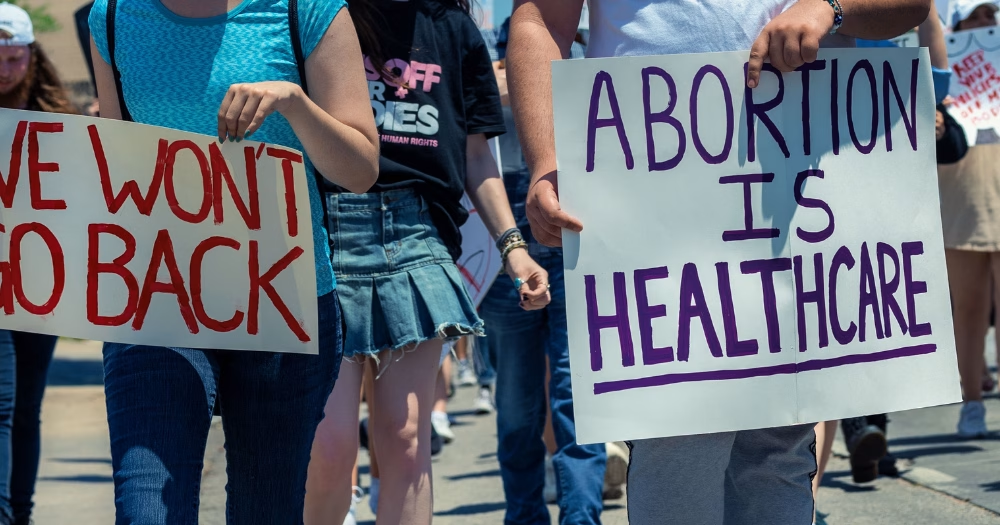
The Dáil has voted to remove Ireland’s mandatory three-day waiting period for abortion services, describing it as the removal of an unnecessary barrier to healthcare.
The proposal was approved by 86 votes to 70 and will now proceed to an Oireachtas committee. It is understood that Minister for Health Jennifer Carroll MacNeill will hold discussions with Attorney General Rossa Fanning, with the bill potentially becoming law before the end of the year.
The Abortion Rights Campaign welcomed the vote, saying: “This particular barrier to abortion care was never suggested by the Citizens Assembly or the Oireachtas committee, but added as a sop to reluctant politicians to make them ‘more comfortable’ with legal abortion.
“We refuse to allow political comfort to be prioritised over women’s healthcare anymore.”
View this post on Instagram
The National Women’s Council also welcomed the vote to end the three-day waiting period for abortions. Executive Director Corrinne Hasson stated, “We know that women in situations of domestic abuse, women living in IPAS centres, disabled women, rural women, and women on lower incomes all face more difficulties attending two GP appointments. We also know that in some cases, the mandatory 3-day wait timed women out of care, forcing some to travel. So it’s very welcome that this will now change.”
The vote comes eight years after the 2018 referendum that repealed the Eighth Amendment in the Constitution. More than two million votes were cast, with 66.4% voting in favour of repeal and 33.6% voting against.
However, the latest vote exposed divisions and criticisms within Fianna Fáil. A majority of the party’s TDs opposed the removal of the waiting period, including five Cabinet members. Minister for Justice Jim O’Callaghan, Minister for Social Protection Dara Calleary, Minister for Housing James Browne, Minister for Children Norma Foley and Government Chief Whip Mary Butler all voted against the proposal.
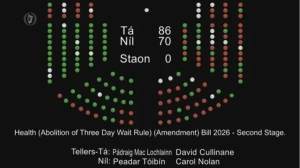
By contrast, Taoiseach Micheál Martin, Minister for Public Expenditure Jack Chambers and Minister for Transport Darragh O’Brien supported the measure. Overall, 30 Fianna Fáil TDs voted against the bill, while 12 voted in favour and six were absent.
Debate has also focused on Sinn Féin’s decision not to support the wider Social Democrats bill that sought not only to remove the waiting period but also to expand access to abortion services in cases involving fatal foetal abnormalities.
A 2023 review of abortion legislation identified a lack of clarity around the application of certain provisions of the law and recommended updated ministerial guidelines regarding fatal foetal abnormality cases. Under current legislation, terminations may be carried out where there is a risk to the life of the pregnant person, a risk of serious harm to their health, or where a condition is present that is likely to lead to the death of the foetus either before birth or within 28 days of birth.
The review also highlighted concerns that a large number of people continue to travel to Britain to access services unavailable in Ireland. Under the existing Act, while people seeking abortions are decriminalised, anyone assisting a pregnant person to obtain an abortion outside the provisions of the legislation can face a prison sentence of up to 14 years. The Abortion Rights Campaign and the National Women’s Council have both noted that further reform is needed.
Social Democrats leader Holly Cairns criticised the pace and state of reform, saying: “There are clear gaps in the abortion law that was introduced following the Repeal referendum, which are having a negative impact on women.
“That is not my opinion. That is the conclusion of an expert review of that law, commissioned by the government, and published three years ago.”
Deputy Cairns is referring to a government-commissioned mandatory review done in 2023 into the abortion legislation. Around 7,000 public and expert submissions were made to the review. Its findings pointed to significant barriers to care and recommended a number of reforms.
Deputy Cairns added: “That report has been continually ignored by the government and undermined in the debate. It is wholly disrespectful to invite people to share details of deeply personal experiences and then ignore the findings. We are tired of having to tell tragic stories to make change in this country.
“Unfortunately, this legislation does not address the myriad of issues that remain with our abortion legislation, which forces 240 people a year to travel elsewhere to get healthcare they should get at home.”
Did you know that this Pride month, you can support GCN by donating €1 when you shop online with PayPal? Simply select GCN at the checkout or add us as your favourite charity* at this link to support Ireland’s free LGBTQ+ media.
*GCN is a trading name of National LGBT Federation CLG, a registered charity – Charity Number: 20034580.
© 2026 GCN (Gay Community News). All rights reserved.
Support GCN
GCN is a free, vital resource for Ireland’s LGBTQ+ community since 1988.
GCN is a trading name of National LGBT Federation CLG, a registered charity - Charity Number: 20034580.
GCN relies on the generous support of the community and allies to sustain the crucial work that we do. Producing GCN is costly, and, in an industry which has been hugely impacted by rising costs, we need your support to help sustain and grow this vital resource.
Supporting GCN for as little as €1.99 per month will help us continue our work as Ireland’s free, independent LGBTQ+ media.