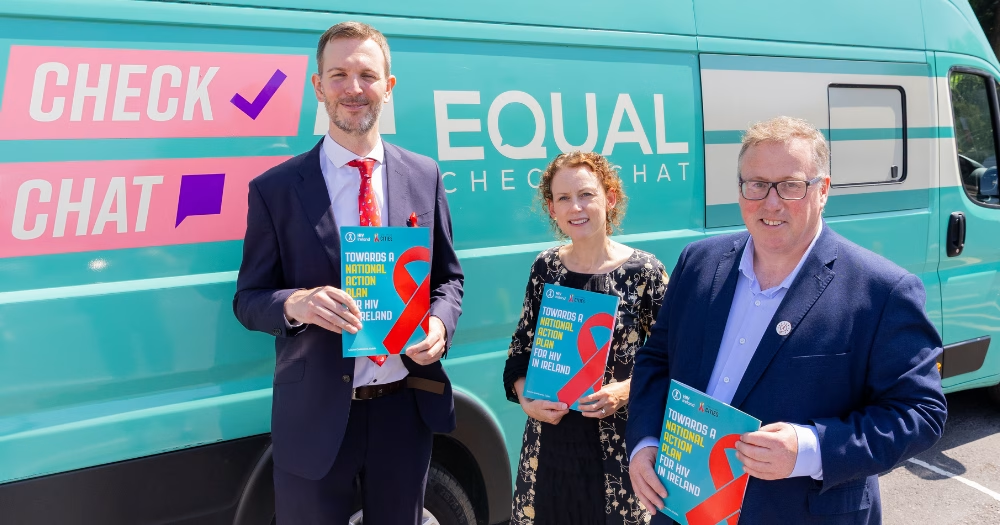
HIV Ireland has launched a new report calling for urgent Government action, as they warn that Ireland is at serious risk of failing to meet its commitment to end new HIV transmissions by 2030.
The report, Towards a National Action Plan for HIV in Ireland, sets out a roadmap aimed at improving HIV prevention, testing and care, with a strong focus on accountability, funding and measurable outcomes.
To coincide with the launch on Wednesday, July 15, HIV Ireland brought its ‘Check and Chat’ bus to Merrion Square beside Leinster House, inviting politicians and members of the media to take an HIV test.
Speaking outside Leinster House at the report launch, HIV Ireland Executive Director Stephen O’Hare told GCN that the document builds on discussions held during last year’s Fast Track Cities Autumn Conference, which brought together clinicians and community organisations from Ireland and the UK to share best practice.
“Ireland has committed to developing a National Action Plan… We want to see that action plan developed. We want to see it resourced,” O’Hare said. “We’ve got four years left to hit our target, to eliminate new HIV transmission.”
He went on to explain how this can be done, stating, “The tools exist to help us get where we need to be, but we need to resource them, and we need to structure in a way that everybody who needs access will get access.”
The organisation says Ireland continues to experience rising HIV diagnoses in some groups, while late diagnosis remains a significant challenge. It also highlighted waiting times of up to a year for people seeking Pre-Exposure Prophylaxis (PrEP).
Among the report’s recommendations are the immediate introduction of routine opt-out HIV and blood-borne virus testing in emergency departments, eliminating PrEP waiting lists, and expanding access to testing, treatment and care through primary and community healthcare services.
The report also warns of the financial consequences of failing to act. It estimates that the cost of caring for people living with HIV in Ireland between 2025 and 2030 could exceed €694 million, while the lifetime costs associated with new HIV diagnoses during that period are estimated at more than €2.02 billion.
Professor Yvonne Gilleece, Consultant in HIV Medicine, said experience in England has shown that a structured, evidence-based national strategy can significantly improve HIV prevention and treatment outcomes, adding that Ireland needs a similar framework to achieve its 2030 target.
Dr Cathal O’Broin, Consultant in Infectious Diseases, said tackling late diagnosis through routine opt-out testing and improving access to PrEP would be essential to reaching underserved communities.
© 2026 GCN (Gay Community News). All rights reserved.
Support GCN
GCN is a free, vital resource for Ireland’s LGBTQ+ community since 1988.
GCN is a trading name of National LGBT Federation CLG, a registered charity - Charity Number: 20034580.
GCN relies on the generous support of the community and allies to sustain the crucial work that we do. Producing GCN is costly, and, in an industry which has been hugely impacted by rising costs, we need your support to help sustain and grow this vital resource.
Supporting GCN for as little as €1.99 per month will help us continue our work as Ireland’s free, independent LGBTQ+ media.