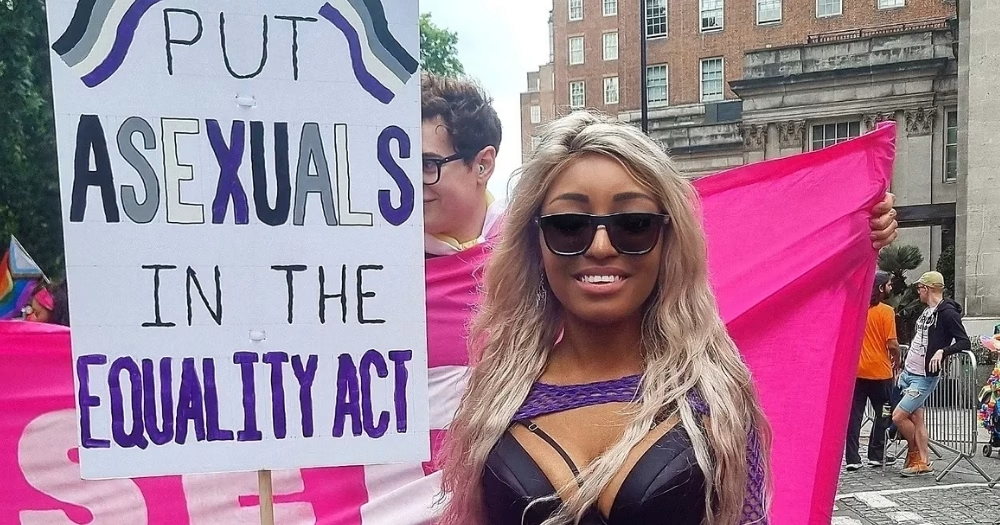
Earlier in June, asexual activist Yasmin Benoit took part in the Silent Letters: Addressing Invisibility in LGBTQIA+ Health and Social Care conference, organised by LGBT Ireland in Dublin. Speaking in front of the audience, she addressed pressing issues faced by the asexual community, such as access to healthcare and being subjected to harmful so-called ‘conversion therapy’ practices.
Yasmin Benoit is one of the most prominent asexual activists worldwide. Having publicly come out in 2017, she soon became an outspoken advocate for the rights of this too-often marginalised part of the community.
I had the pleasure of speaking to her after the conference in Dublin, when she outlined some of the challenges the asexual community still faces nowadays. While there has been progress in the last few years, with increased representation online and on TV, one of the main issues remains visibility.
For asexual people, this is true both inside and outside the LGBTQ+ community. “The community is not any more educated than those outside of it,” Yasmin said.
“You’d probably assume that queer people would know more about it, but really, in my experience, they do not. You have the exact same misconceptions that it’s a personality trait, or it’s a mental condition, or it’s a physical side effect of something, or that it’s a lifestyle choice, or a value judgment towards sexuality in general.”
Beyond the lack of visibility and awareness, there are other issues the asexual community faces, related in part to the former. “We still have the medicalisation issue and the pathologisation issue, which other orientations have also had historically, and other identities still do.
“Unlike homosexuality being de-medicalised in the ’70s, we never really had that. So if you explain asexuality to a medical professional, their training will tell them that this is a psychological condition or that it is a sexual dysfunction. Because that’s what’s literally in the medical manuals and the training, so I don’t blame them for it.
“But it means that the instinct is to see asexuality as either a symptom or as a condition, and thus something that needs fixing,” she added. “And then it ends up going down what is essentially the conversion therapy path, because they are trying to fix your sexual orientation.”
Yasmin also highlighted how, in such instances, medical professionals will try to make their asexual patients adhere to a strictly heteronormative blueprint. “They’re not trying to make more gay people. In none of the case studies I found, particularly the ones of women, were they saying, ‘You need to be more attracted to women. Have you tried being attracted to women?’ They’re like, ‘What’s your problem with men? Why won’t you have sex with men? You should be having sex with men.’
“They’re literally just trying to make more straight people, in essence. Because that is what our society tells people to do.”
For asexual patients, then, “that ends up being a barrier because that’s not what they came to seek healthcare for,” the activist said.
“Even in therapy, if your end goal of what you’re taught is fulfilment or happiness or how you live a normal life, if that end goal is that you need to be experiencing sexual attraction towards men or you need to be having sex a certain amount of times, then you’re never gonna reach the fulfilling end of your therapy.
“People often end up having to do or being told to do things they don’t wanna do but feeling like they should because a medical professional has told them, and then needing more therapy after that.”
The fact that asexual people are more likely to be exposed to conversion therapy has also been documented in the UK government’s National LGBT Survey. Despite this, asexual people were not included in the proposed ban on conversion practices published in June.
“We weren’t included in the proposed ban anyway, even though they found that we were 10% more likely to be offered or to undergo it compared to other orientations,” Yasmin said. “Because there’s still the existing loophole of us not being in the Equality Act, not being in any legislation or in any curriculum or anything else.
“A lot of the times when they’re thinking of conversion therapy, they are thinking of the religious kind rather than one that is literally mandated through the NHS and is included in the training. That’s an entirely different issue to solve.
“I think it’s very important that asexuality is explicitly included in the bans because as with the Equality Act, if it isn’t explicit, then it’s not necessarily there, then it just falls into the loophole.”
This is why we must make sure that asexuality is included in broader conversations about the rights of the LGBTQ+ community. “Every issue that the asexual community is facing, whether it’s conversion therapy or medicalisation or acephobia, it’s all because of heteronormativity. It’s all very much tied to the same cause.
“And also, it is just part of conversations about sexuality. I feel like there’s more to queerness than just who you’re having sex with and how, and I think it does everyone a disservice to boil it down to that.”
To learn more about Yasmin Benoit’s work, visit her website here.
© 2026 GCN (Gay Community News). All rights reserved.
Support GCN
GCN is a free, vital resource for Ireland’s LGBTQ+ community since 1988.
GCN is a trading name of National LGBT Federation CLG, a registered charity - Charity Number: 20034580.
GCN relies on the generous support of the community and allies to sustain the crucial work that we do. Producing GCN is costly, and, in an industry which has been hugely impacted by rising costs, we need your support to help sustain and grow this vital resource.
Supporting GCN for as little as €1.99 per month will help us continue our work as Ireland’s free, independent LGBTQ+ media.