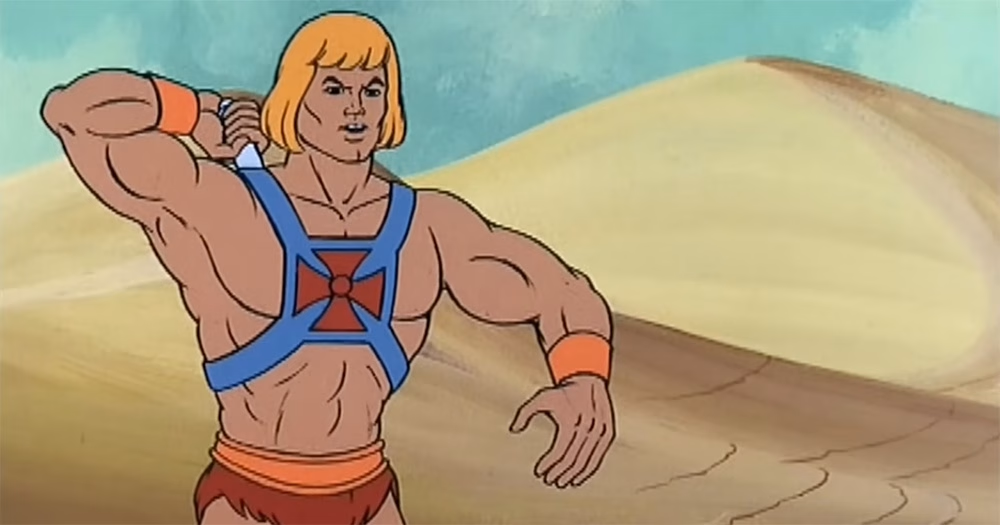
With Masters of The Universe hitting the big screen, I thought I’d take a look at what made the original TV show queer and why the movie may bring more of the same. The animated series He-Man and the Masters of the Universe premiered in 1983, going on to air 130 episodes before finishing in 1985.
The cartoon was produced by Filmation, its creation driven by the success of a toy line created by Mattel the year prior. Lou Scheimer, who voiced characters in He-Man, pointed out that Filmation welcomed many openly gay artists throughout the 1980s, artists who perhaps wanted to see themselves onscreen.
“It was a joke in the studio,” Scheimer recalls. “Everybody was saying, ‘Prince Adam is gay’.” This is a theory shared by many fans, who have pointed out that, amongst other things, the character has never pursued a romantic relationship with women.
The show has obvious queer undertones. He-Man’s muscular body is a focal point of the series. When the show first aired in the United States in the early 1980s, this look would have been familiar to gay men, as it was a prominent aesthetic amongst the community.
Prince Adam and He-Man’s clothing also conform to some queer stereotypes. Adam wears lavender stretch pants, furry purple Ugg boots, and a sleeveless pink blouse. He-Man’s outfit adds to the show’s homoerotic subtext with its resemblance to leather gear, particularly the harness. And then there’s the furry underpants…
Of course, the main character’s dual identity is something queer fans in the 1980s could additionally see themselves in. Some have noted the character’s transformation as an allegory for having the power to come out of the closet. (Adam exclaims, “I have the power!” before the transformation is completed.)
So what about the new movie? It was written by queer screenwriter and director Chris Butler, writer of two Academy Award-nominated movies (ParaNorman (2012) and Missing Link (2019)). He grew up as a fan of the original TV series and has said that it helped inspire him to get into the entertainment industry. He acknowledges that the show, with characters named Fisto and Ram-Man, had an obvious camp element and is full of innuendo.
He decided, “Let’s not shy away from the camp, let’s embrace it.”
The movie’s lead, Nicholas Galitzine, has a large queer following, helped by his roles in gay films like Handsome Devil (2016) and Red, White & Royal Blue (2023). I had questioned whether he would be the right person to play He-Man, a role previously portrayed in live-action by Dolph Lundgren, an actor known for his bodybuilder physique. However, Galitzine has obviously put a lot of work in to capture the look of the character, and the trailers I have seen look promising on that point. He has joked that Prince Henry will have “hit the gym” for the Red, White & Royal Blue sequel, which is currently in post-production, meaning Galitzine had no time to shed the muscle he had gained.
At the UK premiere, Nicholas Galitzine was asked about his sex symbol status amongst the queer community. He responded, “I love all my queer fans. They’ve supported me so much throughout my career. It means being He-Man and being in Leicester Square.”
He also said that he hopes that queer fans go see the movie. Initial reports from fellow geeks have been very positive, so this queer ’80s kid will be heading to see it soon.
© 2026 GCN (Gay Community News). All rights reserved.
Support GCN
GCN is a free, vital resource for Ireland’s LGBTQ+ community since 1988.
GCN is a trading name of National LGBT Federation CLG, a registered charity - Charity Number: 20034580.
GCN relies on the generous support of the community and allies to sustain the crucial work that we do. Producing GCN is costly, and, in an industry which has been hugely impacted by rising costs, we need your support to help sustain and grow this vital resource.
Supporting GCN for as little as €1.99 per month will help us continue our work as Ireland’s free, independent LGBTQ+ media.