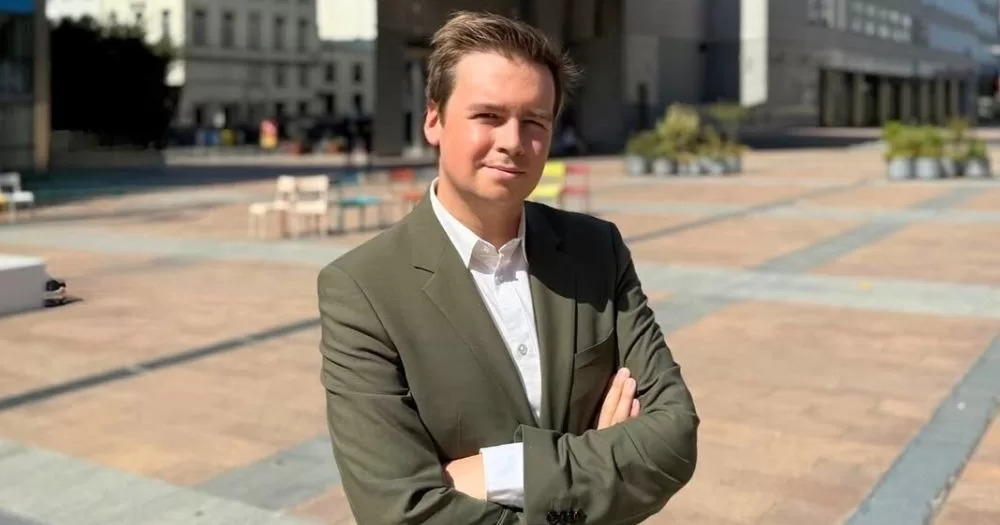
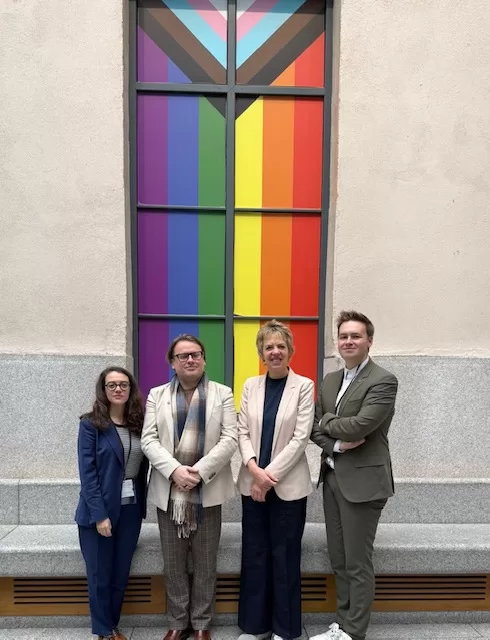
Adam Long, Board Director with the National LGBTQ+ Federation (NXF), recently interviewed the Brussels-based democracy and LGBTQ+ rights campaigner, Rémy Bonny, about his work and activism, having earlier hosted Rémy and his colleague Esther Martinez during their visit to Dublin in October. The visit, during which the delegation met with a number of political and other important officials, was part of a wider initiative to galvanise support among EU member states to take decisive action against the escalating attacks on LGBTQ+ rights in Europe and beyond. The most egregious example of these attacks has occurred in Hungary, where the far-right government of Viktor Orbán has sought to ban LGBTQ+ Pride events, having earlier passed a so-called ‘gay propaganda’ law modelled directly on similar homophobic legislation enacted in Putin’s Russia.
As Rémy Bonny explained, these shameful actions by global autocrats and illiberal ‘populists’ targeting the basic freedoms of LGBTQ+ people, in Hungary and beyond, need to be seen for what they are: a much broader, coordinated attack on fundamental democratic norms and values more generally.
How did you come to be involved in LGBTQ+ rights campaigning/advocacy?
I didn’t become an activist because it looked glamorous. I became one because I was a queer kid who learned very early that the world could be violent, humiliating, and profoundly unfair and that nobody was coming to save me.
I was bullied brutally in my teens. I was beaten in front of my school gates while being called homophobic slurs. Teachers told me I was “stupid.” I was outed at 14 before I even understood who I was, and I carried that fear with me for years. And instead of breaking me, all of this pushed me into politics far too young because fighting back felt like the only way to survive.
My activism began long before I had the language for it. Already at 15, 16, 17, I was sitting in rooms with politicians negotiating constitutional reforms, because I couldn’t stand watching adults make decisions about our lives without ever listening to us. And when I discovered the extent to which anti-LGBTQ+ movements were collaborating across borders, from Moscow to Budapest to Brussels, something inside me hardened. I realised my personal story was not unique. It was structural. It was political.
So I made a choice: if the world wanted to silence queer people like me, then I would spend my life making sure they heard us instead. That’s how I ended up here. Not out of ambition, but out of necessity and out of love for our community.
Can you tell me about the work of Forbidden Colours?
Forbidden Colours is a European human-rights organisation fighting for democracy and LGBTIQ+ rights, and exposing the transnational networks trying to destroy both. We investigate Russian-aligned influence operations, push EU Member States to use their legal powers, and run campaigns that force institutions to act when they would rather look away. We are small, but strategic. And we punch above our weight because our community cannot afford for us to be polite or patient.
You have been visiting a number of EU capitals, including Dublin, as part of a joint initiative with Reclaim. What has been the purpose of these visits?
We’ve been travelling across the EU because Brussels — especially the European Commission — has stopped doing its job. Hungary banned an LGBTQ+ Pride event in 2025, and the Commission took zero meaningful legal action. Zero. So we are going capital to capital, asking pro-democracy governments to step up where the Commission has failed.
Our message is simple: if the EU’s guardian of the Treaties won’t defend LGBTIQ+ rights, then the Member States must. Under Article 259 of the Treaty on the Functioning of the European Union (TFEU), countries like Ireland can take Hungary to court themselves. And right now, that is our only hope
As mentioned, you were in Dublin in early October. Can you tell us a little about your trip, who you met, how it went?
Dublin gave us hope, and that isn’t something I say lightly these days. We met political leaders, civil-society allies, and people in government who actually understood the urgency of the situation in Hungary.
I was honest with everyone we spoke to: this is personal for me. I used to live in Hungary. My heart belongs to the queer community there. I’ve seen first-hand how courageous, creative, and resilient they are. And I’ve watched with horror how Viktor Orbán’s regime pushed the LGBTQ+ community in Hungary to the brink and how the EU institutions looked away. The solidarity we felt in Dublin was real. But now we need that solidarity turned into action.
Why is holding to account the far-right Orbán regime in Hungary so important in the broader European democratic context?
Because Hungary is not only dismantling LGBTQ+ rights: it is dismantling the European project from the inside. Every attack on queer people is also an attack on free speech, on rule of law, on democratic accountability. And every time the EU fails to act, Orbán pushes one step closer to the Kremlin.
A banned Pride is not just a symbolic gesture: it is a test. And right now, the EU is failing that test. People like Géza Buzás-Hábel, the organiser of Pécs Pride, are being interrogated and now formally indicted. Hungary is criminalising peaceful LGBTQ+ activism. If we let this slide, we are letting a Member State become a fully-fledged Russian client regime, with EU funding. This is not just Hungary’s problem. This is Europe’s democracy problem.
What is your message for the European Commission (including Irish Commissioner Michael McGrath)?
My message is blunt: stop abandoning LGBTQ+ people in Hungary. Start doing your job. The Commission has missed every meaningful legal opportunity — from soft-pedalling legal action to refusing to challenge the Pride ban. At this point, it feels like political convenience has replaced moral responsibility.
So let me be very clear. If the Commission continues to refuse to act, Member States like Ireland must use Article 259 of the TFEU and take Hungary to court themselves.
Ireland has moral authority in Europe. It has lived experience of fighting for equality. I am asking Ireland to lead because the Commission is not.
What are the other key LGBTQ+ challenges in the EU right now?
Hungary is the epicentre, but the tremors are everywhere. Bulgaria is pushing a Russian-style anti-propaganda law. Slovakia has adopted constitutional amendments declaring queer people second-class citizens. Italy is making life unlivable for LGBTQ+ parents. Poland’s anti-rights networks are reorganising, waiting for their next political moment. Disinformation campaigns funded by foreign actors are flooding social media across the EU.
These issues do not exist in isolation. They are coordinated, financed, and strategically aligned. Which is why our response must also be coordinated and courageous.
Who are the main backers of the anti-gender, anti-LGBTQ+ movement?
A toxic coalition of actors: Russian oligarchic networks spreading propaganda and financing anti-rights conferences across Europe on behalf of the Kremlin; US Christian right organisations, exporting their culture-war machinery into EU politics, on behalf of President Trump; domestic far-right parties using queer people as scapegoats to consolidate power; and increasingly, anonymous shell foundations that launder money and influence with zero transparency.
What unites them is simple: they see LGBTQ+ equality as a threat to authoritarian and oligarchic control. And they are willing to cross borders, fund extremists, and destabilise democracies to stop us. All to fill their own pockets.
You recently hosted an event in Brussels where former Taoiseach Leo Varadkar spoke. Can you tell us more?
We wanted to bring together political courage and strategic clarity and Leo Varadkar delivered exactly that. He spoke openly about the threats facing democracy, the role of disinformation, and why LGBTQ+ rights are a national security issue in Europe.
The event, which we co-organised with The Merode and Harvard Kennedy School’s Carr Center, had a very specific purpose: to warn Europe that the anti-LGBTQ+ movement is not a culture war; it is a geopolitical tool.
It was also a message towards more conservative voices within the European People’s Party, such as the Germans Ursula Von Der Leyen and Manfred Weber. They should stop selling us out to the far-right. Today, the EPP is blocking any European action to defend the lives of queer people. The liberal parts of the EPP must stand up now.
Having someone with Leo’s experience, especially someone who has personally faced the consequences of standing up for equality, made the conversation both intimate and powerful. It was a reminder that leadership still exists and that we need much more of it.
© 2026 GCN (Gay Community News). All rights reserved.
Support GCN
GCN is a free, vital resource for Ireland’s LGBTQ+ community since 1988.
GCN is a trading name of National LGBT Federation CLG, a registered charity - Charity Number: 20034580.
GCN relies on the generous support of the community and allies to sustain the crucial work that we do. Producing GCN is costly, and, in an industry which has been hugely impacted by rising costs, we need your support to help sustain and grow this vital resource.
Supporting GCN for as little as €1.99 per month will help us continue our work as Ireland’s free, independent LGBTQ+ media.