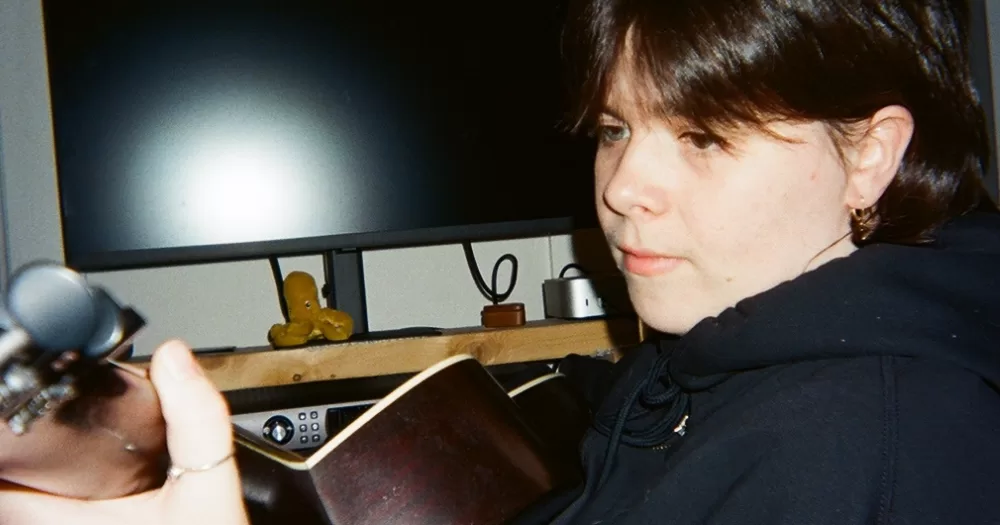
As Leith Ross prepares to bring their I Can See The Future tour to Dublin, the queer indie-folk songwriter sat down with GCN to talk all about entering what they describe as a new chapter, one defined by growth, reflection and what they described as themed with “hopeful existential dread”.
Raised in a small town outside Ottawa, Ontario, Ross has cultivated a devoted international following through candid lyricism and emotionally resonant songwriting. Blending indie folk with alternative flourishes and subtle rock textures, they have amassed more than 450 million streams across their catalogue to date. Yet despite the scale of their success, Ross’ music retains an intimate, confessional quality that feels rooted in small rooms rather than vast stages.
They first introduced their distinctive voice with the independently released Motherwell EP in 2020. Recorded live, the project quickly attracted critical acclaim and laid the foundations of a loyal fanbase. Their rise accelerated with the viral TikTok success of singles such as ‘I’d Have To Think About It’ and ‘We’ll Never Have Sex’, tracks that balanced vulnerability with disarming wit. Through these releases, Ross cultivated a thriving online community drawn to their openness and sincerity.
@leithross yeah </3 </3 </3 thinking thoughts and thinking things, here is a song #hey #missu #urcool ♬ original sound – Leith Ross
Their latest album, I Can See The Future, expands on those themes while grappling with adulthood, self-discovery and purpose. The record navigates personal introspection alongside broader existential questions, reflecting an artist who is both questioning and quietly hopeful. For Ross, it represents movement not away from uncertainty, but towards embracing it.
Ireland holds particular significance. An avid admirer of Irish culture, Ross grew up immersed in traditional music, shaped by their Irish grandparents and Scottish mother. Their grandfather was instrumental in nurturing their musical foundations, teaching them early tunes including ‘The Fields of Athenry’. While in Dublin, Ross hopes to visit The Cobblestone to absorb the trad sessions that continue to inspire their sound.
Community remains central to their artistic ethos. On previous tours, Ross has collaborated with grassroots organisations, offering space during performances for groups such as San Antonio Food Bank, TRANSYOUNITING in Pittsburgh and Black Farmers’ Table in Seattle to address audiences. Although this initiative has not extended to the European leg, the underlying intention persists. “Essentially, I try to bring people into community together in a way that extends beyond the show,” they explain.
Themes of queer identity and belonging are woven throughout Leith Ross’s work. Reflecting on today’s political climate and rising anti-immigration rhetoric, they speak of feeling a particular openness with Irish audiences. “There are definitely places where I feel I can be more open, and Ireland is a big one.”
In conversation, as in song, Leith Ross remains thoughtful, grounded and quietly defiant, an artist finding hope amid uncertainty, and inviting others to do the same. With two Dublin shows, Irish fans will have ample opportunity to experience Ross’ heartfelt songwriting live this February. You can grab your tickets here.
© 2026 GCN (Gay Community News). All rights reserved.
Support GCN
GCN is a free, vital resource for Ireland’s LGBTQ+ community since 1988.
GCN is a trading name of National LGBT Federation CLG, a registered charity - Charity Number: 20034580.
GCN relies on the generous support of the community and allies to sustain the crucial work that we do. Producing GCN is costly, and, in an industry which has been hugely impacted by rising costs, we need your support to help sustain and grow this vital resource.
Supporting GCN for as little as €1.99 per month will help us continue our work as Ireland’s free, independent LGBTQ+ media.