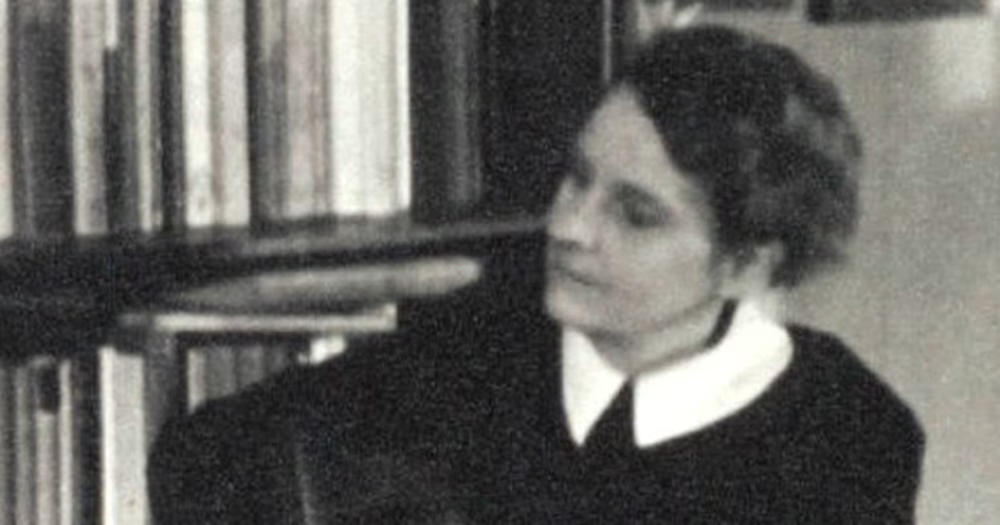
I recently had the pleasure of listening to the audiobook version of How Queer Bookshops Changed the World by A.J. West, read by the author. Among the many stories in that excellent book that sent me down literary rabbit holes was that of pioneering lesbian bookseller, Sylvia Beach, and her connection to James Joyce’s Ulysses. It seems appropriate, given the time of year, to share that story in coincidence with Bloomsday on June 16.
In summer 1920, Adrienne Monnier and Sylvia Beach crashed a party of literary luminaries in Paris. The party was buzzing with excitement due to the attendance of James Joyce, considered a literary prodigy. He had been lured to Paris by the American poet and critic, Ezra Pound.
As Beach recounted to RTÉ 40 years later, she was “frightened and scared” at the prospect of meeting Joyce, but meet him she did. He was standing alone in a small library off the side of the dining room, ignoring the other famous guests. They struck up a conversation in which she told him about her bookshop, Shakespeare and Company, and he told her about the suppression of his new book Ulysses.
In the United States, Ulysses had been serialised in The Little Review, a magazine founded by Margaret C. Anderson in 1914. The magazine had published great artists and philosophers like Gertrude Stein and Pablo Picasso, and began publishing Ulysses in 1918.
It soon ran into trouble. The episode where the main character, Leopold Bloom, masturbates on the beach while gazing at a young 17-year-old girl outraged one particular reader. This reader turned out to be the daughter of a lawyer, who referred the offending material to the New York Society for the Suppression of Vice.
Margaret C. Anderson and her lover and business partner, socialite Jean Heap, were prosecuted. They ended up fingerprinted and fined, and the resulting problems meant US publishers were unable and unwilling to publish Ulysses.
Similar issues occurred in the UK and other countries. Ireland never technically banned the book, but copies failed to make it through customs.
Sylvia Beach would offer Joyce a solution: “Would you like me to publish Ulysses?” He said, “I would.”
Now, a bit on Sylvia Beach (and Adrienne Monnier).
Sylvia Beach was born in Baltimore in 1887. At age 14, she moved with her family to Paris, where her father served as associate pastor at an American church.
The family returned to the United States in 1906, but Sylvia couldn’t forget Paris and returned 10 years later in 1916 to serve as a volunteer relief worker, which was at the height of the First World War. In 1917, she met the woman who would change her life, Adrienne Monnier.
Monnier ran a bookshop called La Maison des Amis des Livres (“The House of Friends of Books”), which she opened in 1915 using money her father received as compensation after a train crash. In interviews, Sylvia would refer to her as just a friend, but she would later say of their first meeting in the bookshop, “That was the beginning of much laughter and love. And of a life-time together.”
Sylvia, with the encouragement of Adrienne, would open her own bookshop, Shakespeare and Company, in 1919. In addition to the books, the shop displayed twin portraits of Oscar Wilde, his image and unspoken calling card to lesbian women and gay men alike.
Sylvia tapped into a market for books from Britain and the United States from Paris’ large community of English and Americans. The likes of F. Scott Fitzgerald and Gertrude Stein frequented the shop, and future Nobel Prize winner Andre Gide was the first subscriber to their lending library.
Publishing Ulysses was a formidable task for Sylvia. She was young and inexperienced, and Shakespeare and Company was a bookshop, not a publisher. Still, Joyce used it as his office and study while Sylvia acted as his agent, publisher and publicist.
She arranged financial support for the book, often from her own shop’s meagre takings. The publishing of the book left her out of pocket. There was no distribution system in those days, and the book was pirated due to its fame and notoriety.
Then, in 1933, in an act of betrayal, Joyce signed a deal for world rights with a mainstream publisher for a considerable sum and a big advance, and cut Sylvia out of the deal. In the preface to the new edition, Joyce belittled her involvement and gave more credit to Ezra Pound, by then a known fascist. When asked about it, Joyce said, “A baby belongs to its mother, not to the midwife, doesn’t it?”
What Joyce could not take away was the contribution that a lesbian bookseller and bookshop had to bringing such an acclaimed novel to the world. Sylvia would continue to sell books and have an eventful life, including a run-in with a Gestapo officer over a copy of Joyce’s other seminal work, Finnegan’s Wake.
She released her memoir, Shakespeare and Company, in 1956, which covers life in inter-war Paris and observations about many famous creatives.
On June 16, 1962, she opened the James Joyce Tower and Museum in Dublin. You can find a short extract of the RTÉ interview with her, where she, in my opinion, is very magnanimous on the subject of choice, here. She died later that year.
You should check out the chapter on Shakespeare and Company in How Queer Bookshops Changed the World for more details on her extraordinary life.
© 2026 GCN (Gay Community News). All rights reserved.
Support GCN
GCN is a free, vital resource for Ireland’s LGBTQ+ community since 1988.
GCN is a trading name of National LGBT Federation CLG, a registered charity - Charity Number: 20034580.
GCN relies on the generous support of the community and allies to sustain the crucial work that we do. Producing GCN is costly, and, in an industry which has been hugely impacted by rising costs, we need your support to help sustain and grow this vital resource.
Supporting GCN for as little as €1.99 per month will help us continue our work as Ireland’s free, independent LGBTQ+ media.