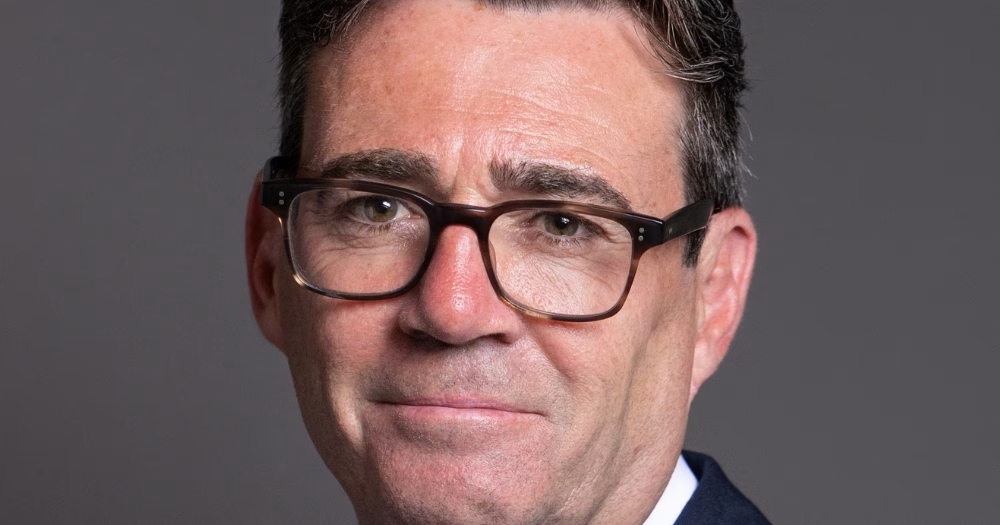
Andy Burnham became British Prime Minister on Monday, July 20, after Keir Starmer formally offered his resignation to King Charles III. Taking the position, the new Labour Party leader said his government will be “a circuit breaker for Britain, bringing forward the biggest changes in the last 40 years”.
Known as the ‘King of the North’, Burnham had been the Mayor of Greater Manchester since 2017. He left the position in June after winning the Makerfield by-election, marking his return to parliament. Burnham was previously an MP for Leigh from 2001 to 2017, when he held several cabinet positions, including Secretary of State for Health under Gordon Brown from 2009 to 2010.
The 56-year-old has a long record of LGBTQ+ allyship, dating back to the ‘80s. As a student activist, he marched against Margaret Thatcher’s Section 28 legislation, which banned the “promotion” of homosexuality in schools. He later said that opposition to the law helped shape his politics, and in 2003, he voted to repeal Section 28 in England and Wales.
Across the following years, he supported civil partnership, same-sex marriage and reform of the Gender Recognition Act, as well as regulations outlawing sexuality-based discrimination and extending IVF rights to lesbian couples.
In 2018, he appointed Carl Austin-Behan as his LGBTQ+ adviser, believed to be the first role of its kind attached to a metro mayor. In the same year, his administration launched Greater Manchester’s LGBTQ+ Equality Panel, committed to tackling inequalities in the area.
In 2025, he formally apologised for decades of anti-LGBTQ+ discrimination by the Greater Manchester Police. As a Catholic, he also previously urged Pope Benedict XVI and the Church to modernise their approach to same-sex relationships.
However, he has also faced criticism from the community and has been accused of u-turning on trans rights.
He previously stated that trans people should be allowed to use the facilities that align with their gender. However, following the Supreme Court ruling on the legal definition of ‘sex’, Burnham said that the Equality and Human Rights Commission (EHRC)’s guidance should be implemented “in a way that protects those spaces but does not marginalise already marginalised communities”.
“Let’s implement the guidance, but do it in the fairest and most compassionate way possible,” he commented.
Furthermore, in 2020, he met with representatives of the LGB Alliance, an organisation that has been criticised for its trans-exclusionary stance, to talk about reforms to the Gender Recognition Act.
Outside of LGBTQ+ rights, Andy Burnham has been criticised for his stance on immigration, recently backing a bill that aimed to reduce the number of successful asylum appeals in the UK. Green Party leader Zack Polanski has also expressed concerns about the new Prime Minister, saying “nothing will change”. In a post on Bluesky, he claimed that Burnham “won’t nationalise water companies”, will stick “to Rachel Reeves disastrous fiscal rules” and “refuses to recognise genocide”.
While some believe that Andy Burnham will bring a different approach to Labour, others are not convinced. His appointment additionally comes at a crucial time for the LGBTQ+ community, as the EHRC guidance is due to come into force in August and a bill banning conversion practices is in the works.
As he assumes his position, Rachel Williams, CEO of Manchester-based LGBTQ+ charity The Proud Trust, wrote an open letter to the Prime Minister, reading, “For years, Manchester has proudly presented itself as a city where LGBTQ+ people are welcomed, celebrated and valued, and you have helped shape that story. You’ve marched through our streets at Pride, spoken publicly about equality and inclusion, and consistently recognised that diversity is one of this city’s greatest strengths. That leadership has mattered, not just symbolically, but to the thousands of LGBTQ+ young people who have looked to Manchester as a place where they might finally feel seen, accepted and able to be themselves.”
The letter continues: “As Prime Minister, I hope you take that same commitment to inclusion with you, because from where we’re standing, many LGBTQ+ young people feel the progress they believed was permanent is beginning to slip away. The time for political courage is now.”
Williams concluded: “The next generation of LGBTQ+ young people shouldn’t grow up believing their rights are conditional, that their identities are matters for political negotiation, or that they must wait for society to decide whether they deserve dignity and respect. They deserve leaders prepared to stand beside them, speak up for them and build a country where every young person, regardless of who they are or who they love, knows they belong. Please, be that leader.”
In his speech on Monday, Burnham said his first instruction as Prime Minister will be to end rough sleeping, with his 10-year plan expected in the coming months.
© 2026 GCN (Gay Community News). All rights reserved.
Support GCN
GCN is a free, vital resource for Ireland’s LGBTQ+ community since 1988.
GCN is a trading name of National LGBT Federation CLG, a registered charity - Charity Number: 20034580.
GCN relies on the generous support of the community and allies to sustain the crucial work that we do. Producing GCN is costly, and, in an industry which has been hugely impacted by rising costs, we need your support to help sustain and grow this vital resource.
Supporting GCN for as little as €1.99 per month will help us continue our work as Ireland’s free, independent LGBTQ+ media.