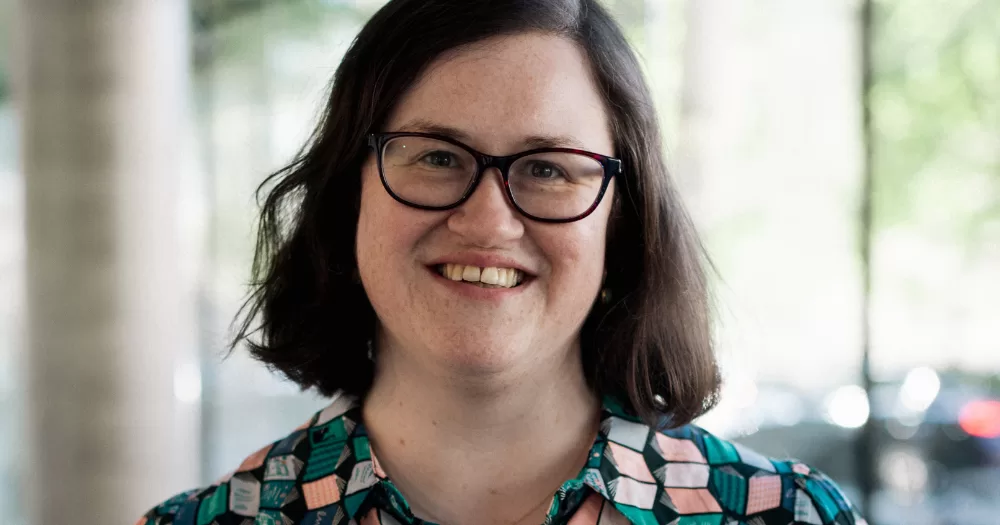
Rosamund Taylor has already established herself as one of Ireland’s most exciting literary voices. Her debut poetry collection, In Her Jaws, was shortlisted for the Seamus Heaney Poetry Prize for a First Collection, while her latest work, Filly, has been selected as Cork’s One City One Book for 2026. Filly is a novel-in-verse that explores queer awakening, abuse, obsession and intimacy; it is both unsettling and deeply moving.
Set within the hostile atmosphere of an Irish secondary school in the early 2000s, the book follows 17-year-old Orla as she navigates her sexuality and becomes entangled in a destructive romantic relationship with her charismatic English teacher, Irene Wall. Told through varying forms including poetry alongside MSN conversations, book reviews and fragmented documents, Filly captures the secrecy and confusion of adolescence with a startling precision.
View this post on Instagram
Speaking about the origins of the novel, Taylor explains that the story emerged from reflecting on the homophobia and misogyny that permeated schools during that period.
“I started writing mainly about that background of the homophobia and misogyny that I had experienced, and I’m sure many people had experienced when they were in school,” she says. “In that atmosphere where you can’t talk about anything, and nobody is open, it creates this world of secrets.”
That silence, or rather the fear of speaking, she believes, creates fertile ground for exploitation and blurred boundaries.“It kind of creates an atmosphere where it’s more possible for something like a student to have an affair with a teacher, because everything is so unspoken. So that was where the seed started.”
At the centre of Filly is Orla’s relationship with Irene Wall, a figure who is both magnetic and deeply manipulative. The novel is written in a fragmented structure, delving into both characters interchangeably. By telling the story from both perspectives, Taylor avoids reducing the novel to a simple morality tale. Instead, she examines the emotional complexity and imbalance of power that underpins abusive relationships.
For Taylor, writing the book as poetry rather than prose offered creative freedom. She credits conversations with acclaimed Irish poet Martina Evans as influential in shaping her thinking. “I was talking to her about what it was like to write a book of poems that were also telling a story,” Taylor says. “She said she used to write novels, and she decided she could write stories in poems because you got to cut out all the boring bits of novels.”
That insight proved liberating for Taylor, who is known for her poetic skills.“It gave me permission to write a story in poems,” she explains. “What gives it strength is that you can really focus on moments that feel important, rather than having lots of build-up. You can get a lot of information into quite a small space, so the story feels really pacey. It made me feel like there are things I can do with poetry that I can’t do with prose.”
The poetic form heightens the emotional intensity of Filly. Moments of tenderness and violence exist side by side, often within the same page, creating a reading experience that mirrors Orla’s emotional life. Taylor says writing Orla was rewarding, even when taking the character into painful territory. “It felt really important to be able to talk openly about things we maybe find hard to discuss, like bullying and self-harm,” she says.
View this post on Instagram
As the novel progresses, Orla develops a meaningful friendship with a trans woman her own age, a relationship built on trust and emotional honesty rather than coercion.“It was really nice to write that relationship of trust that was so different from her relationship with her teacher,” Taylor says. “I had a lot of fun playing with those contrasts.”
Yet some sections of the novel proved emotionally difficult to write, particularly scenes involving abuse and bullying. Revisiting experiences from adolescence through an adult perspective altered Taylor’s understanding of them.“I was thinking about things I’d either witnessed or experienced when I was in school, and when I wrote it down as an adult, it sounded so bad,” she says. “When I’d been a teenager, I’d dismissed a lot of it as, ‘This is just what happens.’”
Looking back now, she sees those experiences differently.“If they happened to an adult, you would immediately say, ‘Well, this was assault.’ It was really painful to think that kids go through this and we dismiss it as part of the growing-up process.”
The novel also reflects Taylor’s fascination with queer representation, or rather, the lack of it in early 2000s culture. While researching Filly, she deliberately limited herself to books published before 2005 in order to accurately recreate Orla’s literary landscape.“Some of them were books I’d read myself as a teenager, and some I just came across,” she says. “It’s interesting how hard it is to find certain kinds of books from that period.”
For queer teenagers at the time, representation was painfully scarce, particularly for people existing at multiple intersections of identity.“If you want to find a character who’s Black and queer now, you can go to something like Heartstopper,” Taylor says. “But before 2005, it was so hard to find any kind of representation. It’s really interesting to see how much that has shifted.”
With Filly, Taylor contributes powerfully to that evolving landscape. Unflinching yet deeply humane, the novel confronts abuse, desire and shame without losing sight of the possibility of connection and survival. Through Orla’s story, Taylor gives voice to experiences that were once buried beneath silence and transforms them into something impossible to ignore.
Filly is available now nationwide.
© 2026 GCN (Gay Community News). All rights reserved.
Support GCN
GCN is a free, vital resource for Ireland’s LGBTQ+ community since 1988.
GCN is a trading name of National LGBT Federation CLG, a registered charity - Charity Number: 20034580.
GCN relies on the generous support of the community and allies to sustain the crucial work that we do. Producing GCN is costly, and, in an industry which has been hugely impacted by rising costs, we need your support to help sustain and grow this vital resource.
Supporting GCN for as little as €1.99 per month will help us continue our work as Ireland’s free, independent LGBTQ+ media.