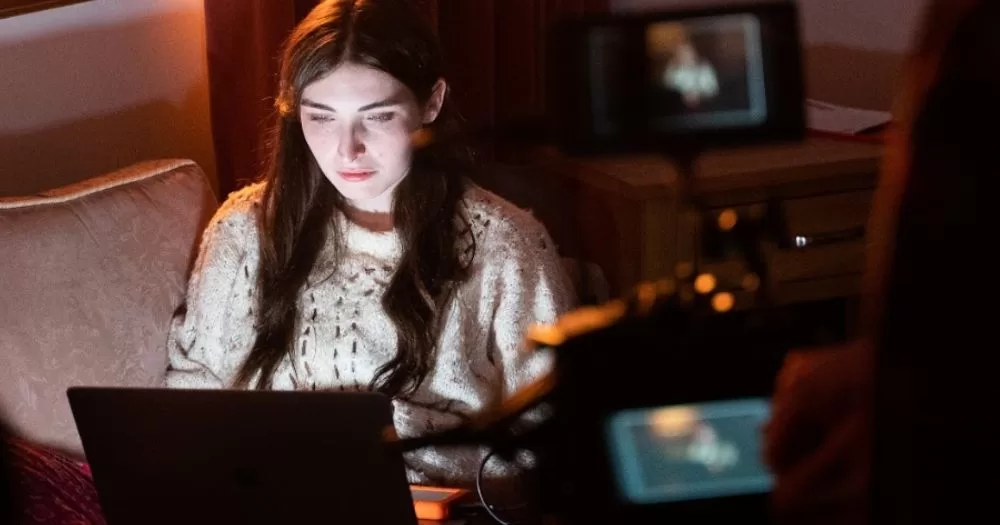
After crowdfunding €4,000 to make her trans horror film a reality, Irish filmmaker Liadán Roche spoke to Rohan Coleman about the power of queer storytelling, the beauty of DIY cinema and why the housing crisis is fertile ground for terror.
The literary talents of James Hudson combine with the film-making expertise of Liadán Roche in an upcoming trans romance-horror short film, Hostile Architecture.
The short film examines Dublin’s housing crisis and its limiting effects on trans intimacy. What’s more, this entire project acts as a representation of the ever-growing rise of the trans film-making scene in Ireland today, with a trans couple directing and writing, two lead trans actors, and a crowdfund of over €4,000 to support this film that centres trans intimacy “in all its sweaty, messy, kinky glory.”
Informed by everyday issues plaguing the Irish population today – the housing crisis, cost-of-living, the job market – Hostile Architecture aims to use fantasy and horror conventions to “magnify the real impact of these issues,” and question whether the lead characters can “survive in a city that wants to squeeze the life out of them.” Grace, played by Liath Hannon, has been evicted and considers a hook-up with Billy, played by Pete MacHale, as a bed to sleep in for the night. When the pair rent an extra-dimensional room to hook up in, they must figure out if “there’s any space for them in the city outside their room” as the walls start closing in on them.
The story, director Roche says, takes “a really common experience”, and pushes it to the extreme.
“In real life, Dublin is being cannibalised by hotels and private corporations while broke young people struggle to live and form connections – you can easily see how horror and romance come out of that setting,” she said.
While the housing crisis may take centre stage in countless conversations across Ireland, the film aims to centre trans people specifically, and explore a new, under-represented community within this housing crisis.
“Our protagonists, Grace and Billy, are two ordinary Irish trans people in that environment, just like me, James and most trans people we know. What we’re trying to do is explore their lives and possibly their romance in a worst-case scenario housing crisis. It’s a fictional story but the threat is very real”, Roche explained.
With €3,500 of their own finances contributed, Roche, Hudson, and producer Ois O’Donoghue aimed to raise an additional €3,500 to “ensure everyone on our cast and crew is paid a fair rate for their work on this film.” In just over one month, this milestone was not only reached, but exceeded, with over €4,000 being raised by early December.
“I’m honestly floored by the outpouring of support we’ve received,” Roche said. “It’s given me a renewed sense of hope for queer and DIY cinema. A few of my film-making friends have reached out, saying it’s given them hope for their own freaky, queer films, and that’s really beautiful! I’m so happy that people trusted James and my vision for the project.”
Indeed, the abundance of support for Hostile Architecture has opened up a multitude of conversations surrounding self-funded films, and the Irish trans film scene for Roche and Hudson.
“I’m most excited by trans films that are being made for trans audiences, but unfortunately, this doesn’t receive as much funding,” she said. “Because of that, these films are often DIY and are forced to make creative decisions in order to solve the many problems that a limited budget can impose.
Trans filmmakers such as Venus Patel, Louise Weard, and Maz Murray are examples of artists Roche states “have very unique visual styles that I believe were informed by a more limited budget. I think lack of funding pushes us to make more creative decisions and also means that we can tell our stories without oversight!”
With that said, however, independent budgets aren’t sustainable for a long-term career in film. Roche hopes “those same unflinchingly creative queer and trans film-makers do receive funding, so they can carry on making incredible films without burning out or exhausting their own finances.”
The mass support for Hostile Architecture communicates a move “towards self-funded and crowdfunded films” among Roche’s peers. With festivals like GAZE LGBTQIA International Film Festival and TITE Film Festival making their home in Ireland and a growth in support for Irish trans films, Roche describes “a real feeling of possibility and hope in the trans film-making scene right now. The general feeling is that if other people won’t support us in our filmmaking, then we’ll just have to support one another.”
Hostile Architecture is currently in production.
© 2026 GCN (Gay Community News). All rights reserved.
Support GCN
GCN is a free, vital resource for Ireland’s LGBTQ+ community since 1988.
GCN is a trading name of National LGBT Federation CLG, a registered charity - Charity Number: 20034580.
GCN relies on the generous support of the community and allies to sustain the crucial work that we do. Producing GCN is costly, and, in an industry which has been hugely impacted by rising costs, we need your support to help sustain and grow this vital resource.
Supporting GCN for as little as €1.99 per month will help us continue our work as Ireland’s free, independent LGBTQ+ media.