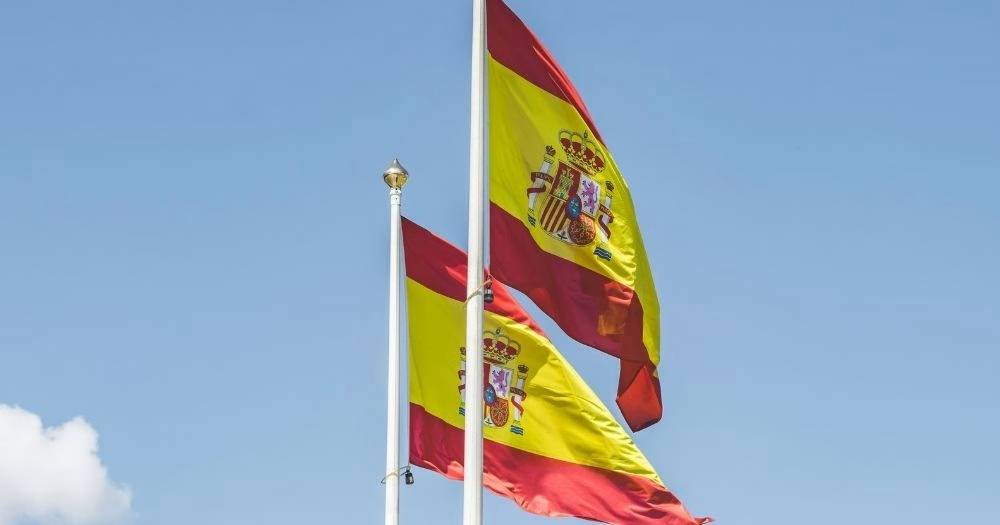
Everyone who knows even a little bit about LGBTQ+ history will have heard of the Stonewall Riots, a key moment at the start of the queer liberation movement that took place in New York City in the late 1960s. Fewer people might be familiar with similar events that have taken place in other countries, such as the 1971 Begoña Passage Raid, which came to be known as the “Spanish Stonewall”. To dive into the history of this event, we need to look back at the LGBTQ+ rights situation in Spain under the regime of Francisco Franco.
While Spain is currently widely considered the most queer-friendly country in Europe, with some of the highest levels of support for LGBTQ+ rights, and recently elected their first trans senator, things were very different under Franco’s authoritarian regime.
During his 36 years in power, the dictator worked to implement several laws in Spain to strip rights from many minority groups, including LGBTQ+ communities.
He attempted to create a homogenous society, where every family followed the same script of a masculine and devoted catholic man, and a feminine, submissive and unopinionated woman. The room for difference inside this social model was non-existent.
In 1970, he approved the Law on Social Danger and Rehabilitation, which criminalised homosexuality and established a series of harsh punishments, including time in prison or in concentration camps. The law was only repealed in 1978, three years after Franco’s death.
This law was a replacement of previous legislation, which was originally called the Law of Vagrants and Criminals (LVC) and was enforced from 1933 to 1970. The content of the LVC criminalised “ruffians, pimps, prostitutes, pornographers, beggars, addicts, drug dealers, gang members, and others who disregard the norms of social coexistence”. Later on in 1954, the law was officially extended to include “those who carry out acts of homosexuality”.
It was a few years before the death of Francisco Franco that the event that would come to be known as “Spanish Stonewall” occurred. Only a couple of years after the milestone LGBTQ+ protests happened in 1969 New York, the Spanish Stonewall took place in the Begoña Passage of Torremolinos, Málaga.
What is now one of the top tourist destinations in Spain was the capital of Francoist Spain’s queer scene. When the Social Dangers Law was implemented in 1970, many businesses were ordered to shut their doors, yet they refused.
A year later, in 1971, the mayor of Málaga, Victor Arroyo, ordered them to close their doors within 24 hours, or else there would be consequences. They once again refused.
The next day, all the queer clubs and bars in Málaga were raided by police, resulting in 300 individuals being “identified” and between 110 and 120 being arrested. Despite its scale, the event did not garner a lot of attention because of the continued suppression of minorities’ rights during the Franco regime.
It was only years later that the raid became known as an important symbol of the struggle for LGBTQ+ rights in Spain and came to be recognised as a moment of resistance against Franco’s regime.
At the time, multiple prison camps were located across Spain, although this was just a nicer name for a concentration camp. Locations such as Badajoz, Huelva and Fuerteventura were home to such camps, with some being managed by clergy members of the Catholic Church.
During the operation of the camps, over 5,000 individuals were sentenced to labour under conditions of hunger, electroshock therapy and other forms of torture.
One prisoner of Badajos spoke in an interview with Archer magazine. Antonio Ruiz was 17 in 1976, a year after Franco had died. In ‘76, Ruiz confided in his mother that he was gay. She confessed this to a nun, who then informed the authorities. In the early hours of the morning, Antonio was arrested.
He was sentenced to Badajos, where he would spend three months. During his time there, he was sexually assaulted by another prisoner. When a guard witnessed the attack, he told the other prisoner, “do what you want with him, he’s a homosexual”.
In particular, transgender people and gay men were targeted by the regime, believing them to be guilty of “scandalous public behaviour” and a specific threat to the social norms of the imagined Spain Francisco Franco desired.
Despite the overwhelming oppression from the state, queer people refused to go silent. During the regime, underground nightclubs and communities formed all over Spain, one of the most famous and influential being ‘El Comodín’, which was opened in 1957 in the northeastern town of Sitges.
The bar is still in operation today, and is a site of ‘gay pilgrimage’ with its famous drag shows and history. Outside is where the first monument against homophobia in Spain was erected in 2006.
© 2026 GCN (Gay Community News). All rights reserved.
Support GCN
GCN is a free, vital resource for Ireland’s LGBTQ+ community since 1988.
GCN is a trading name of National LGBT Federation CLG, a registered charity - Charity Number: 20034580.
GCN relies on the generous support of the community and allies to sustain the crucial work that we do. Producing GCN is costly, and, in an industry which has been hugely impacted by rising costs, we need your support to help sustain and grow this vital resource.
Supporting GCN for as little as €1.99 per month will help us continue our work as Ireland’s free, independent LGBTQ+ media.