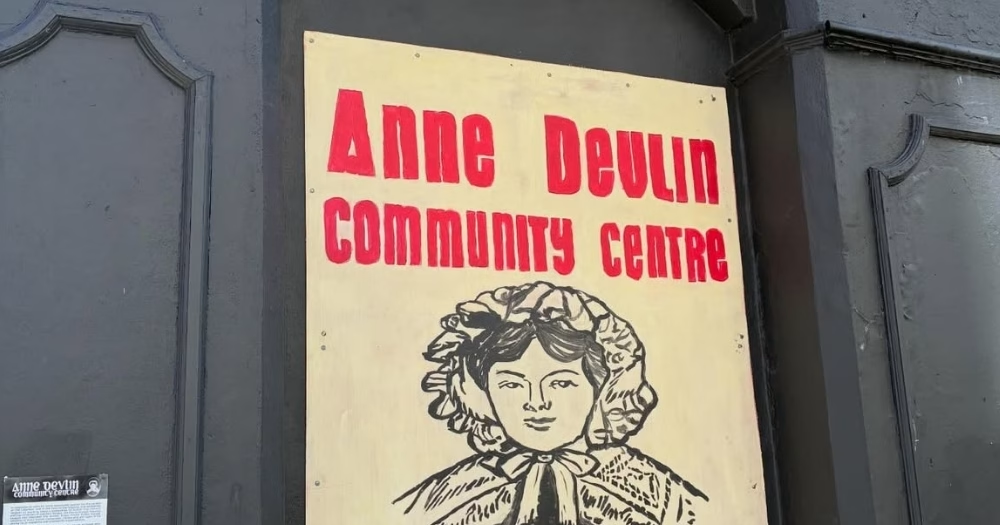
The first thing I noticed when I arrived at the Anne Devlin Community Centre was the sound. Sitting in a large, open room beneath a skylight, I spoke with a representative of the Revolutionary Housing League while, outside, a community boxing class was in full swing.
Laughter echoed through the building between the light thuds of gloves meeting pads, creating an atmosphere that felt a world away from the derelict former pub the building once was.
The Anne Devlin Community Centre opened after activists occupied the long-vacant Ardee House in Dublin’s Liberties, arguing that empty buildings should serve local people rather than remain unused. Just days ago, on July 7, the occupation of the Anne Devlin Community Centre ended following a High Court order. Those behind the project insist the weeks they spent running the space demonstrated just how desperately communities need places to gather.
For the representative I spoke to, the project was about far more than reclaiming an abandoned building. “It just really shows that community spaces are so important,” they said. “Neighbours know each other, people look out for each other, and that’s being eroded.”
They argue that the disappearance of local spaces has weakened traditional community ties across Dublin’s inner city.
“As Dublin used to be, the nannies would be out on the street looking after the kids, even if they weren’t their own. Everyone looked out for each other. It takes a village, and in the Liberties that’s always been true.”
View this post on Instagram
The representative believes rising housing costs and demographic change have accelerated that decline. “Older people are dying, their children can’t afford to stay in the area, and community cohesion is breaking apart.”
That belief formed the basis for occupying the former pub. “There are so many empty buildings,” they explained. “But this one was perfect because of its history and because people had been crying out for it to be used.”
Inside, volunteers organised an ambitious programme of activities. There were free Irish language classes, bike repair workshops, bingo nights, film screenings, community meetings and a donation-based café where nobody was turned away.
“If someone doesn’t have anything, we don’t let them go away empty-handed,” the representative said. “It’s about people looking out for each other.”
The project was built almost entirely through voluntary effort. “We opened this place with very little money,” they said.
“Just our basic skills, community support, donated furniture, food and materials. You don’t need huge amounts of money. You need community organisation.”
Many of the activities emerged organically. Local mechanics offered bike repair classes, families volunteered to help clean the building, while nearby residents donated furniture and equipment.
“We’ve been trying to remind people that they have power,” they explained. “If you’ve got skills, come here and use them. This place is for the community to rebuild into whatever they want.”
The centre was named after Anne Devlin, the Irish republican who assisted Robert Emmet during the 1803 rebellion. The representative said the choice reflected both local history and a desire to celebrate revolutionary women whose contributions are often overlooked.
“We wanted to ground it in local history, but also remind people that there aren’t nearly enough memorials to the women who fought for Ireland.”
The representative explained what they saw as a link between the housing crisis and wider economic structures, arguing that communities have become increasingly disconnected from decision-making. Their longer-term ambition extends well beyond one building and one community.
“Our goal is to hand spaces fully over to local people,” they said. “They run it themselves, then we move on to another building and do the same again.”
View this post on Instagram
According to the Central Statistics Office, 80,328 residential properties were recorded as vacant across Ireland in June 2025. “The majority of people see through the idea that private developers are community heroes,” they said. “When you actually speak to local people face to face, they’re asking why so many buildings are left empty.”
Throughout our conversation, one theme repeatedly resurfaced: community as an antidote to isolation. The representative pointed to a poster hanging downstairs in the building bearing a simple message: “Action is an antidote to despair.”
“When people take action and do things with their hands, their skills, or together with other people, they’re no longer hopeless,” they said. “Their minds open up. They realise they’re frustrated with the system, but they also realise they have each other.”
Outside, the boxing class continued, with bursts of laughter carrying through the open doorway. For a period, the former Ardee House became something it had not been for years: a building filled with people.
Find out more about the centre here.
© 2026 GCN (Gay Community News). All rights reserved.
Support GCN
GCN is a free, vital resource for Ireland’s LGBTQ+ community since 1988.
GCN is a trading name of National LGBT Federation CLG, a registered charity - Charity Number: 20034580.
GCN relies on the generous support of the community and allies to sustain the crucial work that we do. Producing GCN is costly, and, in an industry which has been hugely impacted by rising costs, we need your support to help sustain and grow this vital resource.
Supporting GCN for as little as €1.99 per month will help us continue our work as Ireland’s free, independent LGBTQ+ media.